
IIMBx - Digital Learning Foundation

Value Chain Analysis: Porter's Model & Competitive Advantage

By Tripti Diwakar

Updated on Nov 13, 2026

Share:
  • Value chain analysis is an analysis framework that helps identify activities related to the production of products or services for potential competitive advantages. 

  • The Value Chain Analysis model by Michael Porter classifies the activities into primary and support activities that help provide value to the customers and company. 

  • It helps companies reduce cost of operations, increases efficiency, raises customer satisfaction levels, and helps them find ways to differentiate themselves from their competitors. 

  • This blog discusses the definition, activities, process, benefits, limitations, and process of value chain analysis for competitive advantage. 

What Value Chain Analysis Means for Business Firms? 

Value chain analysis refers to the analysis conducted by business firms to look at different activities that are involved in the creation of a certain product or service. 

Businesses conduct value chain analysis to be able to analyze their operations, improve their activities, and gain a competitive advantage through it. It analyses the following activities: 

  • Identifying Business Activities: Identifying the primary activities as well as the support activities of business firms to see how the various activities contribute to the end product or service. 

  • Evaluating Costs: Evaluating the costs of the different activities to find out which costs can be avoided and thus make business firms more efficient. 

  • Identifying Value-Adding Activities: Understanding which of the activities add to the value of business operations for their customers. 

  • Finding Competitive Advantages: Finding out how the business activities can be improved so that better products or services can be offered than those by their competitors. 

What Are the Primary and Support Activities in Porter’s Value Chain Model? 

According to Porter’s Value Chain Model, all business activities are grouped into two categories which are primary activities and support activities. Primary activities include the activities that are directly involved in the creation, selling, and delivery of products or services to customers. While support activities facilitate primary activities by offering the needed resources. 

These two categories include the following activities: 

1. Primary Activities 

These activities are the ones that are directly related to production, delivery, and after-sales services. These activities include: 

  • Inbound Logistics: The activities that involve receiving, storing, and handling of raw materials and inputs needed for production. 

  • Operations: The process of converting raw material and input into finished products by using manufacturing, assembly, packaging, or any other process. 

  • Outbound Logistics: The process of storage and distribution of finished goods to customers. 

  • Marketing and Sales: All the activities that are used to market products or services to customers such as advertising and pricing. 

  • Service: After-sales service activities provided to customers. 

 2. Support Activities 

The support activities assist the primary activities in operating smoothly and make the business operations more efficient. The support activities include: 

  • Organization Structure: Controlling various organizational functions like planning, finance, accounting, legal, and general administrative. 

  • Human Resources Management: Recruitment, development, training, and management of personnel in order to have the appropriate personnel in the organization. 

  • Technology Development: Using technology, research, software, and innovations to enhance the quality of products and manufacturing processes. 

  • Procurement: Procuring the necessary inputs in the form of raw materials, machinery, etc., for business activities. 

How Does Porter's Value Chain Model Work? 

The model operates through the examination of all business activities involved in providing a particular product or service. It is aimed at analyzing the way activities can affect customer value, operational efficiency, and competitive advantage of the business. In the process of evaluation of the model, primary and support activities are analyzed in order to find out where businesses can reduce their costs and improve their value. 

In general, the model operates according to the following pattern: 

  • Business Activity Identification: Primary and support activities are identified and analyzed to understand how various business functions affect the final product or service. 

  • Individual Activity Analysis: Activities are analyzed individually; ways of how each activity is done and the resources required for it are studied. 

  • Costs and Value Evaluation: Costs of doing each activity are compared with its value for customers and for the business. 

  • Activity Improvement Identification: Opportunities to reduce costs, become more efficient and improve the quality of products or services are identified. 

  • Competitive Strategy Development: Based on the obtained results. 

How Can Value Chain Analysis Create Competitive Advantage for the Company? 

It allows businesses to analyze activities which can increase their value and create competitive advantages. Businesses can learn how they can lower their cost structure, increase the quality of their products or services, and offer better experience to their customers. 

Value chain analysis allows businesses to achieve competitive advantage in the following ways: 

  • Operational Cost Savings: Identification of unnecessary costs of operations and improvement of resource management while maintaining product or service quality. 

  • Product Quality Improvement: Identification of areas in which businesses can improve their production process, quality of materials used, and product inspection. 

  • Customer Satisfaction: Improvement of marketing activities, delivery and after-sales service. 

  • Innovation: Identification of opportunities for innovation in technology, processes, and development of new products or services. 

  • Business Efficiency Improvement: Improvement of coordination between different business activities. 

  • Product Differentiation: Identification of competitive advantages and developing products/services which will help businesses differentiate themselves among their competitors. 
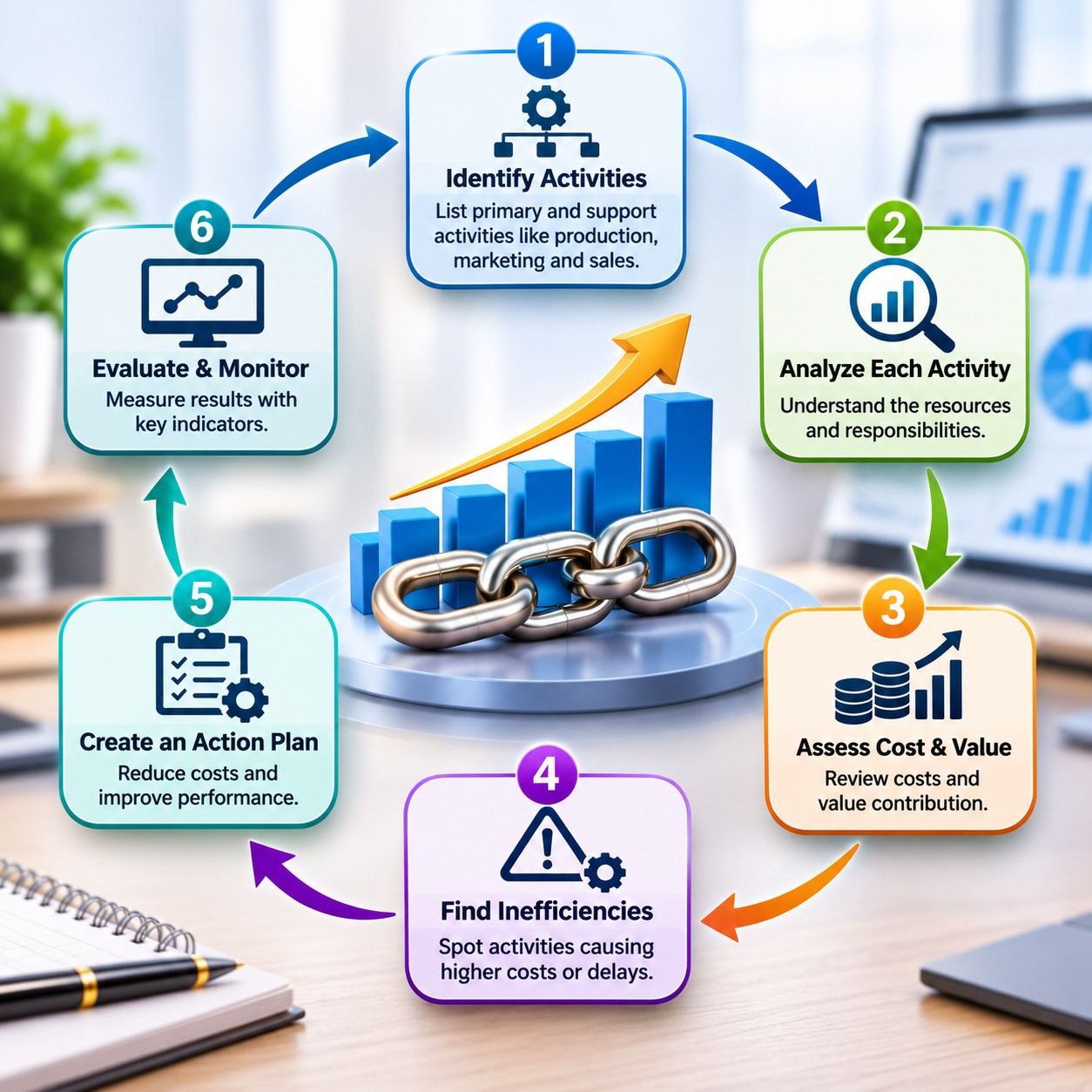
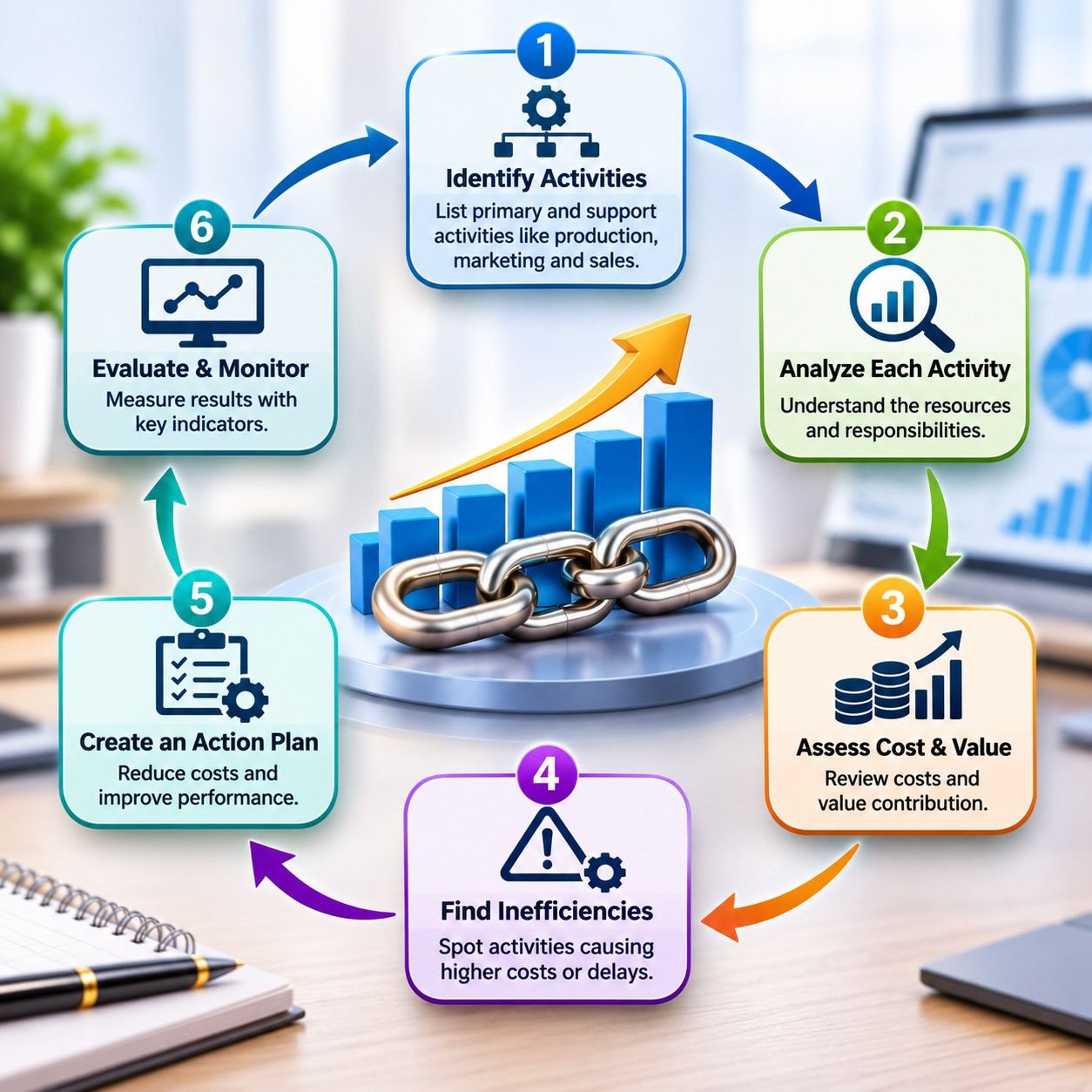
Steps of value chain analysis

What Are the Steps to Conduct a Value Chain Analysis? 

Value chain analysis is performed by analyzing different business activities to identify their contribution to the company’s performance and value. Businesses can analyze value chains for identifying opportunities for cost reduction and improvement of their competitive advantage. 

The following steps allow conducting a value chain analysis: 

  • Identification of Primary and Support Activities: Identify all business activities such as production, marketing, sales, logistics, human resource management, and procurement to learn about the operations of the business. 

  • Analysis of Each Activity: Analyze each activity in detail to learn about the resources and responsibilities necessary for its performance. 

  • Analysis of Cost and Value Added: Analyze the costs associated with performing each activity and learn about its contribution to the value of the end-product. 

  • Identification of Inefficiencies: Determine those activities which lead to increased costs, delays, and problems related to product quality and customers’ satisfaction. 

  • Development of Action Plan: Make decisions on how to reduce costs, improve performance, use technology, and enhance activities that add customer value. 

  • Performance Evaluation and Monitoring: Measure the effects of changes with the help of suitable performance indicators. 

Build Your Business Strategy with IIM Bangalore

Understand how value chain analysis helps businesses identify value-adding activities, improve operational efficiency, reduce costs, and develop a competitive advantage. Explore Porter's Value Chain Model and its application in business management.

Key Learning Areas:

  • Porter's Value Chain Model: Understand primary and support activities.

  • Business Efficiency: Learn how businesses identify operational gaps and improve processes.

  • Competitive Advantage: Explore cost reduction, product differentiation, and customer value creation.

  • Strategic Analysis: Understand how value chain analysis supports business decisions and performance improvement.

Explore learning opportunities at IIM Bangalore to strengthen your understanding of business strategy and management.

What Are the Limitations of Value Chain Analysis? 

Even though the value chain analysis allows businesses to become more efficient and find areas where they can gain a competitive advantage, this method also has some limitations. To conduct a proper analysis, a lot of time, effort, and information will be required. 

Among the most popular limitations of value chain analysis are the following: 

  • Take Time: The analysis of every single primary and supporting activity is rather time-consuming since you need to conduct thorough research, collect and evaluate all necessary information. 

  • Implementation Costs: The analysis of activities and implementation of recommendations on how to improve them will require some additional costs, technological equipment, and staff training. 

  • Difficulties in Information Collection: Gathering of information concerning costs and performances of each activity may be difficult and even impossible. 

  • Market Changes: Customers' preferences, changes in technologies, and actions of competitors may occur quite often and make your analysis outdated. 

  • Business Size: The analysis of every single activity may be rather hard for the large companies consisting of many departments, suppliers, and distribution channels. 

  • Ignoring External Environment: Value chain does not focus on the external environment of the business. 

Value Chain Analysis vs Supply Chain Analysis: What’s the Difference? 

Value chain analysis and supply chain analysis are both tools that are used by organizations in order to better manage their business process, reduce costs, and provide goods or services to customers effectively. Yet, they concentrate on different things within the business environment. In particular, value chain analysis concentrates on the analysis of activities that bring value to customers and provide the competitive advantage to the company. 


Table showing the differences between value chain analysis and supply chain analysis is provided below: 

Basis for Comparison 

Value Chain Analysis 

Supply Chain Analysis 

Meaning 

It analyzes business processes that create value in the products and services offered by the company. 

It analyzes the process of moving products and services from the supplier to the customer. 

Major Purpose 

Creating customer value and competitive advantages. 

Improving the process of moving and delivering products and services. 

Objective 

To improve business performance, offer unique offerings and generate profit. 

To minimize costs of supply chain, coordinate and facilitate timely delivery. 

Major Activities 

Inbound logistics, operations, outbound logistics, marketing, and sales. 

Sourcing, procurement, transportation, inventory management, warehousing, and distribution. 

Scope of analysis 

Internal business activities that lead to the creation of customer value. 

Internal and external business activities that involve suppliers, manufacturers, distributors, and customers. 

Process of Evaluation 

How every activity leads to customer value and business performance. 

Efficiency in the movement of products, materials, and information in the supply network. 

Expected result of analysis 

Customer satisfaction, better product differentiation, and competitive advantage. 

Logistics of cost reduction, inventory management and quick delivery of products. 

Conclusion

Value chain analysis enables organizations to analyze various activities that add value to customers and increase the efficiency of their performance. The Value Chain Model developed by Porter is a tool that facilitates a systematic assessment of primary and support activities to detect inefficiencies and improve business processes. Organizations that use this model can achieve cost reduction, increase the quality of products, and gain a competitive advantage.

Tripti Diwakar

Tripti Diwakar

Digital Marketing & Content Specialist

12+ of articles published

Associated with upGrad since 09 Feb 2026


Domain:

UpGrad

Current role in the industry :

Associate - Content

Education Qualification :

B.com Hons

About

Tripti Diwakar is a digital marketing and content professional with close to one year of experience in digital marketing, content writing, and content development. Currently working as an Associate at upGrad, she focuses on creating and refining content that strengthens brand visibility, connects with audiences, and supports digital growth. With an academic background in commerce and a keen interest in marketing, Tripti brings together business knowledge and creative thinking to develop meaningful, engaging, and audience-centric content. Her areas of interest include digital marketing, content marketing, social media, SEO, and effective digital communication.

Follow me on :

No blogs published yet.

Latest Blogs

Hypothesis Testing
Nov 18th, 2026

Hypothesis Testing

Hypothesis testing is a statistical method used to evaluate assumptions and claims using sample data.

Frequently Asked Questions

General