What Are the 8 Types of Waste That Are Defined Using Value Stream Mapping?
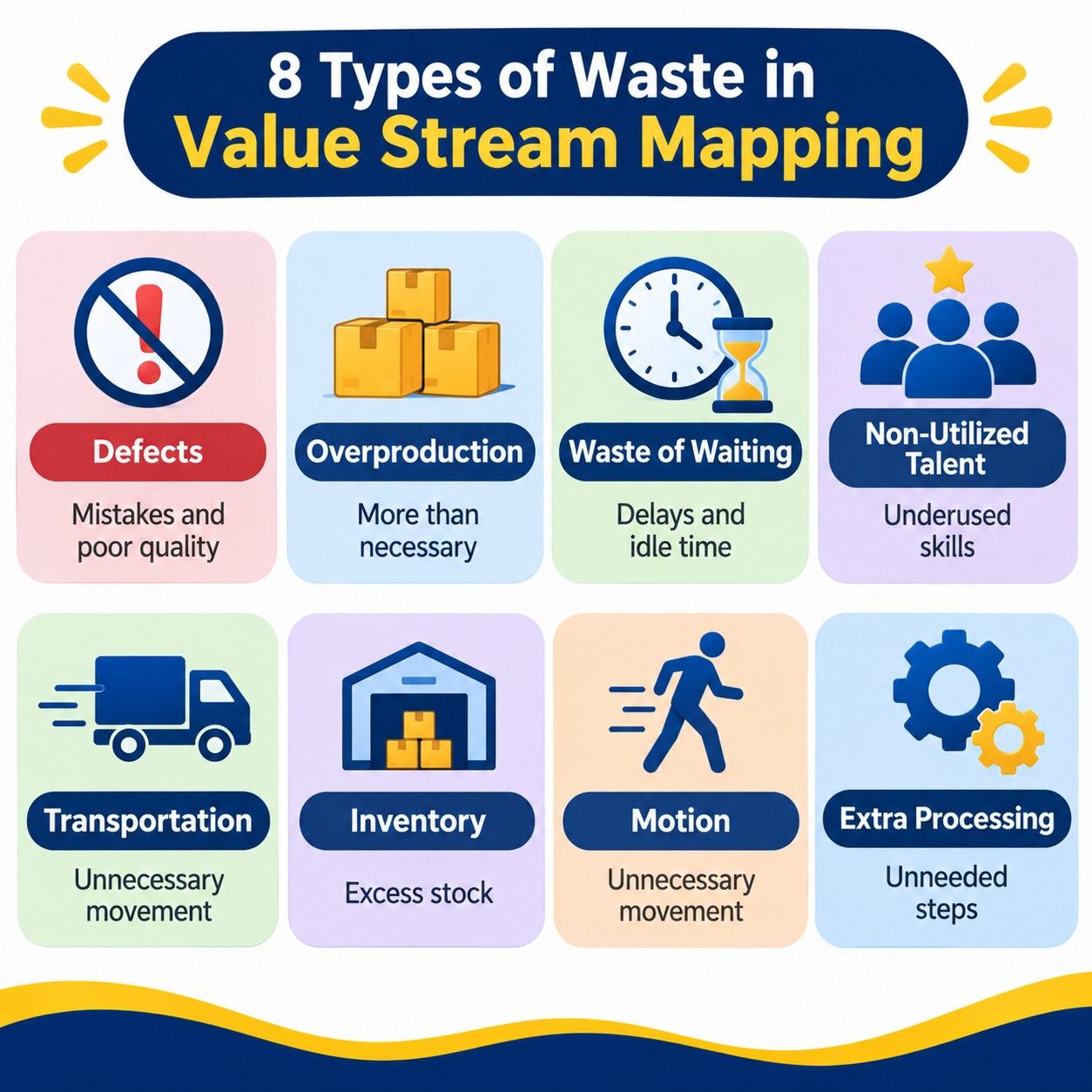
Value stream mapping is an approach that helps companies to recognize activities that take time, effort, and resources without bringing any value to the final output. There are eight types of wastes in total, which have been categorized into DOWNTIME in Lean management.
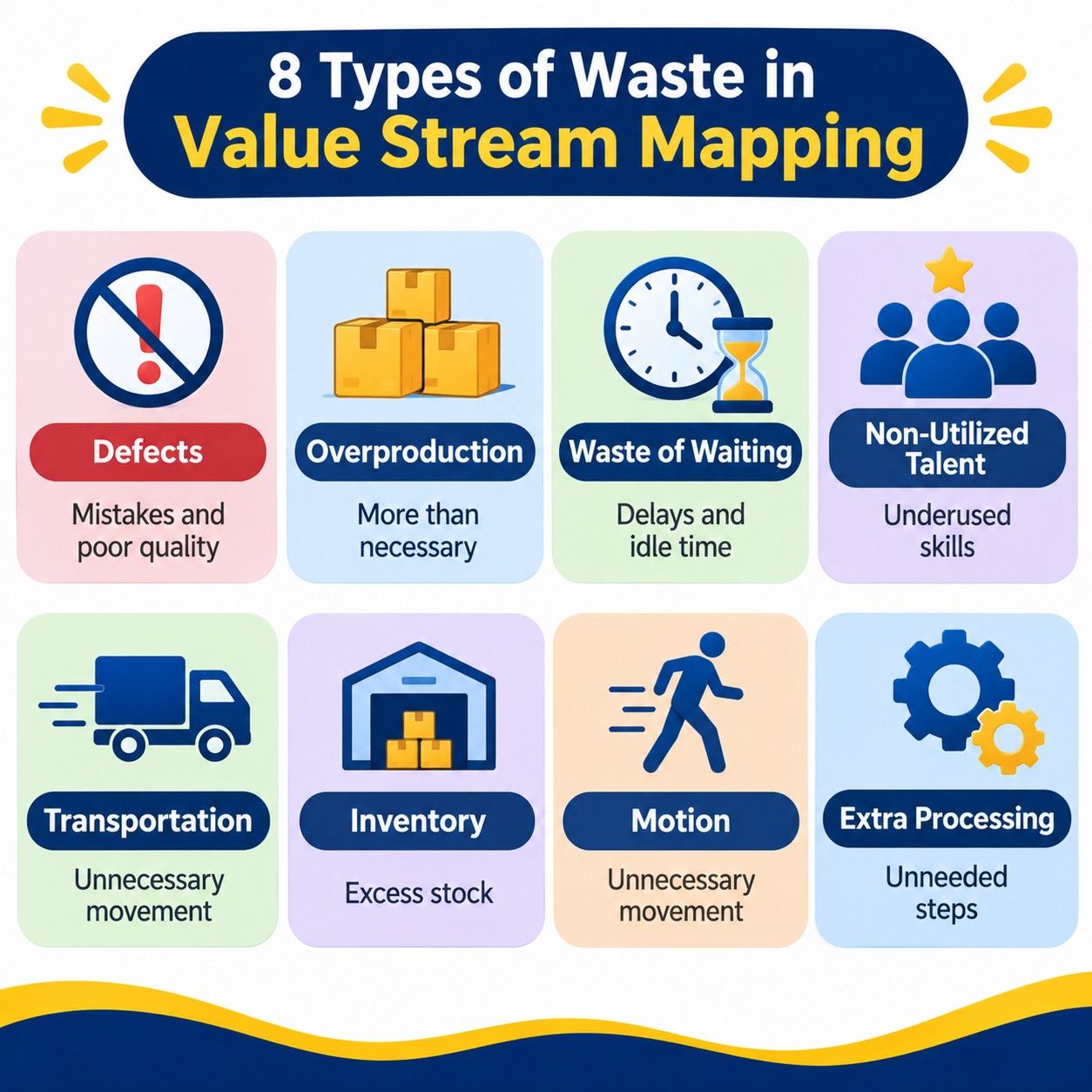
There are eight different types of waste that can be determined using value stream mapping:
Defects: These are mistakes made, defective goods, or poor quality which lead to a need for rework or extra effort to satisfy customers' demands.
Overproduction: This is the production of more goods than necessary or the production of goods too early, which creates unnecessary inventory.
Waste of Waiting: This type of waste occurs when people, machines, and materials are idle because of delays, approval procedures, or interruptions.
Non-Utilized Talent: This happens when the capabilities of the employees are not utilized fully.
Transportation: Unnecessary movement of material, products, or equipment between locations, increasing handling time and operational cost.
Inventory: Excess raw material, Work in progress items, or finished goods that occupy storage space and increase holding costs
Motion: Unnecessary movement of employees or equipment during work, such as repeatedly searching for tools or walking between workstations.
Extra Processing: Performing additional steps, inspection, or work that customers do not require, increasing production time and resource consumption.
Build Your Understanding of Lean Management with IIM BangaloreLearn how Value Stream Mapping helps businesses identify process inefficiencies, reduce waste, improve workflows, and deliver greater customer value. Explore IIM Bangalore’s General Management for Young Leaders (YLP) to build essential leadership skills, strengthen business knowledge, and prepare for future management roles. Key Learning Areas: Value Stream Mapping: Understand its components, symbols, and applications. Waste Identification: Learn about the eight types of waste in Lean management. Process Improvement: Explore the steps involved in creating current-state and future-state maps. Operational Efficiency: Understand how businesses improve workflows and optimize resource utilization.
Explore learning opportunities at IIM Bangalore to strengthen your knowledge of business operations and process improvement. |
How to Make a Value Stream Map: Steps by Steps
The making of value stream mapping requires the depiction of all the process stages, from the moment when there is a customer requirement to the time of production or provision of the product or service to the client. It allows companies to analyze their processes and work out an improved one.
These steps will help you create your value stream map:
Step 1: Pick a Product or a Service: Choose a certain product, a particular service or even a product family to be mapped. Make sure you pick a process that needs improvement because of delays or excessive costs.
Step 2: Determine Customer Requirements: Determine customer demand, order size and delivery schedules and other customer requirements.
Step 3: Map the Current State: Analyze the process and map all of the process steps including movement of materials and information, inventory, waiting times etc.
Step 4: Collect Process Information: Gather process information including cycle time, changeover time, production time, downtime etc.
Step 5: Spotting Waste and Bottleneck: The current state map needs to be scrutinized for identifying unnecessary transport, inventory, waiting, rework, and all other tasks which do not add any value for customers.
Step 6: Developing Future State Map: An enhanced process flow will be developed where unnecessary activities have been minimized, delays minimized, material flow improved and capacity balanced with demand of customers.
Step 7: Formulating an Implementation Plan: Responsibilities, targets for improvements, timelines, and actions to be taken in order to implement the proposed improvements should be determined.
Step 8: Evaluating the Process Efficiency: Tracking of KPIs, comparison of outcomes and improvement targets, and updating of the value stream map should be conducted.
What Are the Real-World Applications of Value Stream Mapping?
The concept of value stream mapping is widely employed by different sectors to enhance efficiency and minimize operational waste. Organizations use the technique in order to analyze material, information and activities flow within different processes to detect improvements needed.
Here are some examples of real-life applications of value stream mapping for different sectors:
Manufacturing Sector: In manufacturing companies value stream mapping can be employed to map the process of raw materials flow, manufacturing activities and the flow of manufactured products.
Healthcare Sector: Value stream mapping in healthcare organizations is employed in order to map the process of patients' registration, diagnosing, treatment and discharging patients from hospital. It will help to minimize patient wait times.
Retail Sector: In retail organizations, value stream mapping is applied to map the process of inventory and order fulfillment activities to minimize delays in inventory replenishment and order fulfillment.
Software Development: The software development team uses value stream mapping to analyze their process of software development that includes coding, testing, approval process, and deployment of the software.
Logistics and Supply Chain Management: The logistics organizations use value stream mapping for analyzing processes like order processing, warehousing, packaging, and shipping. It helps in reducing the delay in deliveries, redundancies, and excessive inventory management costs.
Banking and Finance Services: The banks use value stream mapping for analyzing processes like loan applications, documentation verifications, approval, and account creation. It helps in reducing process time, redundancies, and improving customer satisfaction.
What Are the Challenges of Value Stream Mapping?
Though value stream mapping is helpful for companies in detecting inefficiencies and improving their processes, there are some challenges related to the application of value stream mapping. Correct information gathering, participation of employees, and coordination among different departments play a key role in making maps effective and successful.
The challenges of value stream mapping are as follows:
Challenges of Information Gathering: It may be complicated to gather correct information related to cycle times, inventory, waiting time, and performance of processes.
Resistance of Employees: The resistance of employees to change work flows or processes due to unfamiliarity with the process and lack of desire to change their usual way of performing processes.
Lack of Management Involvement: Lack of management participation may prevent companies from implementing changes.
Complexity of Business Processes: When mapping processes that involve more than one department, supplier, and activities, it becomes difficult to spot all wastage.
Need for Time and Resources: Observation, collection of data, creating maps, and implementation of improvements take a lot of time and resources from the employees of an organization.
Maintenance of Maps: Business processes and demands of customers keep on changing with time. The maps of value streams become outdated if they are not updated with time.
Absence of Cross-Department Communication: Lack of coordination among the departments leads to missing information about the process.
What are the Best Practices in Value Stream Mapping?
Value stream mapping is an effective tool, which requires accuracy in processes, involvement of employees, and monitoring. There are some best practices that need to be considered by organizations to have efficient value stream maps.
The following best practices would enhance the effectiveness of value stream mapping:
Customer Value Focus: Perform those activities that are directly contributing towards customer satisfaction and identify activities that are eating away resources but not adding any value.
Process Mapping: See processes of work in reality and obtain process information through actual observations rather than assumptions and outdated data.
Involvement of People and Stakeholders: Involve people who work at that process along with their superiors, suppliers and other concerned stakeholders.
Use Standard Symbols: Use the symbols of value stream mapping that are universally accepted to describe material flows, information flows, inventory and process activities.
Simple Map: Do not make your map too detailed, concentrate on important process activities, time delays, bottlenecks, and performance measures.
Prioritize Improvements: Find out those areas that contribute the most towards wastages and take corrective action in those areas.
Action Plan: Set responsibilities, time lines and measurable goals to transform recommendations in future state mapping into actions.
Periodic Evaluation and Updating: Periodically review process performance and update the value stream maps when required due to changes in workflow or customer needs.
Value Stream Mapping vs Process Mapping: What Is the Difference?
Value stream mapping and process mapping can be employed for the analysis of processes that happen within a business. However, the two tools are distinct from each other as one focuses on material and information flow, and the other on actions and decisions made during a certain process.
The above-mentioned table points out the most important distinctions:
Comparison Factor | Value Stream Mapping | Process Mapping |
Meaning | Evaluates the movement of materials and information within a value stream. | Provides visual representation of the steps within a particular process. |
Core Aspect | Reveals the presence of waste, delays, and non-value-adding activity. | Identifies tasks, decisions, and sequence of actions. |
Scope | Analyzes the whole value stream, starting from customer needs until the delivery. | Usually, focuses only on one process or workflow. |
Main Purpose | Elimination of waste and increasing efficiency of the process. | Optimization of process and improving transparency. |
Most Important Features | Material flow, information flow, inventory, cycle time, and lead time. | Actions, decisions, inputs, outputs, responsibilities. |
Symbols | Applies process boxes, inventory triangles and information flow arrows. | Uses rectangles, diamonds, arrows, and ovals. |
Data Needed | Cycle time, waiting time, inventory and production data are required. | Tasks, decisions, and process sequences are needed. |
Areas of Application | Manufacturing, supply chain management, health care, and production planning. | Customer service, recruitment, financial and administrative areas. |
Expected Result | Waste reduction and improvement of workflow efficiency. | Increased process transparency and task coordination. |
Conclusion
Value Stream Mapping is a very useful Lean management technique through which businesses can gain insight into how workflows operate, spot waste in processes, and enhance their efficiency. Through value stream mapping, companies are able to decrease delays, eliminate any unnecessary actions, and increase customer value through the analysis of information and material flows. Value stream mapping requires a systematic approach, employee involvement, and constant improvement review.