
IIMBx - Digital Learning Foundation

Minimum Viable Product (MVP): Meaning, Types and Examples

By Tripti Diwakar

Updated on Nov 1, 2026

Share:
  • A Minimum Viable Product (MVP) refers to the most fundamental form of a product with basic features, intended to prove an idea among initial users.

  • An MVP assists companies in understanding customers' needs, proving their product idea, minimizing costs associated with developing the product, and obtaining customer feedback.

  • With an MVP, businesses are able to make necessary improvements and learn about their market demand.

  • This blog post describes the definition, significance, major characteristics, types, examples, issues, and success factors of a Minimum Viable Product (MVP). 

Why Is a Minimum Viable Product Necessary? 

Minimum Viable Product (MVP) enables companies to test a particular product idea before engaging in a costly and lengthy process of its creation. They can see if customers need this product and what enhancements they require. 

Here are some of the main reasons why MVP is necessary for a business: 

  • To test a product idea: Companies can test if their idea will work on the market without having invested much into developing it fully. 

  • To understand customers' needs: The earliest users of a product can give feedback on what they want. 

  • To save costs and risks: Only creating essential functions will enable businesses to manage their costs and expenses. 

  • Better the product: User feedback will assist the organization in recognizing issues that need to be fixed or changed before the full development of the product. 

  • Better decision making: This will also help organizations to make decisions on whether to continue with improvement, expansion, or change in their product concept. 

What are the Main Features of an MVP? 

A minimum viable product aims at solving a particular problem of a customer using only certain features. The purpose of such an approach is to assist companies in validating their hypotheses and receiving useful information from real customers. 

The features of an MVP may be described in the following way: 

  • Necessary features: An MVP is supposed to have only those features which will help solve the main problem of a customer. 

  • Defined target audience: It is a product created for a particular group of users with certain needs. 

  • Time and money savings: An MVP takes less effort than a completely developed product which means that companies can start testing their ideas faster. 

  • Customer feedback: This is an opportunity for gathering useful information about how people are using your product. 

  • Possibilities of upgrading: New features and improvements can be introduced into the product according to user feedback and market demands. 

  • Purpose: Every feature of an MVP should serve a main purpose of validating an idea of a product. 

Interested in understanding how products evolve in the market? Learn about the different stages of the product life cycle and how businesses manage products at each stage.

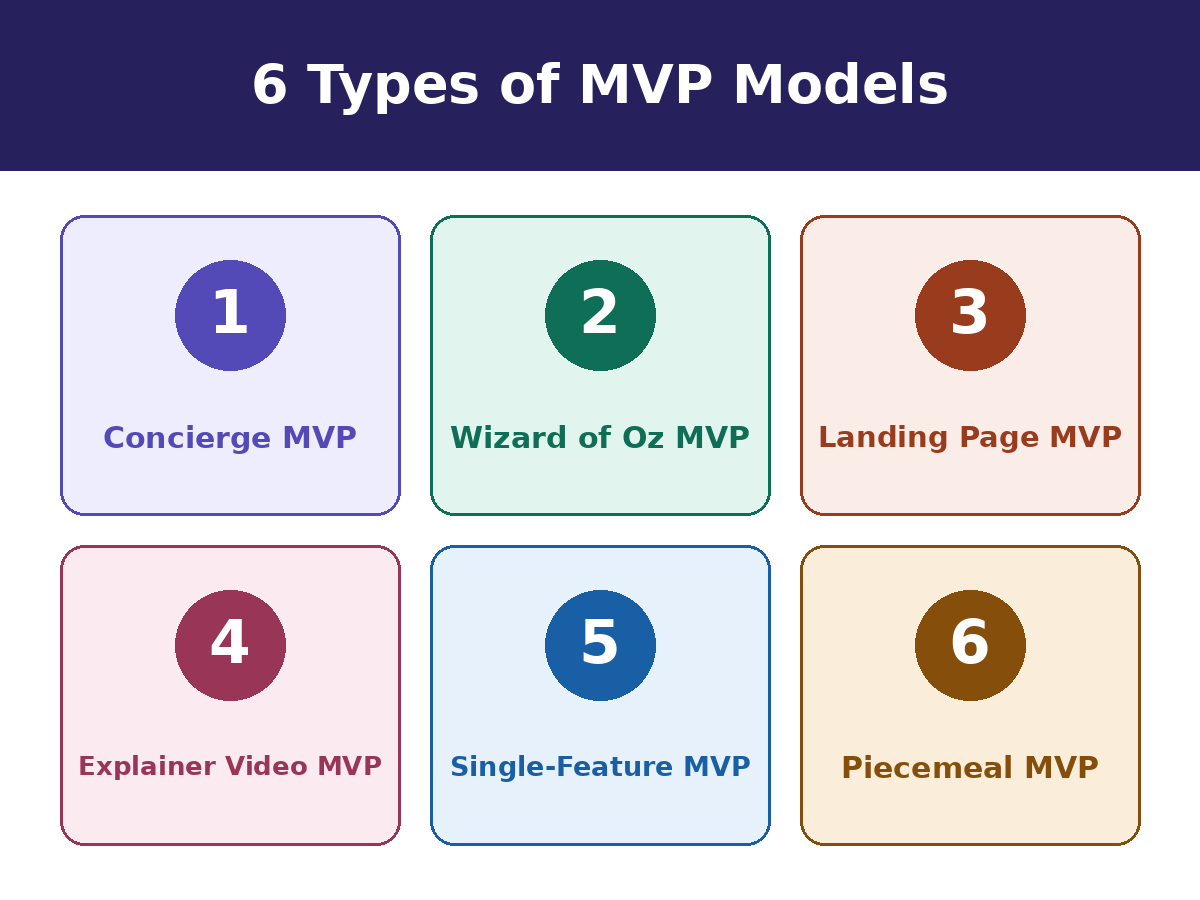
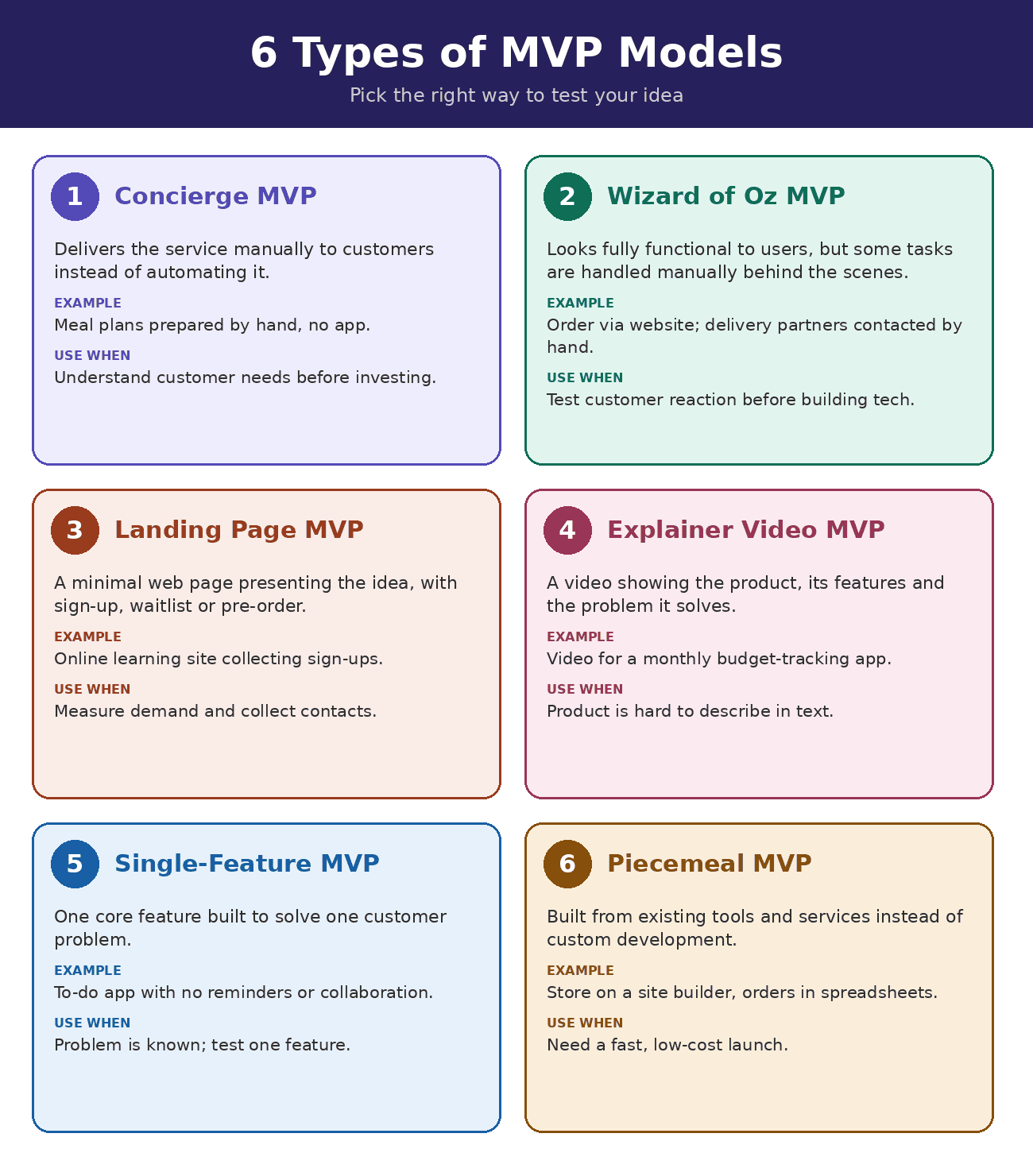
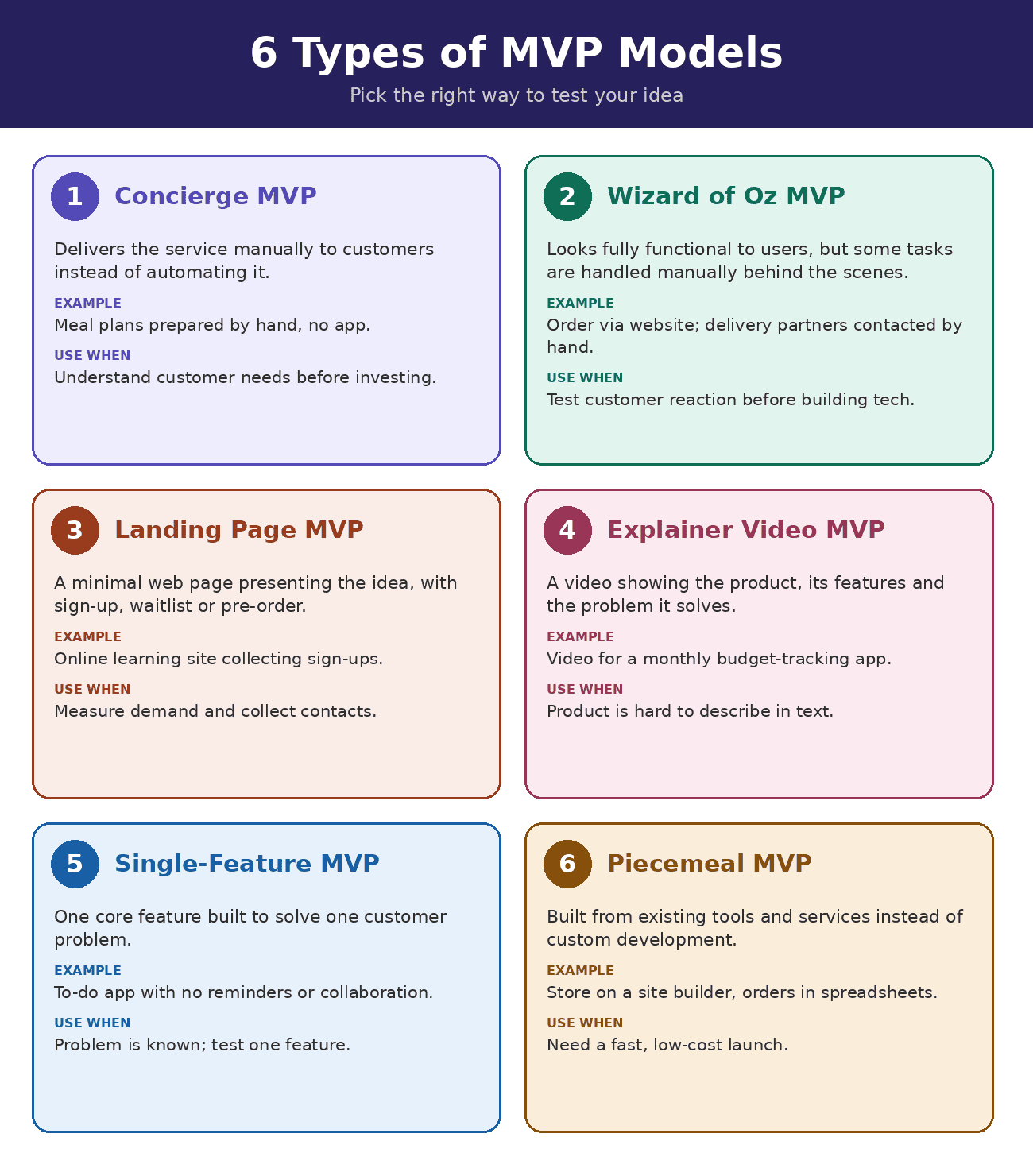
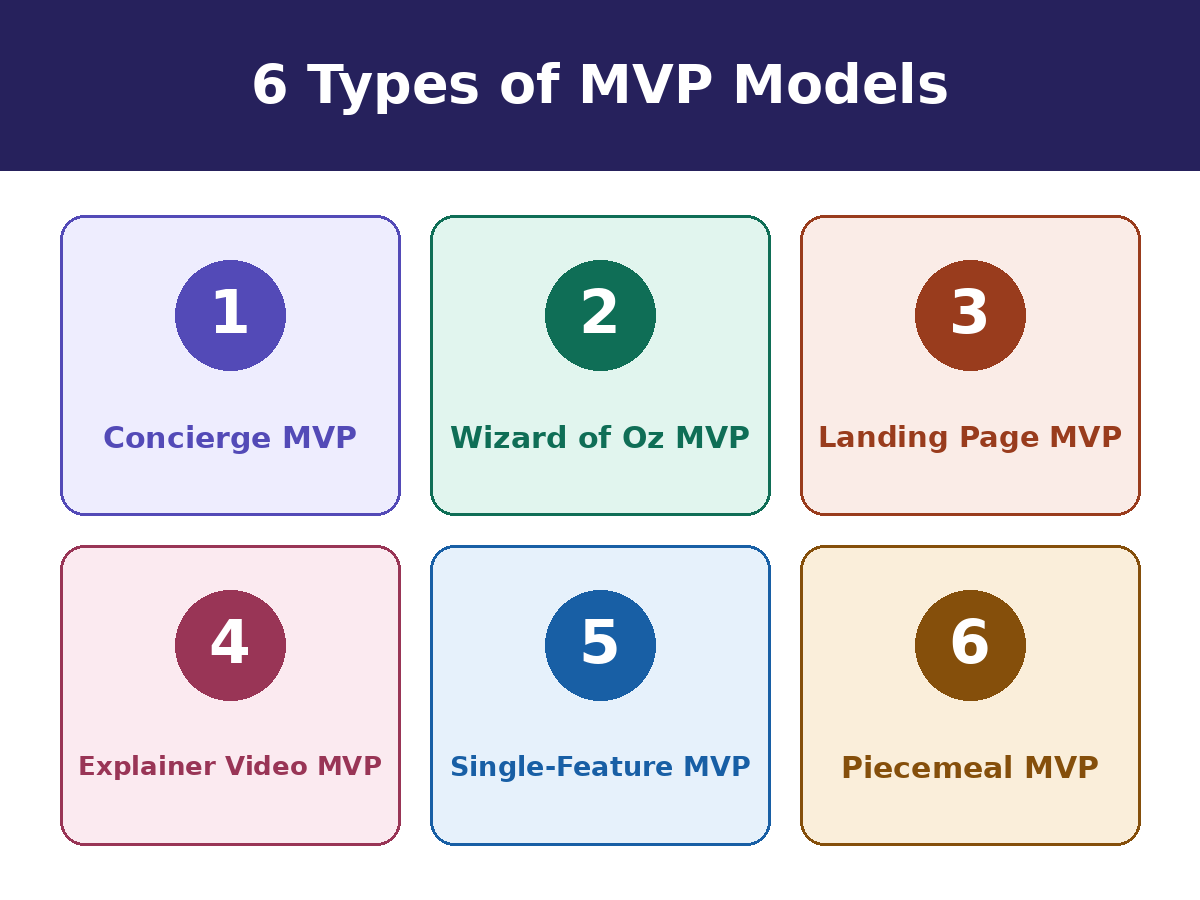
What are the Various MVP Models? 

The types of MVPs that can be developed vary depending on the objectives, budget, product concept, and the target market. There are some MVPs which offer services manually to the clients, while other models use website, video, or tool testing the interest of the client. 

1. Concierge MVP 

Concierge MVP is one of the simplest forms of MVP which involves provision of a product manually to the customers instead of automating it. It allows a business to get the insight about its customers' requirements before any investment into the product. 

  • How it works: In this model, there is direct interaction between the business and its customers as the business offers its service manually to the clients. 

  • Example: A meal planning firm prepares meal plans for customers manually rather than developing an application for it. 

  • When to use it: It can be used by a business in order to understand customer expectations and test service concepts. 

2. Wizard of Oz MVP 

Wizard of Oz MVP is a product that appears to be fully functional for the user, but some features of the product are handled manually. It helps businesses to see how their product is received by the customer before making any investment in technology. 

  • How it works: Customers interact with a basic website or application whereas the business does some tasks manually. 

  • Example: A delivery application helps the user place order through the website, but the business contacts the delivery service partners manually rather than going for the automation process. 

  • When to use it: Businesses can adopt this type of MVP when they need to test their customers' reaction towards the product. 

3. Landing Page MVP 

Landing Page MVP is a minimalistic webpage made to present a product concept and to check customers' level of interest in that particular product. 

  • How it works: The page provides a brief description of the main advantages of the product and can contain a sign-up form, waitlist, or pre-order.

  • Example: The company that plans to introduce an online learning platform creates a website with an option to sign up for updates online education platform makes a website for interested clients to sign up for news about the product. 

  • When to use it: A business can create a Landing Page MVP to determine the demand of customers and get their contact information or messages before the product development.

4. Explainer Video MVP 

An Explainer Video MVP is an MVP that makes use of video for explaining a product, its features and how it will solve the problem that it aims to solve. This can happen without having the actual product at hand. 

  • How it works: The company uses the video to test how the target audience responds through inquiries and other forms of communication. 

  • Example: A new start-up decides to create a video about the app that they are proposing in order to assist the user to keep track of their budget monthly. 

  • When to use it: It can be utilized by businesses if a product is hard to describe using text or if it is essential to test the product's popularity. 

5. Single-Feature MVP 

This MVP is characterized by one major feature designed to address one customer’s challenge. The company will not design a product with multiple features; it will develop and test one major feature of the product at a time. 

  • How it works: This is achieved by creating a base product with one core feature and receiving input from early customers.

  • Example: A startup company develops an application that enables people to make to-do lists and monitor them without any other functions like reminders or collaboration at first.

  • When to use it: Companies can implement this MVP once they understand the problem of their customers and need to test whether some particular feature will work.

6. Piecemeal MVP 

Piecemeal MVP is the strategy of creating a rudimentary form of a product using some existing tool or service rather than developing everything anew. This type of MVP assists the firm in testing its concept through the combination of readily available resources. 

  • How it works: The firm integrates existing resources into providing the expected service and evaluates customers' reactions. 

  • Example: A startup develops a rudimentary online shop via an existing website building platform, controls orders via spreadsheets, and contacts customers via emails rather than building an exclusive e-commerce site. 

  • When to use it: This MVP can be used by firms when a quick launch is required as well as when it is necessary to test the business model without significant expenditure on development. 
Build Your Product Development Skills with IIMBx

Interested in understanding how successful products are developed? Learn about product planning, customer needs, market testing, and feedback to understand how businesses create and improve products using the Minimum Viable Product (MVP) approach.

Key Highlights:

  • Product Development: Understand the stages of building a product.

  • Customer Understanding: Learn how to identify user needs and expectations.

  • Market Testing: Understand how businesses test product ideas.

  • Feedback and Improvement: Explore how customer feedback supports product development.

  • Business Strategy: Learn how MVPs help reduce risks and support better decisions.

Explore IIMBx to find learning opportunities that align with your career goals.

MVP model

Examples of Minimum Viable Product 

Several successful businesses have implemented simple iterations of their products to validate consumer interest prior to developing a full-fledged product. The following examples illustrate how firms can benefit from MVPs in validating an idea, understanding consumers' needs, and making informed decisions. 

1. Dropbox 

  • Dropbox implemented a video demo that illustrated the functionality of its proposed service for file sharing and storage. Rather than developing the product at once, the founders presented the video demo to determine consumer interest in the product. 

  • The positive feedback and increase in sign-ups helped the team to validate consumer interest in the product idea. Therefore, firms can validate consumer interest in the idea using a demo. 

2. Airbnb 

  • The founders of Airbnb began with offering rooms in their San Francisco house to the conference attendees that required accommodation. They implemented a simple website to offer accommodation to visitors to San Francisco that could not find hotels. 

  • This experiment allowed the founders to test consumer interest in paid accommodation in a stranger's apartment. 

3. Zappos 

  • Zappos tested the customer need of purchasing shoes online by not carrying a huge stock to start with. It is said that the founder of Zappos, Nick Swinmurn, photographed shoes from the local store and put them up on the site. 

  • The moment an order was placed, the shoe would be bought from the local stores and delivered to the customer. It is clear that this practice helped them to gauge whether people would purchase shoes online or not. 

4. Amazon 

  • Amazon started off in 1995 as an online bookstore and concentrated on selling books via its website rather than going out with many product lines. 

  • It shows that concentrating on one product category helped them to gain customer experience before diversifying into other product categories or services. 

MVP, Prototype or Proof of Concept (PoC)? 

There are times when all three MVP, prototype, and PoC can be used during the product development process. However, even though all three tools have similar purposes for testing ideas, each of them is designed for different aims. 

Feature 

Minimum Viable Product (MVP) 

Prototype 

Proof of Concept (PoC) 

Definition 

The most basic product with basic functions. 

Early version of the product that demonstrates what it will look like. 

Testing whether something is technically possible. 

Main aim 

Testing customers' demand and receiving feedback. 

Testing design, layout, and functionality. 

Checking technical feasibility. 

Users 

Potential customers or early adopters. 

Designers, stakeholders, and users. 

Developers, engineers, and technical experts. 

Functions 

Limited and usable functionality. 

Interactive and visual representation. 

Testing specific functions. 

Examples 

Basic app for browsing and ordering products online. 

Clickable mock-up of a shopping app. 

A test of payment security on an app. 

Want to understand how businesses plan and position their products? Explore how product strategy helps align customer needs, market opportunities, and business goals.

MVP, Prototype or Proof of Concept (PoC)

What Are the Common Challenges of Developing an MVP? 

The development of an MVP is helpful for companies since it allows testing ideas by using less resources, although there are some difficulties that companies have to consider. It is important to take into consideration customers' demands, development expenses, and the quality of the product. 

The common challenges are as follows: 

  • Selecting the right features: It might be hard to choose the necessary features. Adding too many features increases the development period, while lacking necessary ones may make the product incapable of solving the customers' problem. 

  • Controlling development expenses: No matter how simple the product is, its development takes time, money, and some technical resources. A company should estimate development expenses and pay attention only to those features that help to achieve the main objective. 

  • Receiving the useful feedback from the early users: Customers do not always give their feedback. A company has to pose proper questions to the users and observe their behavior. 

  • Eliminating unnecessary features: A team can be tempted to include features according to its assumptions but it should focus on those features that will aid in testing the basic concept of the product. 

  • Learning from test results: A positive response does not necessarily guarantee the usage of the product by the consumers. It is important for an organization to conduct research before taking any further steps. 

What Are the Indicators of a Successful MVP? 

There are different ways for enterprises to measure the success of their MVPs through analyzing users' behavior, their reactions, and the performance of the product. The choice of metrics depends on the purposes of the product and the ideas that the business is going to test. 

The main metrics are: 

  • Acquisition and engagement of users: Analyzing the number of registrants and how many of them are using the basic functions of the product. 

  • Feedback and satisfaction level: Evaluating the opinion of users based on their reviews, surveys, and recommendations about the improvement of the product. 

  • Conversion rate: Calculating the ratio of users, who take the desirable action - sign up, make a purchase or subscribe to some services. 

  • Retention rate: Determining how many users repeat their visits or continue using the product after the first time. 

  • Indicators of product market fit: Find any evidence showing that there’s a real problem being solved by your product for a certain group of people. Factors such as repeated use, customer referrals, paying for the product, and constant demand will help you evaluate it. 

  • Customer acquisition costs: Estimate the cost of attracting each customer to your business. This will show if your customer attraction strategy is realistic or not. 

Conclusion

The MVP allows organizations to assess whether their product ideas are viable and meet the demands of consumers before making major investments into developing the idea further. Through the process of prioritizing critical features of the product and gathering feedback from users, organizations will be able to lower expenses, improve the product and make better decisions.

Knowing about different types of an MVP, examples of successful MVPs, challenges that organizations may face while developing an MVP and success metrics will be very helpful for entrepreneurs and product developers.

Tripti Diwakar

Tripti Diwakar

Digital Marketing & Content Specialist

4+ of articles published

Associated with upGrad since 09 Feb 2026


Domain:

UpGrad

Current role in the industry :

Associate

Education Qualification :

B.com Hons

About

Tripti Diwakar is a digital marketing and content professional with close to one year of experience in digital marketing, content writing, and content development. Currently working as a Consultant at upGrad, she focuses on creating and refining content that strengthens brand visibility, connects with audiences, and supports digital growth. With an academic background in commerce and a keen interest in marketing, Tripti brings together business knowledge and creative thinking to develop meaningful, engaging, and audience-centric content. Her areas of interest include digital marketing, content marketing, social media, SEO, and effective digital communication.

Follow me on :

No blogs published yet.

Latest Blogs

Frequently Asked Questions

General