

Key Highlights
Product strategy is the planning which a company does to achieve its goals related to its product.
It includes the vision for the product in relation to consumer needs, the market conditions, business objectives, and development priorities.
Key elements of product strategy includes product vision, target market, customer needs, value proposition, product goals, product initiatives, and success metrics.
The different types of product strategy are differentiation, cost leadership, innovation, market expansion, product lifecycle, and customer-centric strategies.
In this blog, you’ll learn the key elements, common types, development process, product strategy examples, and how strategy fits into product development.
Ready to strengthen your business knowledge and leadership capabilities? Explore the IIMBx Certificate in General Management for Emerging Leaders and gain practical insights to navigate business challenges, make informed decisions, and prepare for greater leadership responsibilities.
What Is Product Strategy and Why Is It Important?
“Product”, means the goods or service that the company is going to provide for the consumer.
“Strategy”, means the plan necessary to implement the the product in the market.
Thus, Product strategy is a strategy that describes how the product will satisfy the requirements of customers in line with business goals. It serves as a guide for product teams on how to make decisions regarding market, features, positioning, resource allocation, and priorities.
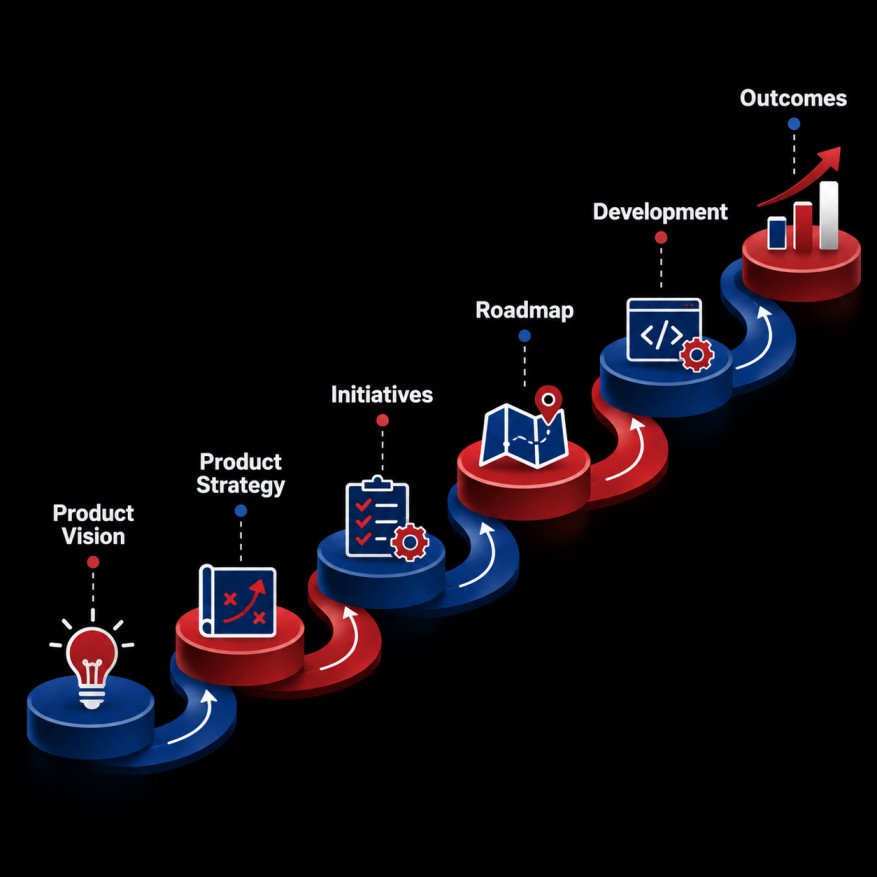
It is more like the link between a vision for a product and its execution.
The vision describes where the product needs to go. The strategy explains how the team plans to move towards that destination.
A well-defined product strategy helps teams answer practical questions such as:
Who is the product for?
Which customer problem does it solve?
What makes the product valuable?
Which goals should the team prioritise?
What should be built first?
How will success be measured?
Product strategy also helps prevent feature-first decision-making. Strategic priorities provides the base for determining which ideas go well with the product's objectives. The strategy should be adaptable. So that if customer expectations, competition, technology, and market conditions change then it can be adapted.
Do read: Performance Management Process: Steps & Best Practices
Key Elements of Product Strategy
Here are the key elements:
Also read: Strategic Management: Process, Importance & Examples
What Are the Different Types of Product Strategy?
One product strategy can’t fit every organisation.
Here are the types of product strategy:
Differentiation Strategy
The differentiation strategy revolves around having a product that is unique from other competing products in terms of its functionality, usability, performance, or something else that the consumer cares about.
Cost Leadership Strategy
This strategy revolves around providing value in the form of cheaper products or services compared to competitors' offers. It needs analysis of pricing and costs, operations, product scope, and necessary resources.
Do read: Transformational Leadership Style: Meaning and Benefits
Innovation Strategy
Innovation strategy revolves around introducing some innovative solutions to solve the problem of the customer through new technology, new product categories, or a different way of delivering value.
Market Expansion Strategy
This strategy revolves around entering a new market for an existing product. It can be either new segments of consumers, new geography, or usage case.
The product may need to be customised to meet the the needs of the new audience.
Do read: Data Driven Decision Making: Guide for Better Decisions
Product Lifecycle Strategy
The priorities of a product are likely to changer as it progresses through the various stages of its life cycle. That is from introduction through to growth, maturity, and decline. In the early stages the emphasis is on validation and adoption, but with more mature products the focus is instead on retention, differentiation, or portfolio decisions.
Customer-Centric Strategy
Customer-centric approach focuses customer problems and their satisfaction as their main priorities for the product’s development. Behavior, feedback, research and satisfaction are the main priorities throughout the product lifecycle.
Must read: Organisational Design Guide 2026 | Types and Process
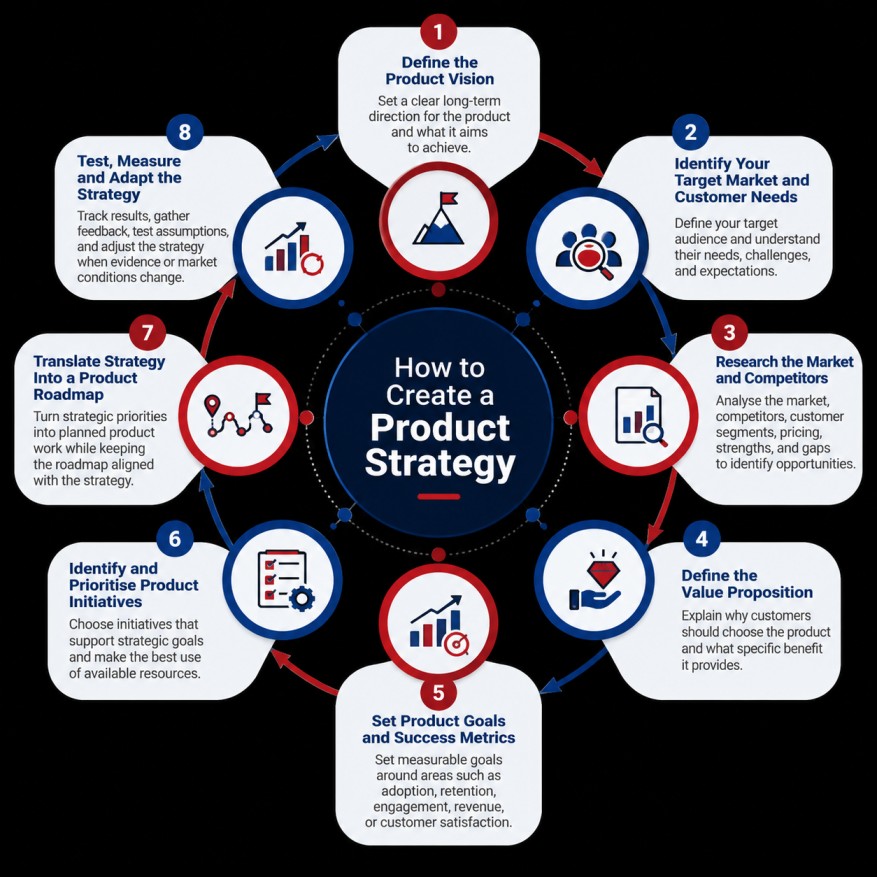
How to Create a Product Strategy
Creating a product strategy requires each decision to be connected to a customer problem, market opportunity, or measurable business outcome.
1. Define the Product Vision
Begin by describing the vision for the product and the future it should create. A vision provides a long-term direction for the product development team. It should be specific since a generic vision would not help when prioritising between different demands on the team.
2. Identify Your Target Market and Customer Needs
Identify who your target customers are. Then the next step would be to identify what those customers need, what problems they have, and which solutions currently exist.
You can gather valuable information from customer interviews, surveys, behavioral data, support interactions, and even market research may yield.
3. Research the Market and Competitors
Do a market analysis prior to dedicating extensive product resources to the development of the product. Analyze competitor’s products, in terms of positioning, customer base, pricing strategy, advantages, and deficiencies.
Market research doesn’t mean to copy your competitors.Instead, your main focus should be to understand what different value your product can provide.
Must read: What Is Management? Meaning, Functions & Importance
4. Define the Value Proposition
The value proposition should communicate the reason why a customer should choose your product among others. It should clarify what customer problem you solve through the product.
A good value proposition is specific enough to to guide through product decisions. For example, if the same value proposition can be applied to any product in the category, it's not good enough.
5. Set Product Goals and Success Metrics
Product strategy should turn into measurable outcomes. The goal may refer to adoption, retention, engagement, revenue, conversions, customer satisfaction, or any other meaningful metric.
Make sure to select proper metrics for a given goal. Otherwise, for example, the mere existence of high traffic does not guarantee a successful product strategy if users are not using the product.
6. Identify and Prioritise Product Initiatives
Product initiatives are bigger tasks to achieve strategic objectives. Prioritization allows a team to make a decision on how limited time and money should be allocated on which level of the product strategy.
Also read: Strategic Management: Process, Importance & Examples
7. Translate Strategy Into a Product Roadmap
The roadmap turns strategic priorities into planned product work. It should reflect the strategy rather than replace it.
A roadmap can change as evidence changes. The underlying strategic direction should provide the context for those changes.
8. Test, Measure and Adapt the Strategy
No strategies should not be considered as the permanent strategy. They need to be evaluated by measuring their performance, collecting customer feedback, testing assumptions, and making decisions on the basis of new information.
The best strategies allow for the possibility of learning. In case an important assumption turns out to be incorrect, it might be better to change course rather than defend an outdated strategy.