


Quick Overview
PESTEL analysis is a strategic framework that examines six external business factors to identify potential risks, uncover opportunities, and support long-term planning.
Learn how political, economic, social, technological, environmental, and legal changes can affect a business.
Set a business goal, research external factors, identify opportunities and threats, create an action plan, and review it regularly.
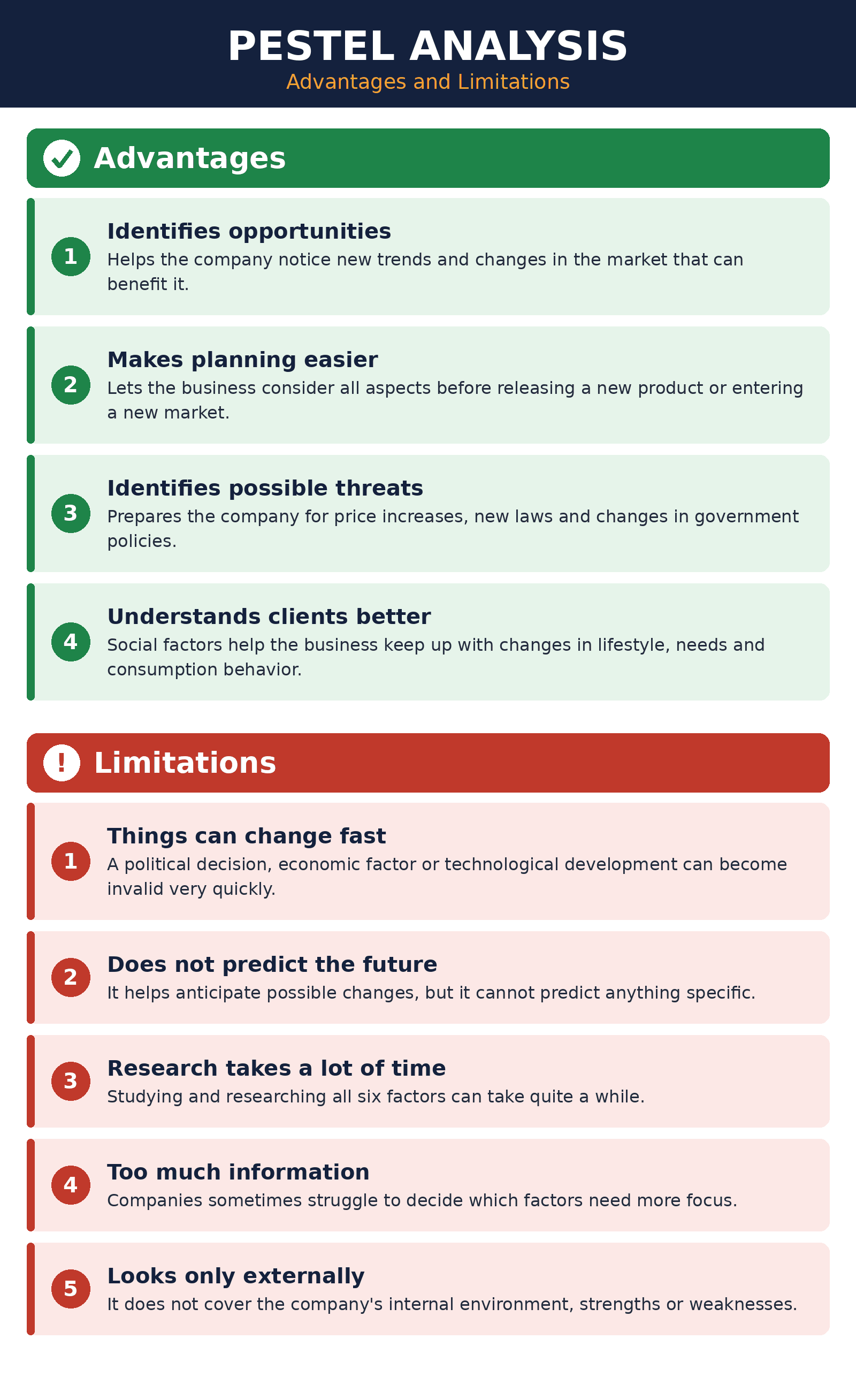
PESTEL analysis helps businesses plan ahead, identify risks, and spot opportunities, but it cannot predict the future and does not assess internal business factors.
This guide covers what PESTEL analysis is, the six factors of the PESTEL framework, how to conduct a PESTEL analysis step by step, real-world examples, and its key advantages and limitations.
What Is PESTEL Analysis?
PESTEL analysis is a valuable framework which can help to assess various factors influencing the performance, decision making processes and growth of the business. The analysis allows companies to know everything that goes on in the surroundings and the ways in which this knowledge influences them.
PESTEL stands for Political, Economic, Social, Technological, Environment and Legal. Each element represents a specific aspect of the external environment of the business, such as government policies, economy, preferences of consumers, technology, environment and law.
PESTEL analysis enables firms to understand the possible threats and opportunities that exist, to be ready for changes and to design a proper strategy. PESTEL analysis differs from the frameworks that assist in analyzing the weaknesses and strengths of the firm. PESTEL analysis focuses on the external environment of the business.
What Are the 6 Factors of PESTEL Analysis?
Everything happening around a business impacts it. It could be government policy changes, technological advancements or change in consumer preferences. Businesses can use PESTEL analysis to understand these changes and how they might impact their plans.
So let’s go through the six factors, with simple explanations and examples.
1. Political Factors
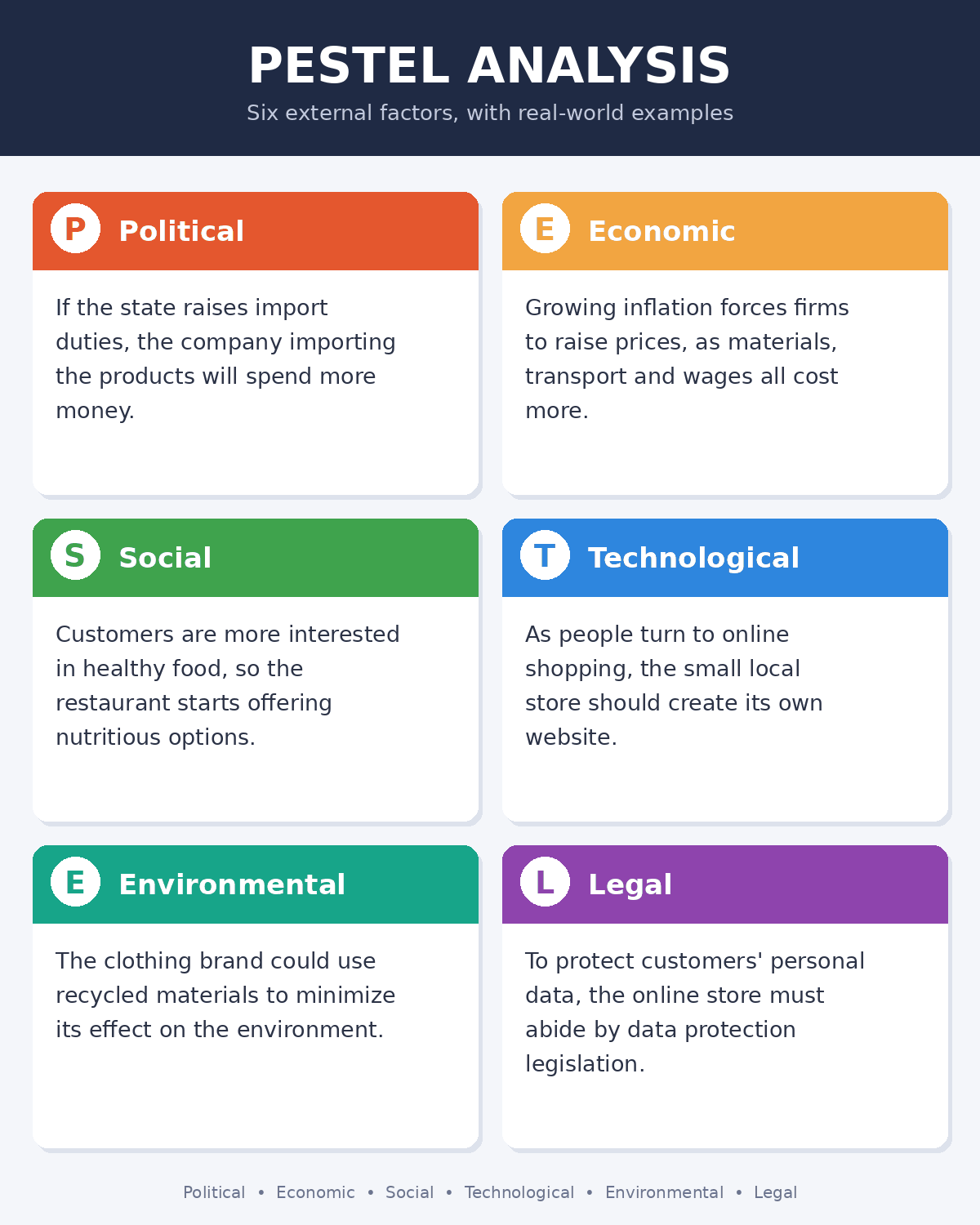
Some of the political factors are government policies, taxes, trade regulations, and political stability. These factors influence the expenditure of a business organization, its location, and long-term planning.
Example: In case the government increases the tariffs on imports, a firm importing raw materials will be affected.
2. Economic Factors
Economic factors include aspects such as inflation, interest rates, unemployment, and economic growth. Such changes may impact costs of doing business and customer spending power.
Example: During inflation, the cost of raw materials and transportation may increase. A bakery may have to spend more on flour, sugar, and electricity, affecting its profits.
3. Social Factors
Social factors look at the lifestyles, values, preferences, and purchasing behavior of the people. Companies have to know what customers need so they can provide appropriate products and services.
Example: As more people become health-conscious, food companies may introduce low-sugar snacks, healthy drinks, and plant-based food options to meet changing customer preferences.
4. Technological Factors
Businesses keep evolving due to new technology that may include automation, new technologies, artificial intelligence, and digital platforms which allow them to save time, improve their goods, and increase the number of customers.
Example: A retail store may introduce an online shopping app and AI-powered product recommendations to improve the shopping experience and increase sales.
5. Environmental Factors
Environmental factors include concerns such as climate change, pollution, waste, and natural resource usage. These factors are looked at by businesses to understand the environmental threats and how to lower their impacts on the environment.
Example: The clothing company may decide to use recycled materials and environmentally friendly packaging.
6. Legal Factors
Legal Factors are those legal considerations that companies have to comply with. This might relate to the rights of employees, customers, workplace conditions, and privacy of customers’ data.
Example: An online store has to be in compliance with relevant legislation when gathering and storing data about customers.
In case firms analyze all the six variables together, they will be able to see clearly what happens outside. Also, Read our guide to SWOT Analysis to learn how to use SWOT analysis alongside PESTEL for strategic planning..
How to Conduct a PESTEL Analysis Step by Step
A PESTEL analysis becomes more manageable by splitting it into smaller steps. The objective is to determine what is going on in the external environment and how such changes may impact your operations. Here is how to do it.
Step 1: Set Business Objective
Firstly, identify what knowledge you require. Will it be related to launching your product, entering a new market, or expansion of your current business? Defining your objective will enable you to focus on relevant aspects.
Step 2: Investigate Six PESTEL Factors
Gather information regarding political, economic, social, technological, environmental, and legal elements that might impact your business. Make sure to use reputable sources for this such as government websites, industry surveys, market research, and publications.
Step 3: Examine Opportunities and Threats
After you have gathered the information, you will want to evaluate how each of these factors can influence your business. While some factors can be sources of new opportunities for a business, others might pose challenges to your organization.
Step 4: Examine the Significance of Each Factor
Not all external factors will impact your business the same way. You need to think about how possible it is for these changes to occur and what effect they may have on your cost structure, clients, performance, etc.
Step 5: Develop an Action Plan
Based on your results, come up with a course of action that your business needs to follow. It may require you to change your pricing, find new suppliers, use new technology, and even adapt to new regulations. You will need to allocate responsibility and timelines to implement your action plan.
Step 6: Review and Update Your Analysis
As the business operates in an environment which is changing continuously, PESTEL analysis does not just occur once. It is very important that you keep on analyzing your findings based on changes in the market, technology, politics, and laws.
A business can perform a review of its PESTEL analysis in light of new data protection laws or any shift in consumer trends.
Note: An effective PESTEL analysis is not just about listing external factors; rather, it helps you prioritize changes and respond to them effectively.
What Are Some Examples of PESTEL Analysis?
There are many factors that can influence an organization, such as price increases and changes in consumer behavior. Let us discuss some of the examples to comprehend how the PESTEL analysis works in real life.