Introduction Stage: Building Awareness and Attracting Early Customers
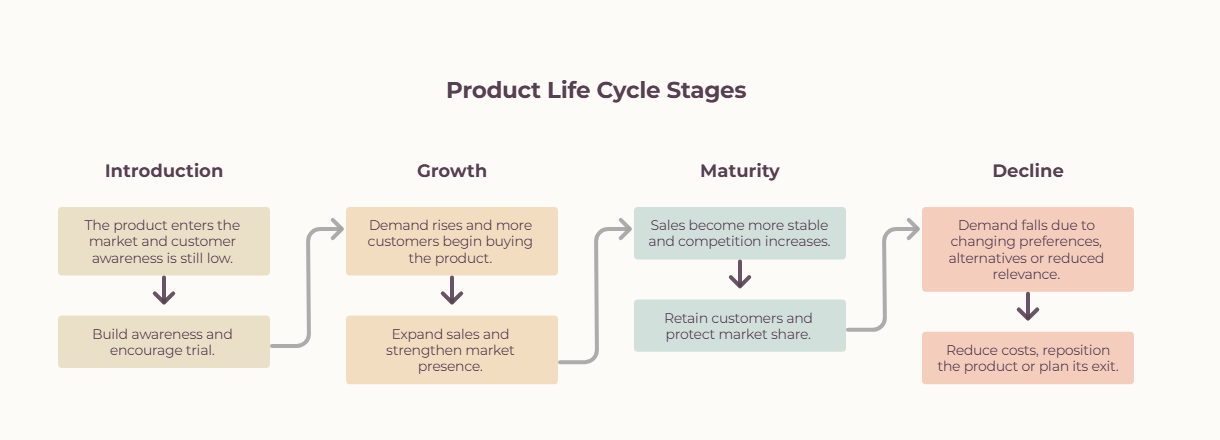
The introduction stage starts when the product goes into the market. Consumers may not know much about the product at this stage, and it is up to the organization to educate consumers about what the product offers.
Slow sales may be experienced during this stage due to lack of development of a customer base. Marketing at this stage is largely done through demonstrations and campaigns aimed at educating consumers about the product.
Businesses may also test an early version of a product through a minimum viable product (MVP) to gather customer feedback and identify improvements before expanding its reach.
Businesses may focus on:
Explaining the product’s purpose and benefits clearly.
Reaching customers who are most likely to try it first.
Collecting feedback to identify problems or areas for improvement.
Choosing a price that supports the product’s positioning and launch goals.
Example: When a company introduces a new smart home device, it may use product demonstrations and trial offers to show customers how the device works and how it fits into their daily lives.
Growth Stage: Increasing Sales and Expanding Market Share
At the stage of growth, more consumers become aware of the product and start purchasing it as sales grow. Good reviews and recommendations can contribute to increased demand, as well as more availability of the product. Competitors will also get into the market if they see that the product is gaining popularity.
Instead of introducing the product, businesses are trying to reach more consumers and increase demand. It could be necessary to expand the distribution network, improve the capacity of production or introduce some more features to differentiate from other similar products.
Businesses may focus on:
Making the product available through more sales channels.
Improving features based on customer feedback.
Strengthening brand recognition and customer trust.
Monitoring competitors and responding to changing market expectations.
Example: As demand for a particular wireless earbud model grows, its manufacturer may expand retail availability, introduce additional colour options and invest in wider advertising to reach new customers.
Maturity Stage: Defending Market Share in a Competitive Market
By maturity stage, the product already has an established client list; however, the sales become stable, and it is more difficult for the company to gain new customers.
The product life cycle often becomes more focused on customer retention, differentiation and cost management at this stage. Businesses may update products, introduce bundles or improve customer service to encourage repeat purchases. Effective customer retention strategies can also help businesses maintain customer loyalty in a competitive market.
Businesses can use SWOT analysis to assess their strengths, weaknesses, market opportunities and competitive threats before deciding how to maintain their position.
Businesses may focus on:
Improving customer experience and after-sales support.
Introducing useful updates rather than unnecessary changes.
Offering bundles, loyalty benefits or targeted promotions.
Keeping costs under control while maintaining product quality.
Example: A well-established laundry detergent brand may introduce a concentrated formula, refill packs or a fragrance variant to retain existing customers and appeal to new preferences.
Decline Stage: Adapting to Falling Demand
The stage of decline is reached when there is a decrease in the sales of a product for a certain period of time. It means that either the customers switched to some other options or there have been changes in the technologies and the product is not needed anymore.
It is also necessary to understand that the stage of decline does not mean that the product should be withdrawn immediately.
Businesses may focus on:
Reducing production and promotional spending.
Serving loyal customers who still need the product.
Repositioning the product for a smaller or more specific market.
Discontinuing the product when continued sales no longer justify the cost.
Example: As streaming services replace DVD rentals for many customers, a DVD rental business may reduce its outlets, focus on collectors or close operations if demand is no longer sufficient.
What Marketing Strategies Work Best at Each Product Life Cycle Stage?
There are marketing strategies that can prove highly effective in launching products but may not prove effective if the product is already established in the market place. Businesses need to consider customer awareness, competitor activity, sales trends and the product’s overall costs before deciding what to do next.
Product Life Cycle Stage | Pricing and Promotion Strategy | Distribution Strategy |
Introduction | Use premium or introductory pricing. Build awareness through advertising, demonstrations and trial offers. | Start with suitable channels that reach the target audience. |
Growth | Review pricing as demand changes. Promote product benefits and highlight differences from competitors. | Expand availability through more retailers and online channels. |
Maturity | Use competitive pricing, bundles and targeted discounts to retain customers. | Improve product availability and strengthen relationships with sales partners. |
Decline | Adjust prices, reduce promotional spending and target customers who still value the product. | Focus on profitable channels and manage remaining inventory. |
These approaches are guidelines rather than strict rules. A business may use premium pricing during growth if demand supports it, or continue investing in promotion during maturity if there is a clear opportunity to attract new customers.
An effective product strategy helps businesses align product positioning, customer needs and business goals as the product moves through different stages of its life cycle.
The product lifecycle works best as a decision-making framework, not as a rulebook. Sales data, customer responses and competitor activity should guide the final choice.
Want to understand how competition shapes business decisions? Explore our guide to Porter’s Five Forces: Model, Analysis and Examples to learn how businesses assess competitive pressures and market attractiveness.
Product Life Cycle Examples From Real Businesses
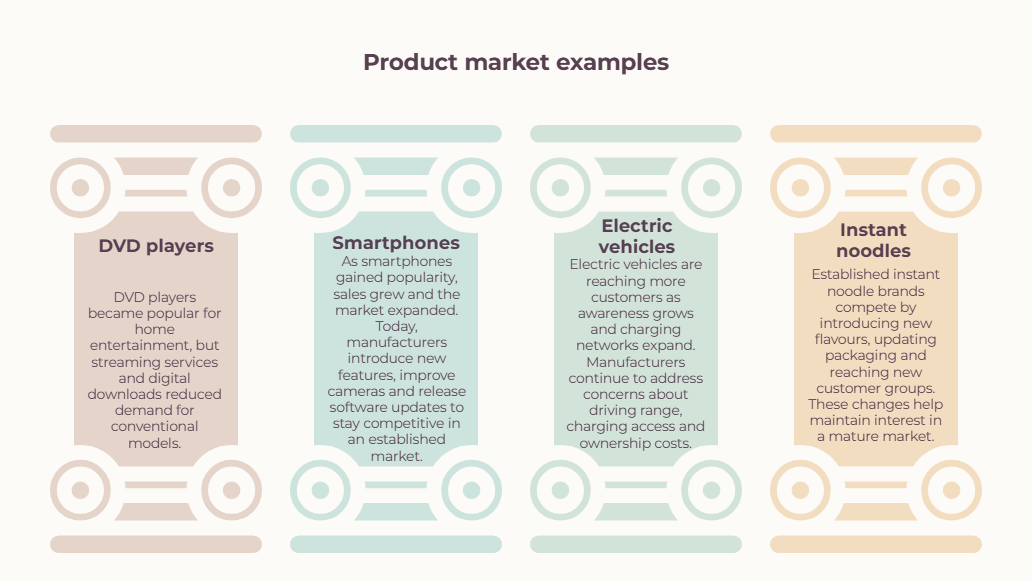
Products move through the product lifecycle at different speeds depending on customer demand, competition and market changes. These examples show how businesses respond to different stages.