
IIMBx - Digital Learning Foundation

What Is Operations Management? Scope, Functions and Careers

By Tripti Diwakar

Updated on Oct 30, 2026

Share:
  • Operations management refers to planning and organizing all business operations to ensure smooth flow of operations for the success of the business organization. 

  • It assists in the efficient use of resources by organizations to cut down costs, improve efficiency, and complete tasks on time. 

  • It is concerned with quality and timely delivery of goods and services while meeting the requirements of customers in an efficient manner. 

  • This blog discusses the definition, scope, functions, types, skills, and career prospects of operations management. 

Why Is Operations Management Important? 

Operations management is vital in facilitating the smooth conduct of operations in the business world. This includes management of resources, quality control, cost control, and meeting customer expectations among others. Good operations management is instrumental in improving productivity and realizing business objectives. 


Importance of Operations Management is demonstrated by the following facts: 

  • Enhances Operational Efficiency: Operations management helps businesses to ensure that operational activities are conducted effectively with little or no delay at all. 

  • Facilitates Cost and Waste Control: Operations management assists businesses in cost control and waste avoidance during the manufacturing process. 

  • Ensures Quality in Products and Services: Operations management ensures that products and services are of high-quality as per the set standards. 

  • Increases Customer Satisfaction: Operations management enables businesses to offer their customers quality products and services. 

  • Improves Resource Utilization and Productivity: It helps in making efficient use of resources, including human resources and other assets. 

What Are the Main Functions of Operations Management? 

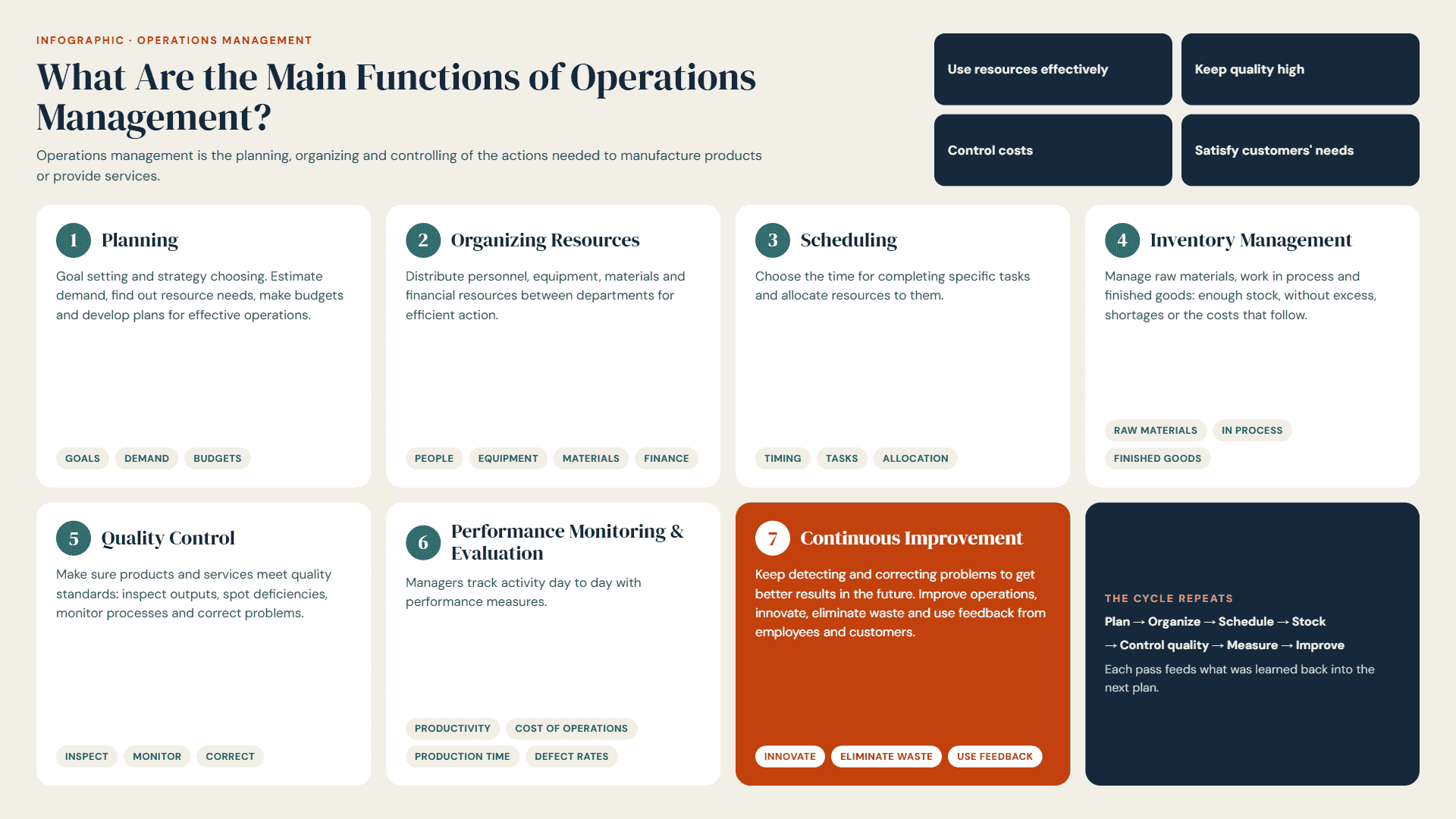
Operations management is related to the processes of planning, organizing and controlling actions that are needed to manufacture products or provide services. Operations management allows organizations to use their resources effectively, to keep the level of quality high, to control costs and to satisfy customers' needs. The major functions of operations management can be described as follows: 

1. Planning 

This function includes goal setting and strategy choosing. Estimating demand, finding out the need for resources, making budgets and developing plans for effective business operations is the main purpose of planning. 

2. Organizing Resources 

Organizing resources means the process of distribution of such resources as personnel, equipment, materials and financial resources between departments for the purpose of efficient actions. 

3. Scheduling 

It is connected with the problem of choosing the time for completing certain tasks and allocation of resources. 

4. Inventory Management 

This is the process of managing raw materials, goods in the process of manufacture, and finished goods. It enables firms to have enough stock without having excess stocks, shortages, and associated costs. 

5. Quality Control 

Quality control is an assurance that the product/service meets certain quality standards. Quality control entails inspection of the outputs, identification of any deficiencies, process monitoring, and correction of any problems to ensure consistency and customer satisfaction. 

6. Performance Monitoring and Evaluation 

Operation managers monitor their activities on a day-to-day basis through the use of performance measures such as productivity, cost of operations, time taken for production, and defect rates. 

7. Continuous Improvement 

Continuous improvement implies continuous detection and correction of problems in order to achieve positive outcomes in the future. A company can improve its operations, introduce innovations, eliminate waste, and make use of feedback from employees and customers. 
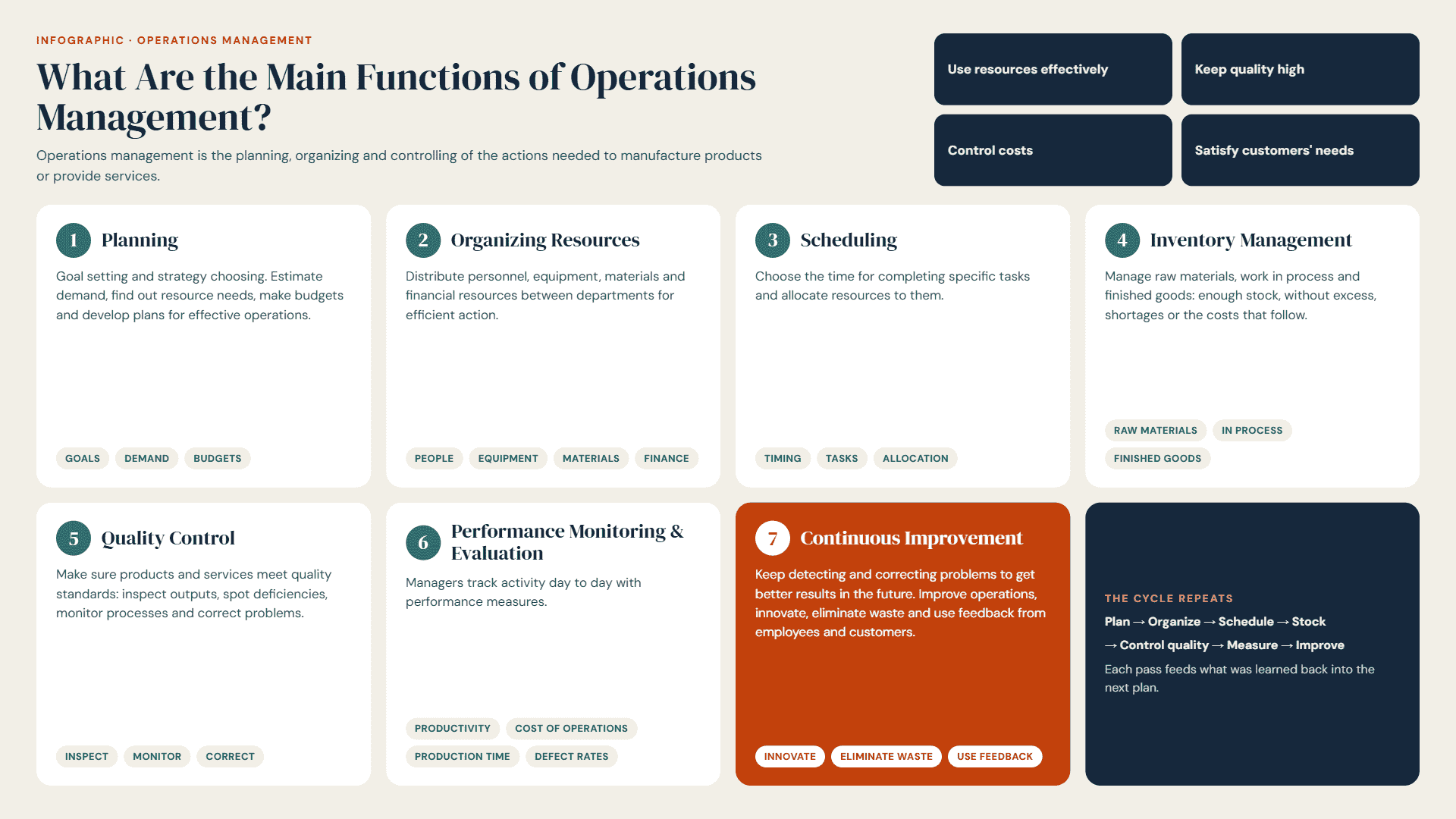
Main Functions of Operations Management

What Are the Types of Operations Management? 

Operations management differs from one firm based on the nature of its processes and the goods/services it provides. It aims to manage particular processes with the objective of improving efficiency and controlling costs. The key types of operations managements are: 

1. Manufacturing Operations Management 

Production operations management involves manufacturing products through the management of raw materials, machines, laborers, and manufacturing process. This is useful to ensure that factories have quality products without wastage and achieve their production goals. 

2. Service Operations Management 

Service operations management entails the planning and management of activities to provide particular services. Service operations management applies to businesses like hospitals, financial institutions, educational institutions, and others. 

3. Supply Chain and Logistics Management 

Supply chain and logistics management involve the flow of raw materials and finished goods from suppliers to customers through the processes of purchasing, logistics, warehousing, and inventory management. 

4. Project Operations Management 

Project operations management is the management of resources, activities, budgets, and timelines for completing various projects. This method of managing is widely applied in construction, information technology, consulting, and many other industries, where the projects need to be completed. 

5. Digital Operations Management 

Digital operations management refers to the management of business operations through the usage of digital technologies. It covers workflow automation, digital data monitoring, digital systems management, and others. 

Build Your Business Analysis Skills with IIMBx

Interested in becoming a business analyst? Build your understanding of business concepts, data analysis, and problem-solving to prepare for opportunities across industries.

Key Highlights

  • Analytical Skills: Develop skills in data interpretation and problem-solving.

  • Technical Knowledge: Learn about tools such as Excel, SQL, and Power BI.

  • Business Understanding: Understand business requirements and processes.

  • Career Opportunities: Explore roles across IT, finance, consulting, and other industries.

Explore IIMBx to find learning opportunities that align with your career goals.

What Skills Are Required by Operations Managers? 

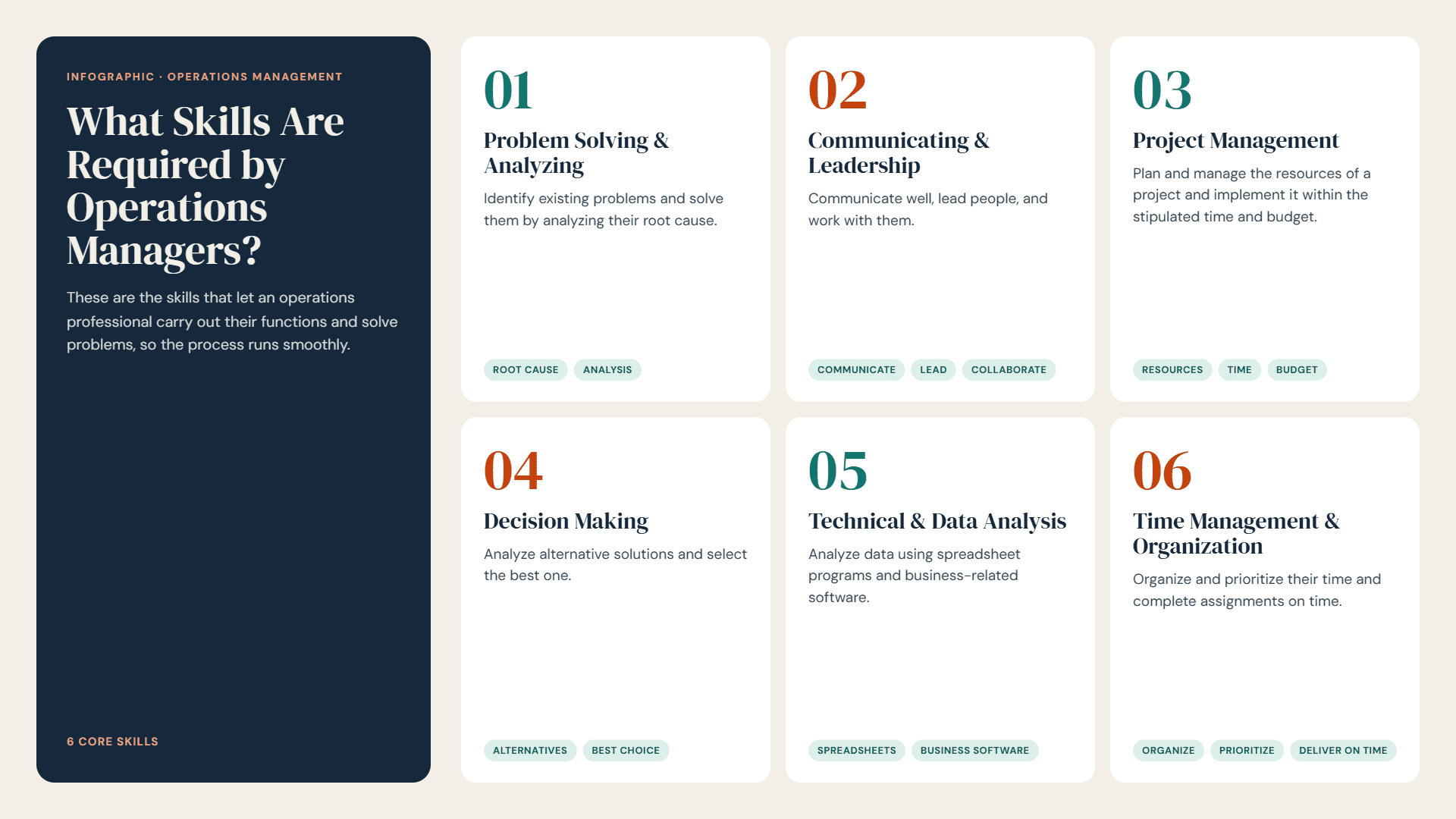
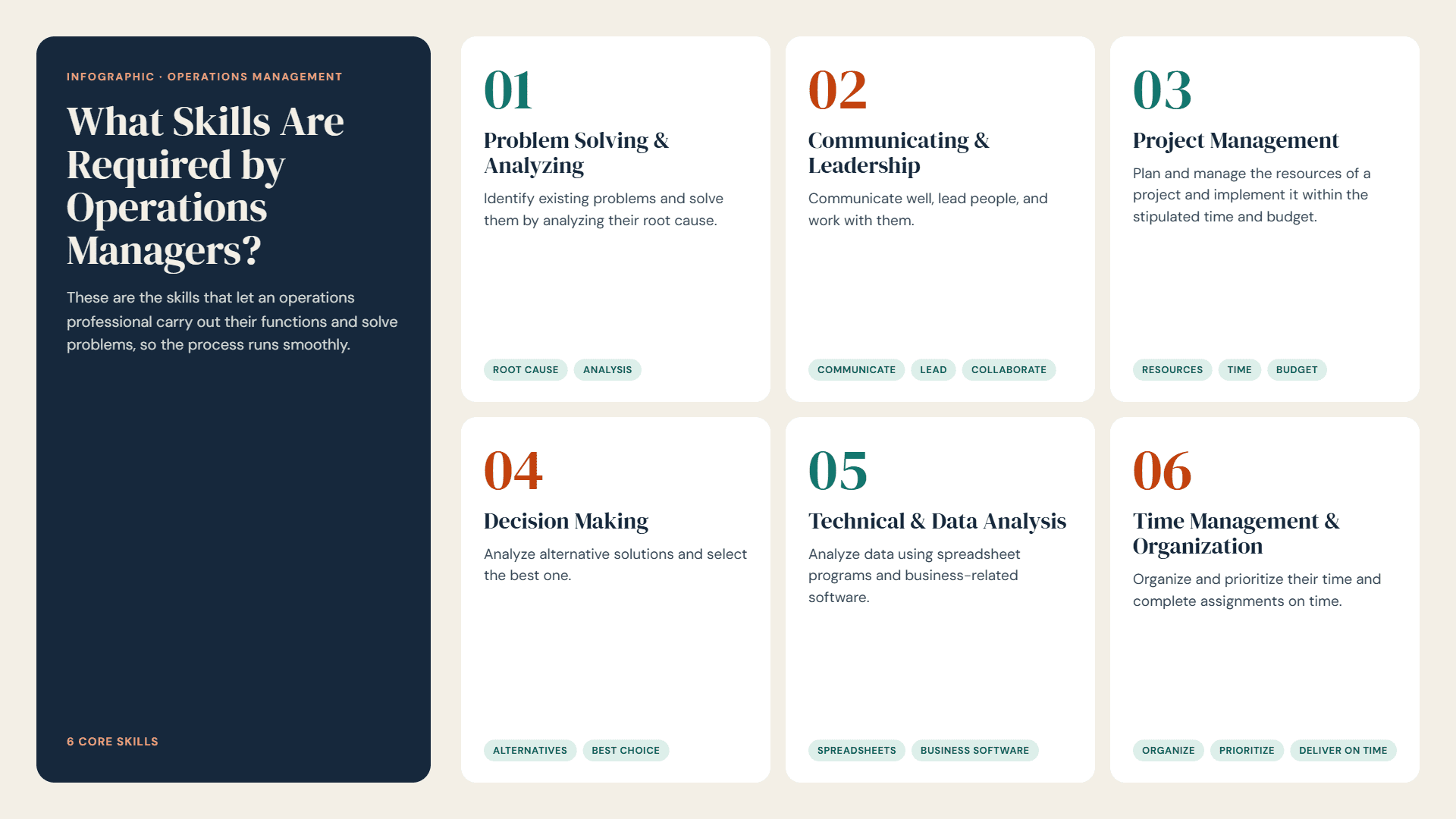
The skills related to operations management include all those skills that make it possible for the professional to carry out his functions and solve problems in order to make the process run smoothly. 

  • Problem Solving and Analyzing: Identify existing problems and solve them by analyzing their root cause. 

  • Communicating & Leadership Skills: Communicate well, lead people, and work with them. 

  • Project Management Skills: Plan and manage resources of the project and implement it within the stipulated time and budget.  

  • Decision Making Skills: Analysis of alternative solutions and selecting the best solution. 

  • Technical and Data Analysis Skills: Carry out data analysis through the use of spreadsheet programs and business-related software.  

  • Time Management and Organizational Skills: Organize and prioritize their time and complete their assignment in time.

What Are the Career Opportunities in Operations Management? 

Operation management provides career choices in various fields like manufacturing, healthcare, retail, logistics, IT, and e-commerce. People in this field oversee all day-to-day business functions, process improvements, cost control, and product/service quality assurance. 

The following table highlights some common career options in operations management: 

Job Role 

Avg Salary 

Operations Executive 

₹3.4 LPA 

Operations Manager 

₹11.4 LPA 

Production Manager 

₹14.3 LPA 

Quality Control Manager 

₹13.1 LPA 

Supply Chain Manager 

₹15.4 LPA 

Project Manager 

₹17.9 LPA 

Business Operations Analyst 

₹7.1 LPA 

Logistics Manager 

₹10.7 LPA 

Salary source: Ambition box

Skills of operation management

Operations Management VS. Supply Chain Management 

The two fields are related but not identical as operations management is associated with processes of production of goods and services whereas supply chain management takes care of movements of materials, products, and information from the suppliers through business organizations to customers. 

Below is a comparison between operations management and supply chain management: 

Point of Comparison 

Operations Management 

Supply Chain Management 

Definition 

Managing internal processes that are involved in the production of goods/services. 

Managing material, product, and information flows within the supply chain. 

Primary Concern 

Productivity, quality, and operational efficiencies. 

Efficient sourcing, transporting, storing, and distributing of products. 

Important Tasks 

Production planning, resource allocation, quality control, and process improvement. 

Procurement, supplier coordination, inventory management, logistics, and distribution. 

Associated Business Activities 

Manufacturing of goods and services, workforce planning, and daily business processes. 

Procurement, warehousing, transportations, supplier management, and distribution. 

Example 

Factory Manager manages the manufacturing process. 

A supply chain manager ensures timely and proper flow of materials to factories and finished goods to retailers. 

Conclusion

The concept of operations management is useful in assisting organizations to perform their activities efficiently and effectively while maintaining the quality of goods and services. Some of the topics included under operations management include planning, inventory management, quality management, and process improvement. This knowledge will assist students and professionals to explore job opportunities in operations management. One will be able to get a job in the manufacturing industry, health sector, information technology industry, logistics industry, among others, if one is knowledgeable and skilled in operations management.

Tripti Diwakar

Tripti Diwakar

Digital Marketing & Content Specialist

4+ of articles published

Associated with upGrad since 09 Feb 2026


Domain:

UpGrad

Current role in the industry :

Associate

Education Qualification :

B.com Hons

About

Tripti Diwakar is a digital marketing and content professional with close to one year of experience in digital marketing, content writing, and content development. Currently working as a Consultant at upGrad, she focuses on creating and refining content that strengthens brand visibility, connects with audiences, and supports digital growth. With an academic background in commerce and a keen interest in marketing, Tripti brings together business knowledge and creative thinking to develop meaningful, engaging, and audience-centric content. Her areas of interest include digital marketing, content marketing, social media, SEO, and effective digital communication.

Follow me on :

No blogs published yet.

Latest Blogs

minimum viable product
Nov 1st, 2026

minimum viable product

A Minimum Viable Product (MVP) refers to the most fundamental form of a product with basic features, intended to prove an idea among initial users.

Frequently Asked Questions

General