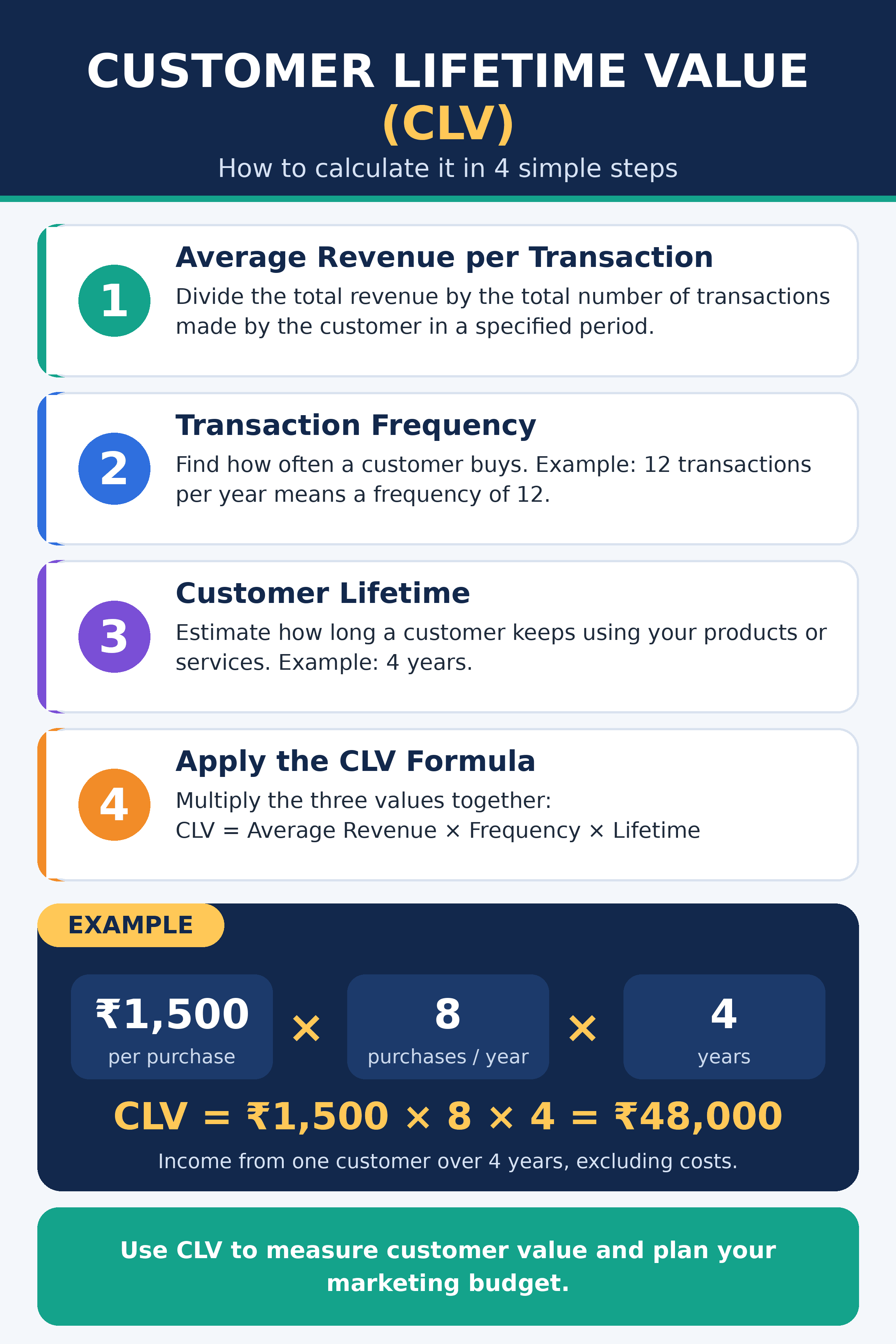
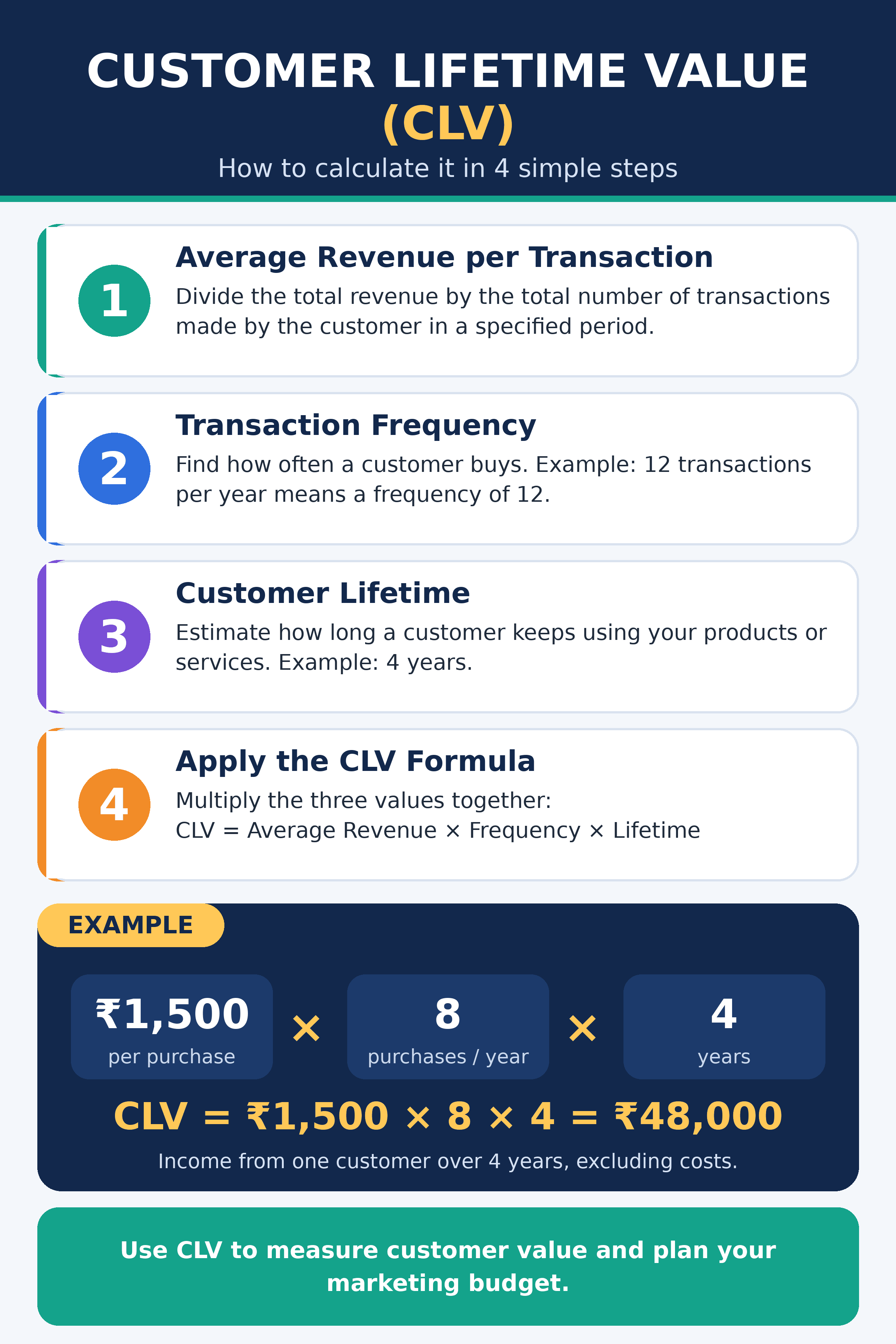
Step 1: Determine the average revenue from each transaction.
To do that, divide the total revenue by the total number of transactions made by the customer in a specified period.
Step 2: Establish the transaction frequency.
Now determine how frequently a customer visits the store to make a purchase. For instance, if the client makes 12 transactions per year, his or her transaction frequency would be 12 per year.
Step 3: Determine the customer's lifetime.
Calculate the duration for which a customer will continue to use the products/services of the business. Suppose, for instance, that the average lifetime of customers with the business is four years.
Step 4: Apply the CLV formula.
Example: Assume the spending per purchase is ₹1,500, and the frequency of shopping in a year is 8 and continues to remain so for 4 years.
CLV = ₹1,500 x 8 x 4 = ₹48,000
It means that you will be generating an income of ₹48,000 from one customer within four years, excluding costs incurred in the process. Through CLV, you can measure customer value and plan the marketing budget accordingly.
Customer Lifetime Value Calculation Example
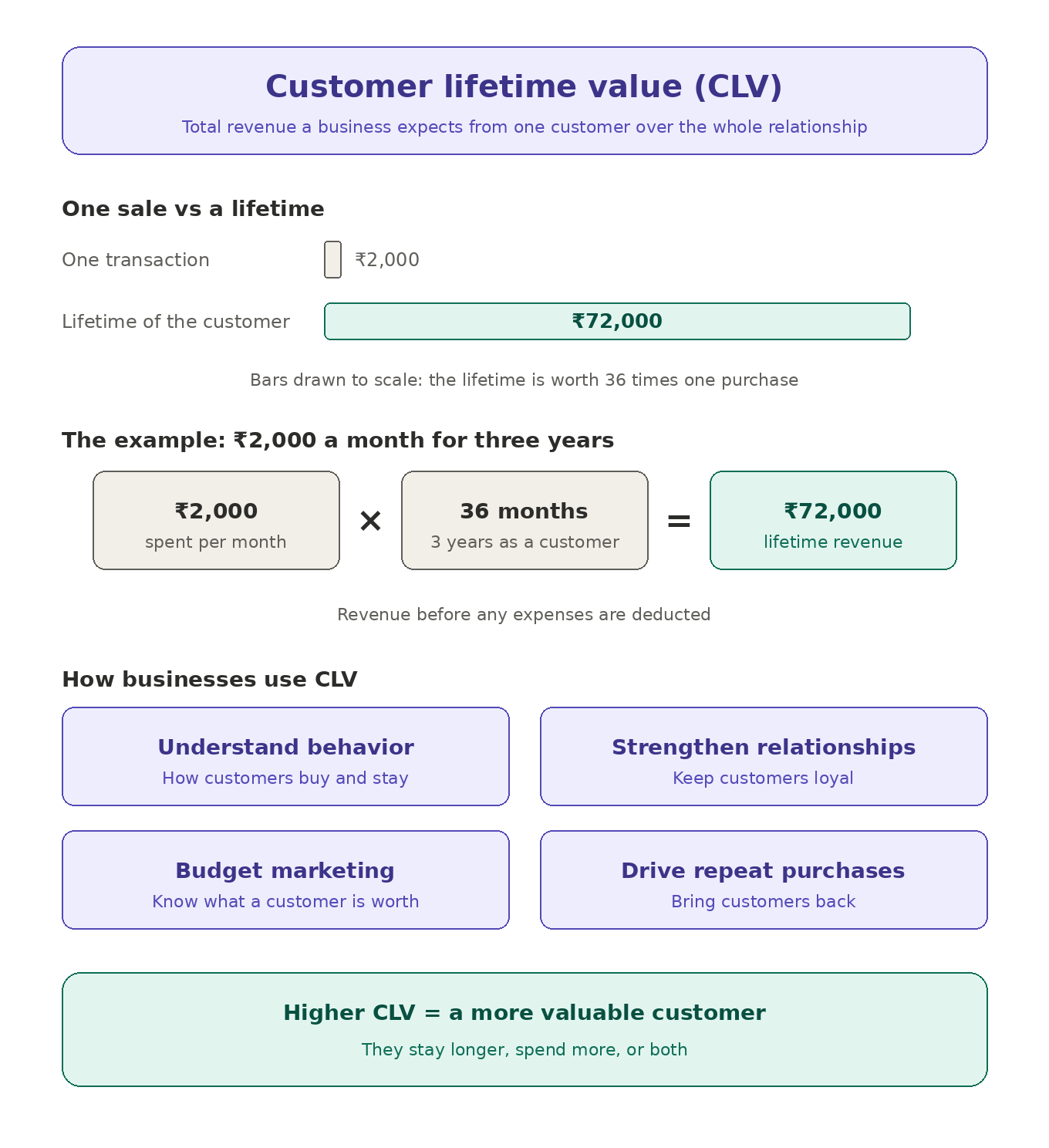
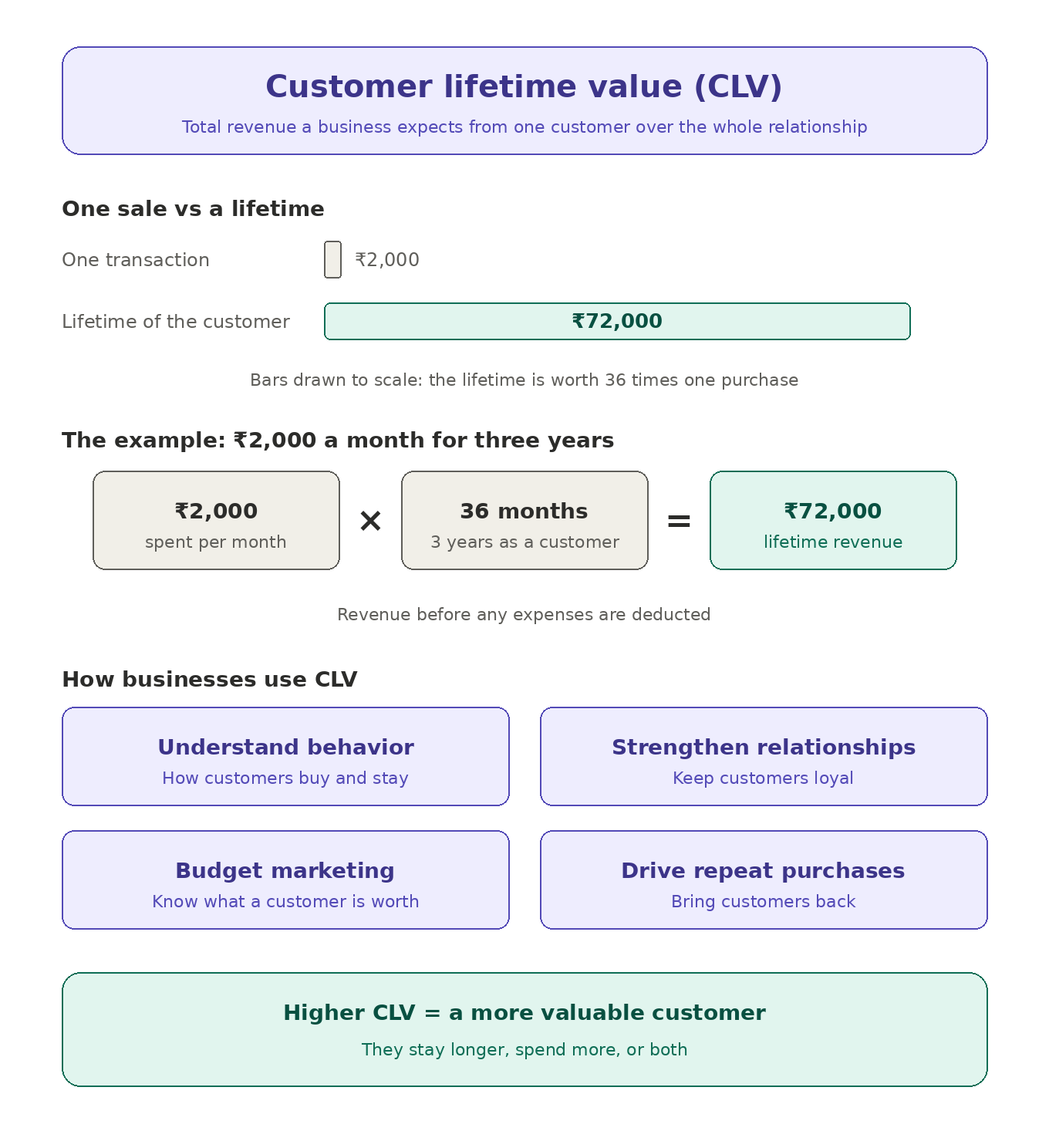
Let us understand the concept of Customer Lifetime Value through an example. You operate an online clothing store and wish to estimate the total amount of money that can be earned from one customer.
Here are the details:
Average Purchase Value: ₹2,000
Purchase Frequency: 6 times a year
Customer Lifespan: 3 years
Now, use the basic CLV formula:
CLV = Average Purchase Value × Purchase Frequency × Customer Lifespan
CLV = ₹2,000 × 6 × 3
CLV = ₹36,000
This means you can expect that your revenue per customer for the next three years is expected to be ₹36,000. The knowledge of this number will enable you to understand the value of your customers over time. It can be used to develop strategies on spending on marketing and building good relations with customers.
Why Is Customer Lifetime Value Important?
Customer lifetime value (CLV) allows companies to determine how much money a customer can generate for them in the long run. Rather than relying only on single purchases from a customer, companies can apply CLV to make better marketing and customer service decisions. Here are some key reasons why CLV matters:
Contributes to marketing budgeting: CLV will assist you in finding out how much to spend in order to acquire new customers and retain the existing ones.
Helps with customer retention: Knowing the value of the loyal customers will assist you in concentrating on pleasing them and acquiring orders from them again.
Identifies valuable customers: CLV will enable you to know the valuable customers who earn more for you and thus their preferences.
Facilitates effective decision making: With CLV, you can make good decisions about pricing, creating loyalty programs and offering products/services that the customers need.
Generates long term profitability: Creating relationships with your customers over time can yield you repeat sales and reduce costs of acquiring new customers.
Enables business growth measurements: Measuring CLV over time will reveal whether customers are spending more, staying for longer or are not interested in your business anymore.
In general, CLV helps you get out of your sales mindset and into a mindset focused on creating relationships with customers.
What Factors Affect Customer Lifetime Value?
There are several factors that determine the level of revenue that the customer will produce for the organization within a certain period of time. Knowing about these factors will enable you to learn why your customers remain loyal or why they go away. Here are the main factors that affect Customer Lifetime Value (CLV):
Retention rate: The longer customers stay loyal to your brand, the greater their CLV. Low retention rate can have an impact on CLV negatively.
Purchase frequency: High-frequency buyers will most likely create more value over time for your company.
Average order value: The higher amount that customers pay for each purchase, the higher their CLV can be.
Customer satisfaction: Customers with good experiences are likely to come back, refer your company to friends and establish a long-term relationship with your brand.
Quality of your product or service: Quality products/services make customers buy repeatedly and gain their trust.
Cost of customer acquisition (CAC): To acquire new customers, you have to spend some money. The CAC does not influence revenue-based CLV, but it definitely impacts the profitability of the relationship with a customer directly.
Marketing and loyalty programs: Offers made to the customer, as well as communication, can be used to make customers more loyal and eager to buy from you again.
Churn rate: The bigger number of people who stop being your customers or unsubscribe, the shorter the average lifespan of customers will be.
As a result of observing these elements, it will be possible for firms to know what makes the customer valuable and how to retain them and make repeat sales.
Understand Customer Value with IIM Bangalore’s Emerging Leaders Program Ready to make better business decisions and understand what drives long-term customer value? The IIM Bangalore Emerging Leaders Program (ELP) for Working Professionals helps you build practical knowledge of leadership, finance, customer value, strategy and data-driven decision-making. It can help you connect customer insights with broader business goals and prepare for greater responsibility in your organisation. Why choose this program? Build leadership skills to manage people, performance and conflict Strengthen your financial acumen and understanding of customer value Develop strategic thinking and data-driven decision-making skills Apply management concepts through The Arena, a live business simulation Work on a real organisational problem through a faculty-guided action learning project
|
How to Increase Customer Lifetime Value?
Increasing CLV is all about creating healthy customer relationships and giving people compelling reasons to return to you again and again. The happier that customers are with what you offer them, the more likely they are to purchase from you again and again. Here are some practical ways to increase CLV:
Improve the Customer Experience: Ensure that all customer interactions are easy and beneficial for them - whether it's surfing on your website, making a purchase or receiving support.
Make recommendations personal: Offer products, services and offers based on the likes and past transactions of customers.
Provide the customers with certain loyalty programs:
Offer them additional points or discounts for their every repeated purchase or subscription so that they keep coming back to you again and again.
Provide good customer support:
Respond promptly to the customers’ requests and provide them assistance whenever they want it.
Encourage repeat purchases through:
Giving them many options of communication through the emails and offers you send to them.
Provide great products or services: Provide what customers want. Quality builds trust in customers.
Get customers' feedback: Get feedback from your customers about your services or products or about anything else and use them for your benefit.
Find out how to reduce the number of customer churns: Find out the reasons why your customers stop using your products or services and fix those issues.
Make reasonable upsells and cross-sells: Offer your customers the products that suit their needs best.
The key is to focus on customer satisfaction and long-term value rather than just making more sales. Track CLV regularly to see which strategies work best and where your business can improve.
Knowing your CLV is useful, but it also helps to know how many customers you need just to cover your costs. You can work this out with a simple break even analysis
What Is a Good Customer Lifetime Value?
Your CLV depends on your industry, business model, profit margins and the cost of acquiring a customer. There is no standard CLV that applies to all businesses. The CLV that is considered good for a subscription business can be different from what is considered good for a retail business.
To assess if your CLV is good, you need to compare it to the cost of acquiring a customer. This ratio is called the Customer Lifetime Value to Customer Acquisition Cost ratio (CLV: CAC).
For instance, if your CLV is ₹30,000 while your CAC is ₹10,000, then your CLV:CAC ratio will be 3:1. That is, you make an estimated ₹3 for every ₹1 spent in acquiring the customer. The ratio of 3:1 is often considered a general benchmark, especially for SaaS and subscription-based companies. However, the ideal CLV:CAC ratio will depend on different factors including the cost of operations and recovery period of the company.
In order to know whether your CLV is good, compare it with the costs involved in customer acquisition and see whether the change over time will result in sufficient profit from the customers.
Conclusion
Customer Lifetime Value will give you an idea of how valuable a customer is to your business. With the calculation of CLV, you will be able to make better decisions when it comes to marketing and customer loyalty programs. It is all about making sure that you keep your customers satisfied, make them come back for more and provide them with the products or services they need.