
University Logo
Admissions Open for the 2026 Cohort
Phone1800 210 2020
IIMBx - Digital Learning Foundation

Organizational Behavior: Meaning, Models, Importance and Examples

By Anushwa Raj

Updated on Oct 28, 2026

Share:
  1. Home
  2. Blog
  3. Organizational Behavior: Meaning, Models, Importance and Examples

Organizational Behavior (OB) is the study of how individuals, groups, and organisational structures influence behavior, workplace relationships, and overall performance.  It is useful for the business organization to understand the motives of their employees, leadership, team spirit and working atmosphere and take managerial decisions based upon that.

  • There are three levels of organizational behavior which include individual behavior that studies about the motive and attitude of individuals, group behavior that studies about the teamwork and communication and organizational behavior that studies about the organizational culture and policies.

  • The five models of organizational behavior include: autocratic, custodial, supportive, collegial and systems. These models can be applied by any business organization in order to improve cooperation, involvement, leadership and conflict resolution within organizations.

This article explains the meaning, scope, three levels, five major models, importance, and practical examples of organizational behavior to help you understand how it influences everyday workplace decisions.

Ready to build your management knowledge and leadership skills? Explore the Certificate in General Management for Young Leaders to develop practical business insights, strengthen decision-making skills, and prepare for future leadership responsibilities.

What Is Organizational Behavior? Meaning and Definition

Organizational behavior (OB) is the study of how individuals, groups and organisational structures influence behavior in the workplace. It explains why employees respond differently to situations, how teams work together and how management practices shape workplace relationships and performance.

Drawing on psychology, sociology, anthropology and management, organizational behavior examines motivation, leadership, communication and decision-making. It helps managers understand employee behavior and create a work environment that supports both employees and organisational goals.

Key Characteristics of Organizational Behavior

Organizational behavior has several characteristics that distinguish it from the study of individual performance alone.

  • People-focused: It examines employees' attitudes, motivation, perceptions and actions at work.

  • Multidisciplinary: It uses ideas from different social sciences to explain workplace behavior.

  • Goal-oriented: It considers how employee behavior connects with organisational objectives.

  • Dynamic: Workplace behavior changes with leadership, team relationships, technology and organisational conditions.

  • Practical: Its concepts can help managers address communication gaps, conflict, low motivation and team performance.

Scope of Organizational Behavior in the Workplace

The scope of organizational behavior covers several aspects of working life. It helps explain what influences employees, how teams function and how the wider organisation shapes day-to-day activities.

Its main areas include:

  • Employee motivation: Understanding what encourages people to perform, learn and contribute.

  • Leadership: Examining how different leadership styles affect employees and teams.

  • Communication: Studying how information is shared and how misunderstandings arise.

  • Group dynamics: Understanding teamwork, group roles, collaboration and conflict.

  • Organisational culture: Examining shared values, workplace norms and accepted ways of working.

  • Change management: Understanding how employees respond to new systems, responsibilities or policies.

  • Decision-making: Exploring how individuals and groups assess information, solve problems and make choices.

Disciplines That Contribute to Organizational Behavior

Organizational behavior does not rely on one subject alone. Different disciplines explain different parts of workplace behavior.

  • Psychology: Helps explain personality, perception, learning, motivation, emotions and individual performance.

  • Sociology: Examines group relationships, organisational structures, workplace roles and power dynamics.

  • Social psychology: Explores how people influence one another, including communication, attitudes and group decision-making.

  • Anthropology: Helps explain organisational culture, shared values, customs and differences in workplace practices.

  • Political science: Contributes to the study of authority, power, workplace politics and conflict.

  • Management studies: Connects these ideas with leadership, planning, employee development and organisational performance.

Together, these disciplines help managers look beyond an employee's immediate actions and consider the personal, social and organisational factors that may influence them.

What Are the Three Levels of Organizational Behavior?

Organizational behavior is commonly studied at three levels: individual, group and organisational. Each level focuses on a different part of the workplace, but they are closely connected.

An employee's behavior may be influenced by personal motivation, the expectations of their team and the organisation's policies at the same time.
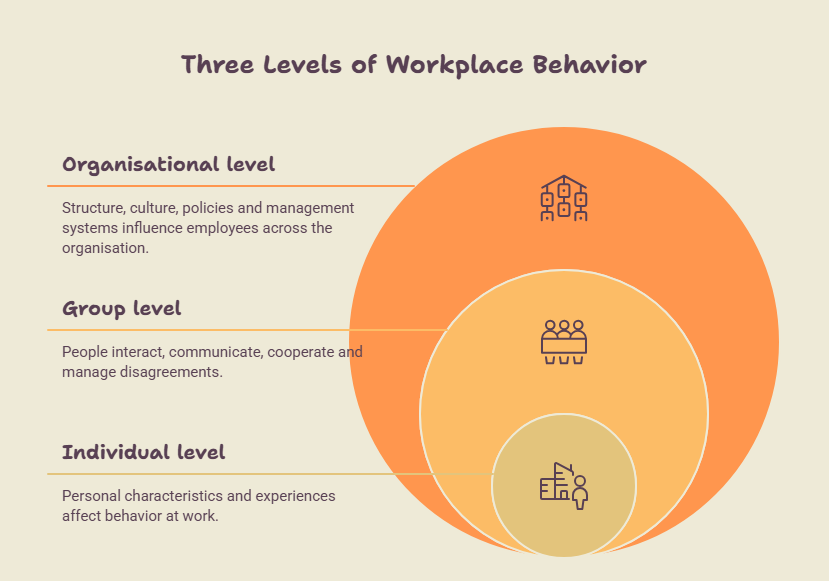
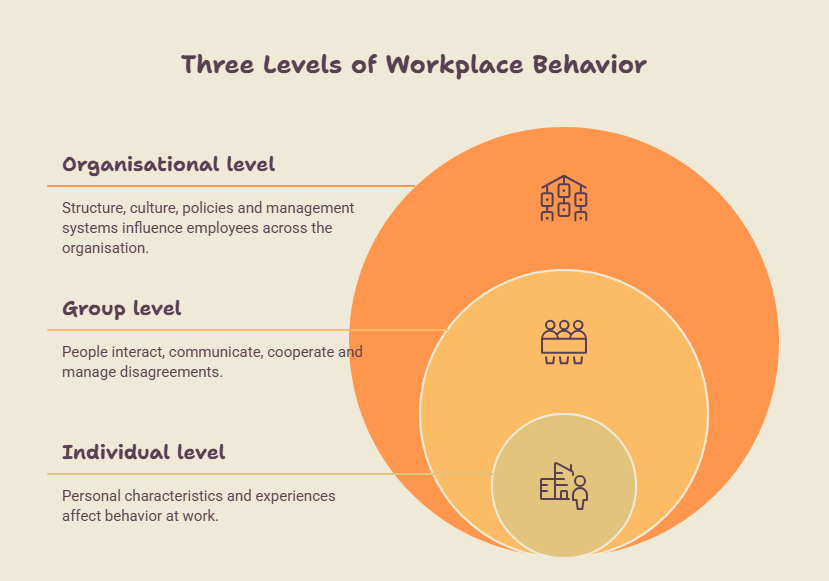
Three Levels of Workplace BehaviorThree Levels of Workplace Behavior

Individual-Level Organizational Behavior

At the individual level, the analysis is done on the basis of a single employee and factors that influence the behavior of this employee. They may include individual’s personality, values, attitude, perception, skills, motivation and experience.

For instance, an employee who is frequently provided with feedback may feel confident enough to deal with the tough assignments. The other one might require further clear instructions or sufficient time to gain the same confidence. This knowledge would help to adjust the style of communication for each person. 

Group-Level Organizational Behavior

At the group level, attention is paid to the behavior of individuals in the group.

Let’s consider a case when the marketing department prepares for launching the product. If everyone knows his or her responsibility and shares information, it will be easier to cooperate in the process. Otherwise, even qualified people may not be able to meet the deadline. 

Organizational-Level Behavior

The organizational level takes into account the external environment in which people perform their work. This includes organizational structure, working atmosphere, policies, power, resources, and management of changes.

For instance, the existence of clear lines of reporting and constant expectations for performance may facilitate the understanding of responsibilities of the employees. Frequent changes in policies and unclear decision-making process may confuse employees from various departments. 

Understanding organisational design can help explain how reporting relationships, decision-making authority and team structures influence employee behavior and workplace coordination.

What Are the Major Models of Organizational Behavior?

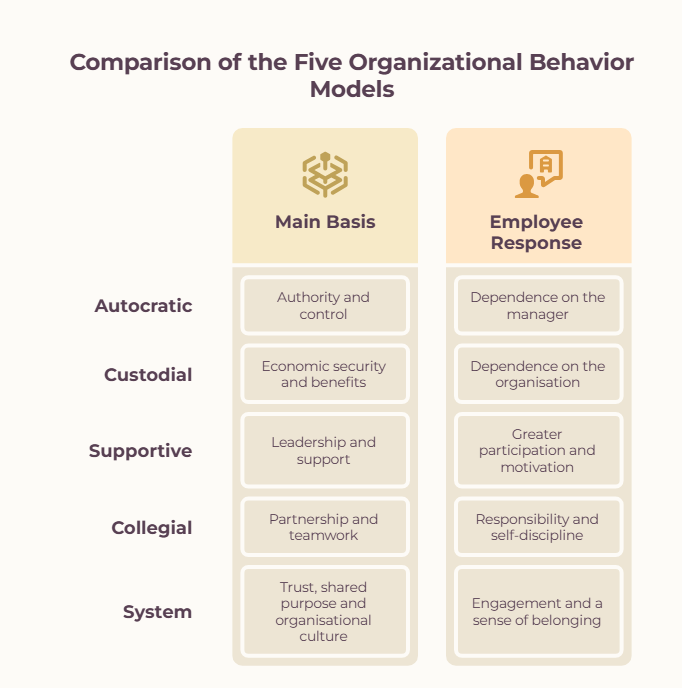
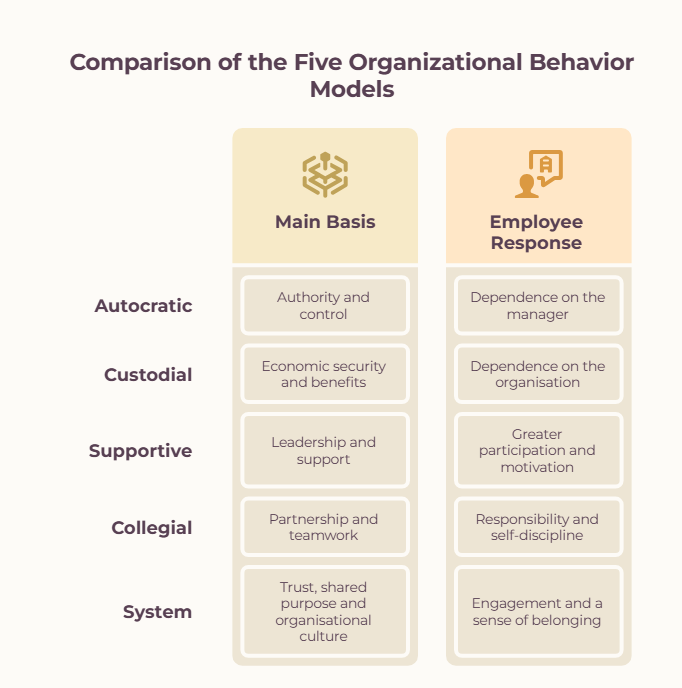
Organizational behavior models demonstrate the effect of management strategies on employee behavior and relationships in the workplace. There are five major models of organizational behavior: autocratic, custodial, supportive, collegial and system. 

Comparison of the Five Organizational Behavior ModelsComparison of the Five Organizational Behavior Models

1. Autocratic Model

The autocratic model relies on managerial authority and control. Managers make decisions and expect employees to follow instructions, leaving little room for participation.

Workplace example: A factory supervisor assigns tasks and gives direct instructions during an urgent production issue.

2. Custodial Model

The custodial model focuses on employee security through salaries, insurance and other benefits. It can improve job security but may not guarantee strong motivation.

Workplace example: A company offers health insurance, retirement benefits and a structured compensation package.

3. Supportive Model

The supportive model emphasises leadership, guidance and employee development. Managers help employees overcome challenges and perform better.

Workplace example: A team leader provides regular feedback and helps employees access the resources they need.

4. Collegial Model

The collegial model promotes teamwork, mutual respect and shared responsibility. Employees collaborate and take ownership of their work.

Workplace example: Designers, developers and marketers work together to plan a new product feature.

5. System Model

The system model focuses on trust, shared values, employee well-being and a sense of purpose.

Workplace example: A company encourages employee feedback, supports professional growth and connects individual contributions with organisational goals.

Why Is Organizational Behavior Important in an Organization?

Organizational behavior helps businesses understand employee actions, motivation and workplace relationships. It enables managers and employees to improve communication, resolve conflicts, strengthen teamwork and adapt to change. 

  • Improves employee motivation: Understanding employees' needs can help managers choose suitable ways to recognise effort, provide feedback and encourage development.

  • Strengthens teamwork: Knowledge of group dynamics helps teams coordinate tasks, manage disagreements and share responsibilities.

  • Supports effective leadership: Managers can adapt their approach to employees' needs, the nature of the work and the situation.

  • Helps manage workplace conflict: Understanding perceptions and communication styles can make it easier to identify the cause of disagreements.

  • Supports organisational change: Knowing why employees may resist new processes helps managers communicate changes and address concerns.

  • Improves decision-making: Organizational behavior encourages managers to consider employee responses, team relationships and workplace culture before making decisions.

Practise Through Role-Playing and Workplace Scenarios

Role-playing helps employees practise handling workplace situations, such as team disagreements, performance reviews and changes in responsibilities. It allows them to understand different perspectives and improve their communication skills.

Example: A manager practises giving feedback about missed deadlines while listening to the employee's concerns and discussing possible solutions.

Review Past Negotiations and Identify Areas for Improvement

Reviewing past negotiations helps employees identify communication gaps, misunderstandings and approaches that could have worked better. This can help them handle future discussions about deadlines, workloads and responsibilities more effectively.

Seek Feedback and Learn Different Negotiation Approaches

Feedback helps employees understand how their communication and behavior affect others. By listening to suggestions, considering different viewpoints and practising active listening, they can improve workplace relationships and resolve disagreements more constructively.

Conclusion

Organizational behavior is the topic that explores the impact of individuals, groups and systems of an organization on the way of work performed by employees. The topic covers three levels and five major models along with the theories associated with them to examine such things as motivation, leadership and teamwork in an organization.

As far as a business is concerned, the most crucial aspect is related to the application of the discussed above concepts into practice. Analyzing such factors as needs of the employees, communication and interactions within a team and an organization, it will be possible for a manager to make wise decisions to develop the organizational atmosphere of responsibility.

Anushwa Raj

Anushwa Raj

SEO & Content Marketing Specialist

4+ of articles published


Current role in the industry :

Consultant

Education Qualification :

B.Com Hons. with Research

About

Anushwa Raj is an SEO and content marketing professional at upGrad, working across SEO articles, website copy, keyword research, and content strategy. She enjoys creating reader-first content that balances search intent with clarity, making complex topics simple, useful, and engaging.

Follow me on :

No blogs published yet.

Latest Blogs

minimum viable product
Nov 1st, 2026

minimum viable product

A Minimum Viable Product (MVP) refers to the most fundamental form of a product with basic features, intended to prove an idea among initial users.

Read More
PESTEL Analysis: 6 Factors, Framework & Examples
Nov 1st, 2026

PESTEL Analysis: 6 Factors, Framework & Examples

Learn what PESTEL analysis is, explore its six key factors, understand how the framework works, and discover examples, benefits, and limitations.

Read More
Supply Chain Management: Meaning, Process and Benefits
Nov 1st, 2026

Supply Chain Management: Meaning, Process and Benefits

Learn what supply chain management means, how it works, its five stages, different models, key benefits, common challenges, and ways to improve efficiency.

Read More

Frequently Asked Questions

General

Copyright 2026 of [University Name]