

Key Highlights
Organisational design refers to how an organisation structures its functions, processes, roles, decision rights, competencies, and reporting lines to achieve its goals.
It is the approach which determines the way in which a company functions, in terms of collaboration, decision making, and responsibility.
The right organisational design takes care of structure, processes, competencies, culture, and changing business demands.
Good organisational design assists companies to increase coordination, determine responsibilities, take decisions, and adapt themselves to changing circumstances.
In this blog, you’ll explore designing organisational structure, key elements, principles, types, influencing factors, step-by-step process, real-life examples, and common mistakes in organisational design.
Ready to strengthen your business knowledge and leadership capabilities? Explore the IIMBx Certificate in General Management for Emerging Leaders and gain practical insights to navigate business challenges, make informed decisions, and prepare for greater leadership responsibilities.
What Is Organisational Design?
Organisational design is the process of aligning a company on how should it be set up, what will be the hierarchy and how people should work together to achieve its goals.
Organisational design is important because it looks at things like:
Who work in what role
Who reports to whom
Who makes which decisions
How different teams work together
How work moves from one team to another
What skills each team needs
In simple terms, organisational design answers questions like “Who is responsible for this?”, “Who makes the decision?”, “Which teams need to work together?” and “How should the work flow?”
Organisational Design vs Organisational Structure
Though these two terms may look similar, they have separate meanings.
Organisational design is deciding how the whole organisation should work, whereas
organisational structure is about how people and teams are arranged within that organization.
Organisational structure describes the formal arrangement of roles, teams, reporting relationships, and authority. Organisational design is broader because it considers how that structure fits with strategy, processes, capabilities, culture, and the way work gets done.
A structure can look neat on paper. It still might not work well in practice.
Also read: Strategic Management: Process, Importance & Examples
Key Elements of organisational Design
There are few basic elements which shapes how an organisation words as a structure. The elements are inetrconnected so one is dependent on the other.
Here are the key elements:
Organisational structure: It defines how people and teams are organised. Teams may be arranged according to functions performed, products produced, locations, customers, or a combination of all.
Roles and responsibilities: This determines the tasks that should be performed by specific persons and teams. Well-defined roles help avoid confusion about ownership of a certain task.
Decision rights: It tells us who has the authority to make what decisions. For example, who approves a budget, sets product priorities, or handles a customer issue?
Reporting relationships: This is to clarify who report to whom. It helps build accountability and facilitates understanding of the information flow in the organization.
Processes and workflows: Specifies how information flows between individuals and teams. For example, a request of a customer will go through stages such as sales, operations, accounting, delivery, and support.
Capabilities: Refer to the skills and knowledge necessary to accomplish organisational objectives. The right teams need the right expertise.
Span of control: Refers to the number of direct reports to a manager. Too many direct reports can hinder the ability of a manager to effectively assist his/her team.
Organisational layers: Shows how many managerial levels are between employees and senior managers in an organization. Too many layers hamper communication and decision-making.
Must read: What Is Management? Meaning, Functions & Importance
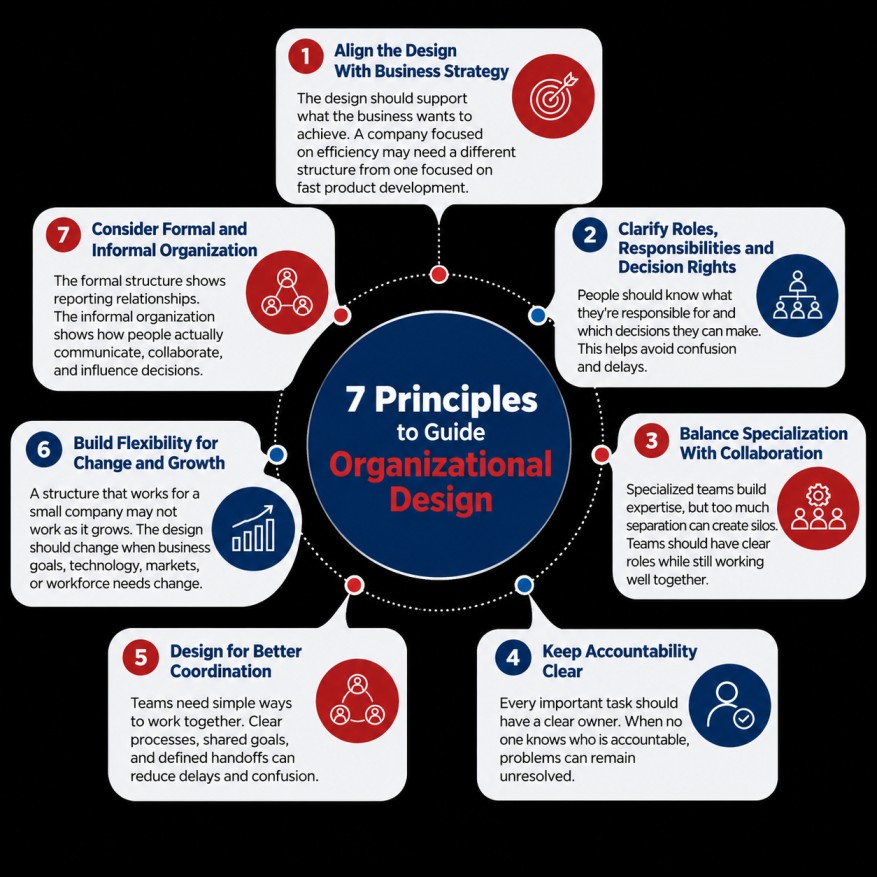
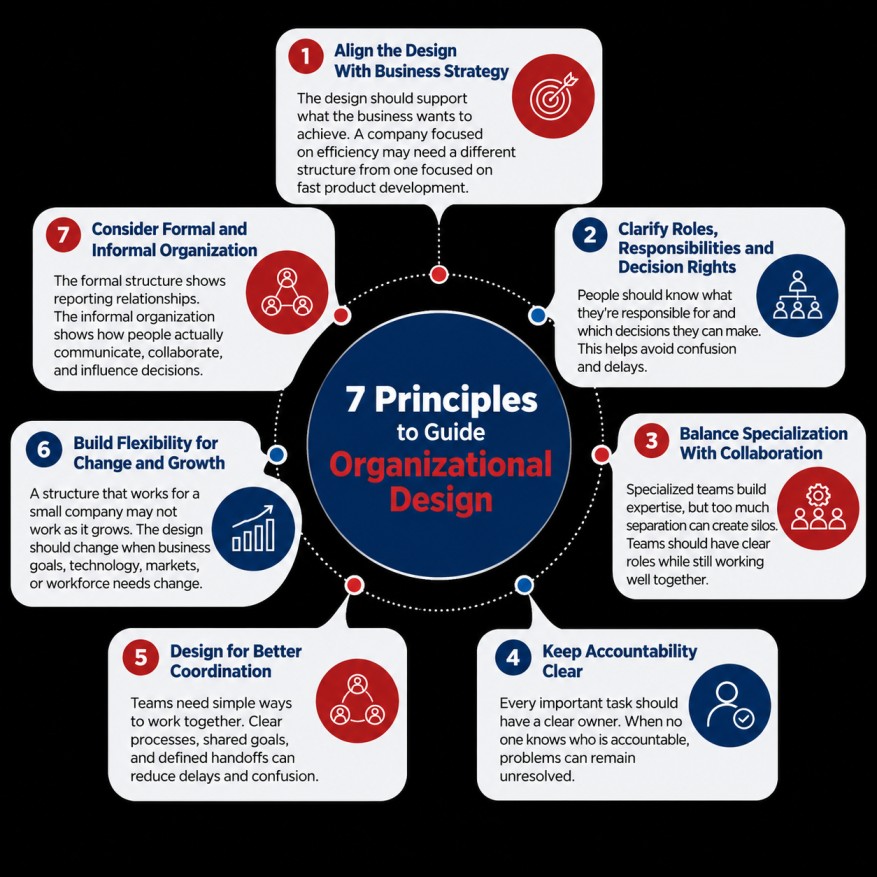
7 Principles to Guide organisational Design
A working organisational design needs a few practical principles. These principles helps leaders to make choices about structure, authority, roles, and workflows without any confusion.
Here are the 7 basic principles: