IIMBx - Digital Learning Foundation

SWOT Analysis: Meaning, Template and Examples for Businesses

Key Highlights

A SWOT analysis is a framework that helps businesses evaluate their position from the point of view of four standpoints.

  • SWOT analysis full form is Strengths, Weaknesses, Opportunities, and Threats. 

  • Strengths and Weaknesses are the internal factors that come from within the business, and Opportunities and Threats are the external factors that come from outside of the business.

  • SWOT analysis helps businesses to make clear and informed decisions, set their priorities, and find out the blind spots in their business before they can turn into a problem.

In this blog, you’ll learn SWOT analysis meaning, its four components, and the steps involved in conducting one, a ready-to-use template, business examples, common mistakes, benefits, limitations, and swot analysis example.

Do read: Performance Management Process: Steps & Best Practices  

What Is SWOT Analysis, Its Importance and When to Use It

SWOT analysis is a strategic planning framework that helps to find out a business’s internal strengths and weaknesses alongside external opportunities and threats.

Internal factors are those that you can control in the business, like your team, brand reputation, etc. External factors are those factors which come from outside your business, like market trends, competitor moves, etc.

These four factors help to scrutinise the business. This evaluation helps to find out the current position of your business in the market.

Why is SWOT analysis important?

Here is how SWOT analysis helps businesses:

  • It helps you identify competitive advantages of your business over your competitors.

  • It tells you areas in your business that need to be improved.

  • It enables you to see business opportunities and threats. This helps you come up with contingency plans.

  • It helps you identify and use your resources better. When you know your strengths and weaknesses, you use them judiciously.

  • It also helps to determine your priorities before making investments.

  • It helps to determine the business objectives.

  • It helps you make decisions rationally and not based on assumptions. Especially when your business needs big decisions.

When should a business use SWOT analysis?

You can use SWOT analysis when launching a product, reviewing performance, planning expansion, or responding to changing customer needs. You can also use it to find out factors responsible for your sales decline or when a competitor introduces a new feature or product.

Must read: Leadership and Management: Meaning, Skills & Importance  

What Are the Four Components of SWOT Analysis?

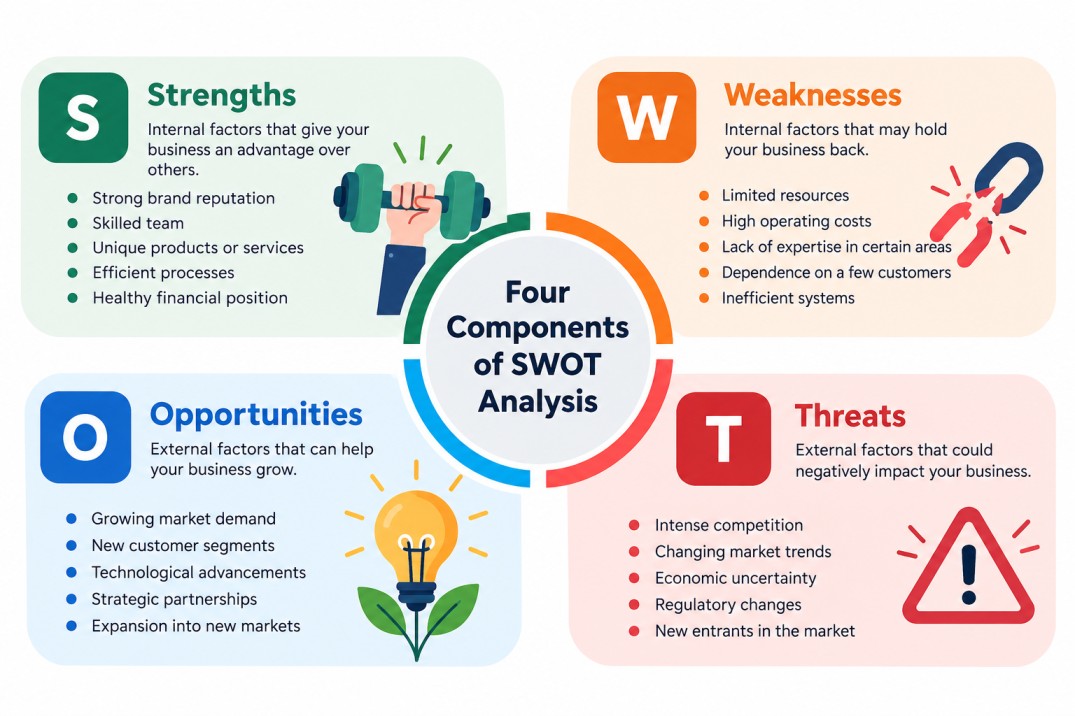
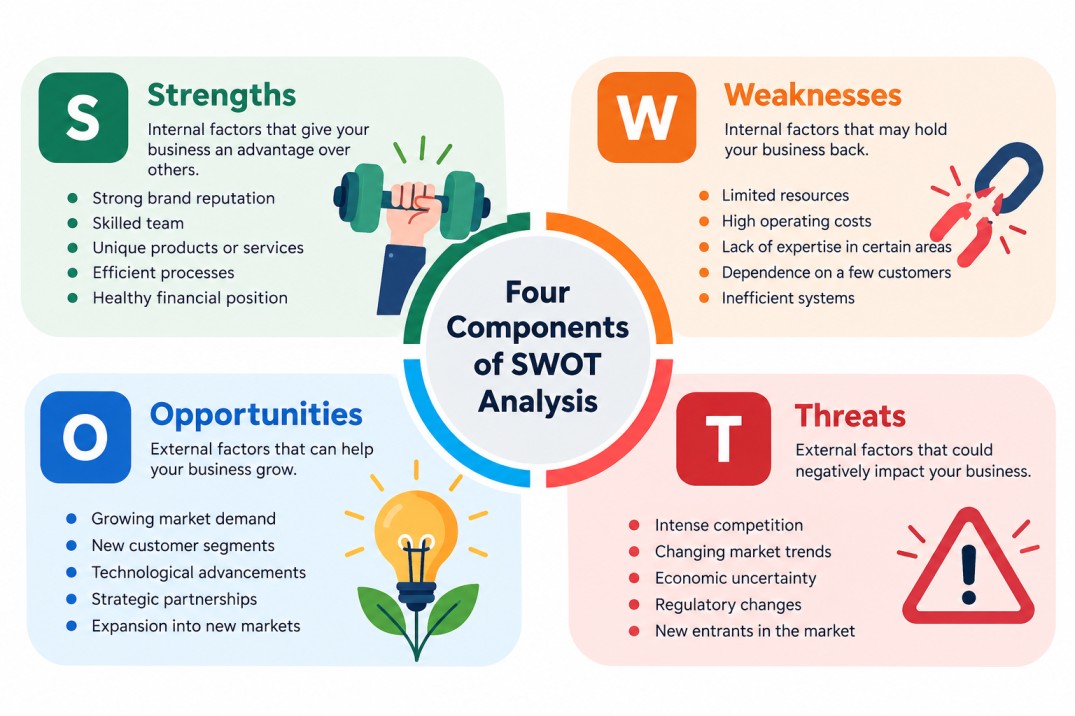
The SWOT analysis comprises the following elements: strengths, weaknesses, opportunities, and threats.


SWOT analysis infographic illustrating the four components: strengths, weaknesses, opportunities, and threats, with business-related examples of each factor.

Strengths

Strengths are the factors that make your business better than other competitors, like a loyal customer base or being the best product in this segment. It's the attributes which are the USPs of your business. 

The questions to be asked while evaluating your strengths:

  • What do we do better than our competitors?

  • Do we have any special features (unique skills, technology, or assets, etc.) that distinguish us from the others?

  • Why do customers choose us?

Weaknesses

Weaknesses are internal factors that limit your business’s performance. These are the attributes your business has that are causing it not to perform well, like your competitors, outdated equipment, low brand awareness, etc. You have to be honest here and find out where your weaknesses lie.

This evaluates the areas of your business that need work. 

The questions to be asked while evaluating your weaknesses:

  • Where do we lack resources, skills, or processes?

  • What do customers complain about?

  • What do competitors do better than us?

Opportunities

These are areas which you can extend your business to, or benefit from. These are external factors like rising demand for a product, a growing customer segment, etc. 

This lets you explore areas where you can gain an advantage. 

The questions to be asked while evaluating your opportunities:

  • Are there emerging market trends we can benefit from?

  • Is there an underserved customer segment?

  • Could new technology, partnerships, or regulations work in our favor?

Threats

These are the factors that can harm your business directly or indirectly. Like the rise of a new competitor or rising supplier prices,etc. These are external factors which can make an impact on your business’s performance. You cannot influence all of them, but evaluating them will provide you with a chance to be prepared for them.

The questions to be asked while evaluating threats:

  • Are there any new rivals on the market?

  • Have customer tastes or market conditions changed?

  • Could regulations, economic changes, or supply disruptions affect us?

Build Your Leadership Skills with IIM Bangalore’s Young Leaders Programme

Ready to strengthen your management skills? The IIM Bangalore Young Leaders Programme (YLP) for Working Professionals helps you build practical business knowledge and improve your ability to manage teams, handle processes, and make informed business decisions.

Why choose this program?

  • Build essential management and leadership skills

  • Learn practical business concepts

  • Improve your decision-making abilities

  • Strengthen your approach to managing teams and processes

  • Apply your learning to real-world business situations

How to Conduct a SWOT Analysis Step by Step

As the first step, get people from various departments such as sales, operations, finance, marketing, and customer service. This is necessary as everyone has a different point of view and together their thoughts will be less biased. Here is a practical step-by-step process on how you can do a SWOT analysis of your business:


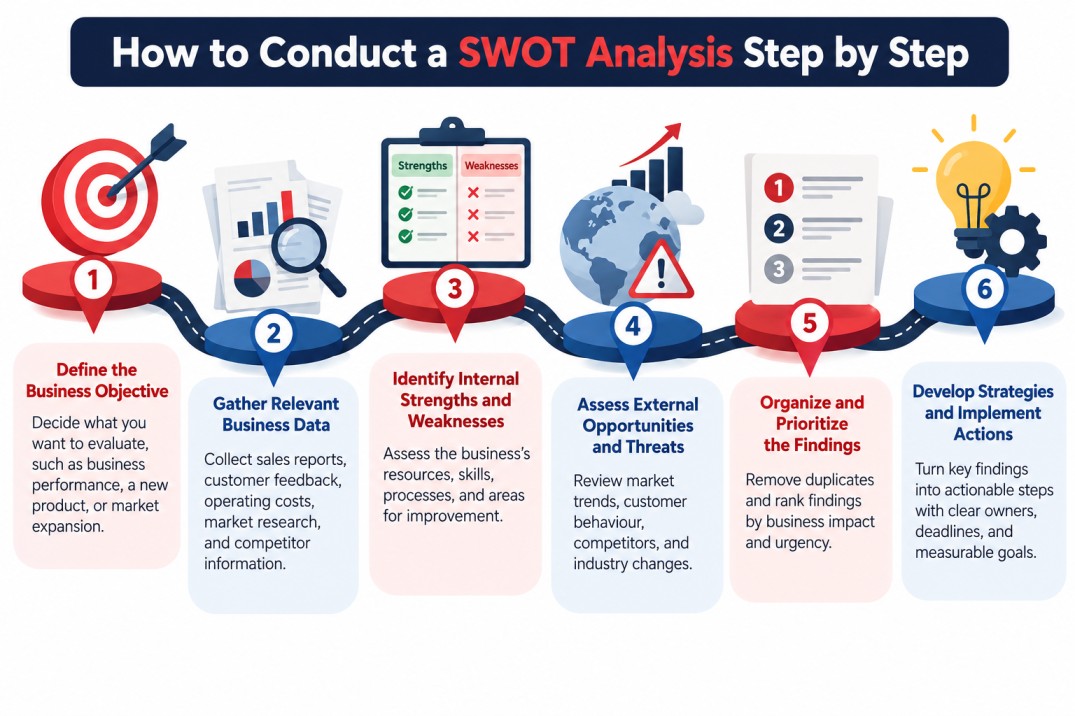
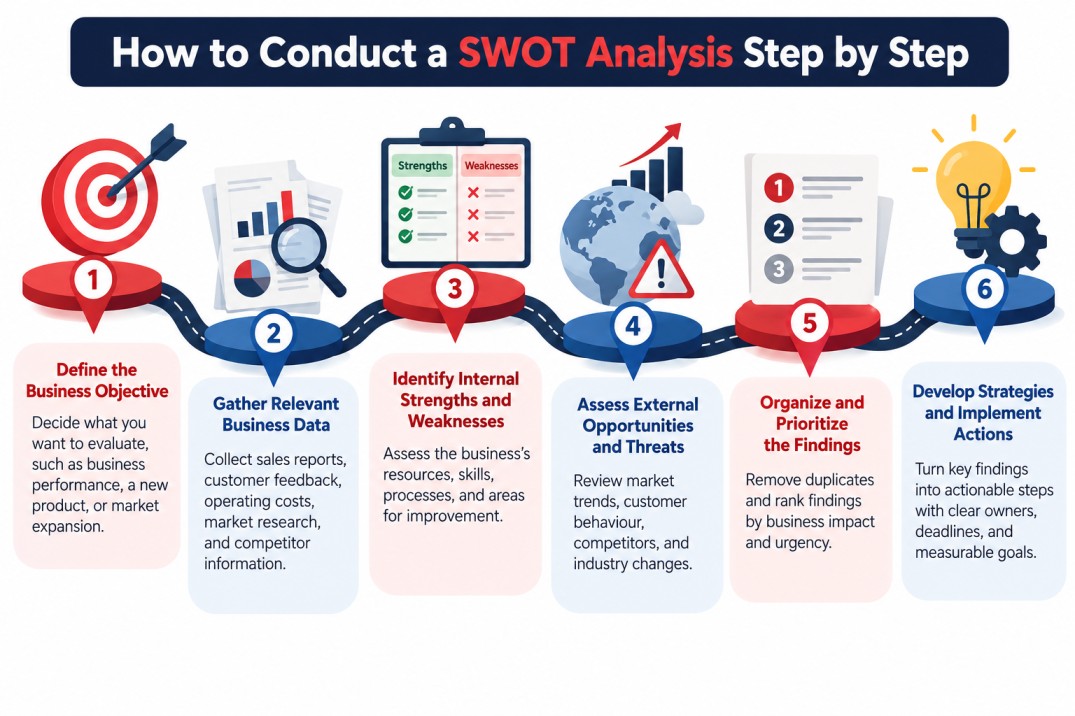
Step-by-step infographic showing how to conduct a SWOT analysis, from defining business objectives and gathering data to assessing internal and external factors, prioritizing findings, and implementing strategies.

Step 1: Define the business objective

Before performing your SWOT analysis, it is important to establish the purpose of that analysis. Why are you conducting your SWOT analysis? Perhaps you are introducing a new product or you need it for a marketing campaign? When you reach a conclusion here, your objective becomes clear. A vague objective will waste your time and efforts and won't get the results you want.

For example, a question such as "Should we open a second store?" is a direct question rather than “how the business is performing”.

Step 2: Gather all relevant business information

As the next step, collect all necessary data about the business. It should include sales data, customers' feedback, employees' feedback, cost of operations, market research, and competitors' information. Take only data as the basis of the evaluation and not assumptions. Don't take into consideration people’s opinion here as this works for only facts.

For example, the statement “customer service is our strength” needs to be backed up by rating scores, repeat orders, and complaints to determine whether there is evidence for that statement.

Step 3: Identify Internal Strengths and Weaknesses of your Business 

To start with, look within the business organization and discover what your business is good at and where it lacks. You should evaluate the resources, skills and processes.

For example, 

Internal Strengths: Good brand name, talented employees, innovative technology, customer loyalty

Internal Weaknesses: Small budget, outdated systems, lack of skills, dependence on few clients

Step 4: External Opportunities and Threats Analysis

Analyze market trends, consumer behavior, competition, technology, regulation, and the economic environment. Look for the opportunities that your business can tap into. 

Also look for what future threats can come your way. It is very important to predict and evaluate threats so that you can come up with strategies to tackle them. 

For example, 

Opportunities: Rising demand, new technology, underserved markets, partnership options

Threats: New competitors, price wars, regulatory changes, economic uncertainty

Step 5: Prioritize and structure the analysis

When you start a SWOT analysis, you will get a lot of answers. Don't just place them in your matrix before carefully considering them. Select the answers which are backed by data. Remove any observations which seem irrelevant. Rank them by their urgency. Each quadrant should be very precise and clear.

Businesses can also use Porter's Five Forces model to understand industry competition, assess competitive pressures and evaluate their market position.

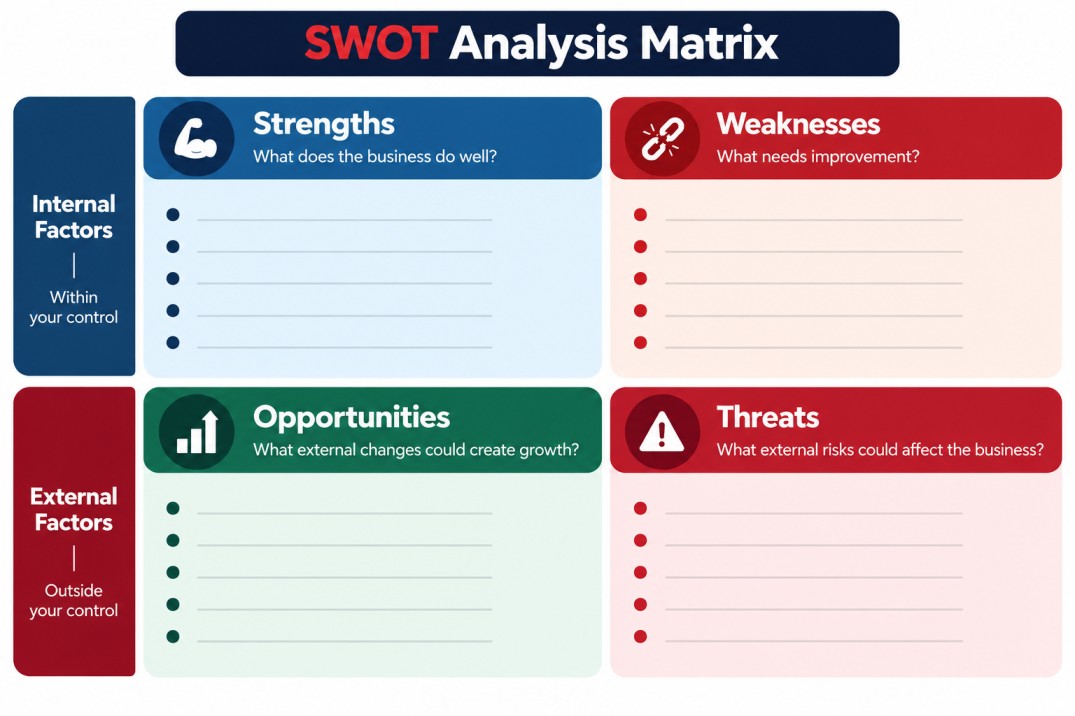
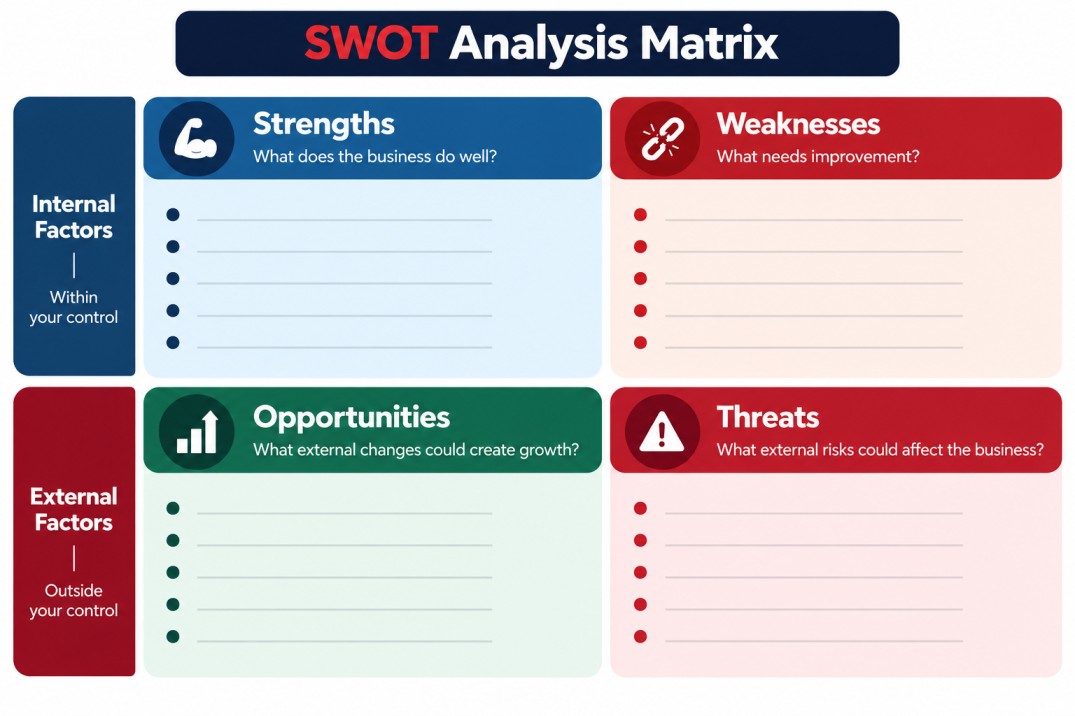
Blank SWOT analysis matrix template with four quadrants for strengths, weaknesses, opportunities, and threats, categorized into internal and external business factors.

Step 6: Develop business strategies and take action

After analyzing your findings, you should begin forming a strategy about what follows next.

To put these findings into a broader business context, companies can also use the Business Model Canvas to map their value proposition, customer segments, key activities, and revenue streams.

You can start by assigning owners to each activity, setting a deadline, and determining a result that needs to be measured for each item on the list by priority. Taking action and implementing the findings is the main goal of your SWOT analysis.

If you apply the four quadrants of SWOT analysis in the way described here when creating your strategy, you'll receive better results:

  • Strengths + Opportunities: Use your strengths to capitalize on opportunities.

  • Weaknesses + Opportunities: Address internal weaknesses so that you can take advantage of opportunities.

  • Strengths + Threats: Use your strengths to reduce or neutralize threats.

  • Weaknesses + Threats: Reduce weaknesses and eliminate threats.

The final step will be to do this at least once or twice a year to plan for the next. The SWOT analysis will only be correct if the data or the information used for SWOT analysis is true. If there is any bias or it's an assumption, it won't give you the correct information. 

Ready to strengthen your leadership and management skills, the IIMBx Certificate in General Management for Emerging Leaders  can help you develop practical capabilities in leadership, decision-making, strategy, and business management.  

SWOT Analysis Template for Businesses

A SWOT analysis template gives you a ready-made structure. You can create this on a whiteboard, spreadsheet, or a doc file. 

Basic SWOT analysis template

Strengths

Weaknesses


Opportunities

Threats

Detailed Template With sample questions

You can use these guiding questions to fill in each quadrant: 

Strengths

Weaknesses

What can we do better than our competitors? 

What special resources or capabilities do we have? 

What do our customers appreciate about us?

Where are we lacking in skills, funds, or technology? 

What do our customers criticize? 

Where are we inefficient?

Opportunities

Threats

What market trends are working to our advantage? 

Who are the underserved customer groups? 

Will any technological change benefit us?

Who are the new competitors we face?

Are there changes in cost, regulation, or customer preference to consider?

Action-Oriented SWOT Template (With Priority and Owner)

Adding priority and ownership turns your SWOT from a list into a working plan.

Factor

Description

Impact (High/Med/Low)

Action Required

Owner

Deadline

Strength

Weakness

Opportunity

Threat

TOWS Matrix: Turning SWOT Into Strategy

Once your quadrants are filled in, use this matrix to combine them into strategic actions.

Opportunities

Threats

Strengths

SO Strategies: Use strengths to capture opportunities

ST Strategies: Use strengths to reduce threats

Weaknesses

WO Strategies: Fix weaknesses to take advantage of opportunities

WT Strategies: Minimize weaknesses and avoid threats

Also read: What Is Management? Meaning, Functions & Importance  

Real-Life SWOT Analysis Examples

Here are SWOT analysis examples of well-known brands to show how businesses evaluate their strengths, weaknesses, opportunities, and threats. 

1. Amazon 

Strengths

Weaknesses

Strong global brand recognition

Complex operations across multiple business segments

Extensive logistics and distribution network

High costs associated with fulfilment and infrastructure

Diverse revenue streams, including cloud services

Dependence on maintaining reliable delivery and service quality

Opportunities

Threats

Expand cloud computing and AI services

Intense competition across retail and technology

Grow digital services and subscription offerings

Regulatory scrutiny and antitrust challenges

Improve delivery efficiency through automation

Changing consumer spending and rising operating costs

Key takeaway: Amazon can use its well-built distribution system along with technology to increase efficiency and stay ahead of other competitors.

2. Apple 

Strengths

Weaknesses

Strong brand loyalty

Premium pricing limits affordability for some customers

Integrated hardware, software, and services

Significant dependence on iPhone sales

Established ecosystem of connected devices

Closed ecosystem can limit customer flexibility

Opportunities

Threats

Expand services and subscription offerings

Strong competition in smartphones and consumer electronics

Reach more customers in emerging markets

Regulatory pressure on app distribution and platform policies

Develop new AI-powered features and services

Supply chain disruptions and changing technology preferences

Key takeaway: Apple can benefit from their loyal customers, providing more services and keeping in touch with them according to changes.

Must read: Business Continuity Management: Process and Importance  

3. Starbucks 

Strengths

Weaknesses

Recognizable global coffeehouse brand

Premium prices may discourage price-sensitive customers

Established customer loyalty

High costs associated with operating physical stores

Broad product range and store network

Maintaining consistent service across locations can be challenging

Opportunities

Threats

Expand digital ordering and loyalty programmes

Competition from coffee chains and independent cafés

Introduce products suited to local preferences

Fluctuating coffee and other ingredient prices

Improve store efficiency and customer experience

Changes in consumer spending and beverage preferences

Key takeaway: Starbucks can please customers by increasing its service quality, introducing new products, and controlling costs.

Also read: What Is Slack in Project Management? Types & Calculation  

Benefits and Limitations of SWOT Analysis

Here are the benefits and limitations of SWOT analysis:

Benefits

Limitations

Helps to prioritize.

It depends on the quality of the data available.

Points out problems internally as well as externally.

The results can be based on opinions, not facts.

Promotes cooperation.

The ranking of priorities is not automatic.

Shows possible opportunities for expansion.

It does not address the underlying cause of issues.

Assists in product development decisions.

May require additional research to validate findings.

Suitable for businesses of various sizes.

Needs regular updates as conditions change.

Also read: What Makes a Good Leader? 10 Essential Qualities and Skills  

Common SWOT Analysis Mistakes and How to Avoid Them

Even a neatly completed matrix can lead to poor decisions if the information behind it is weak. Here are the common mistakes and how to avoid them:

Common Mistake

How to Avoid It

Being too vague

Use evidence, such as customer satisfaction scores or repeat purchase rates.

Confusing internal and external factors

Classify staff expertise as an internal strength and growing market demand as an external opportunity.

Listing too many factors

Focus on findings that directly affect your objective.

Ignoring evidence

Validate assumptions using sales records, customer feedback, and market research.

Failing to act

Assign responsibilities and deadlines to turn findings into measurable actions.

A SWOT analysis should also be reviewed when business conditions shift. Don't treat an old matrix as a permanent picture of the company.

Also read: Business Process Management: Types, Lifecycle & Benefits  

Conclusion

The usefulness of SWOT analysis lies in the fact that it enables businesses to evaluate their position and to understand the threats and opportunities they have. The significance of the technique does not consist in making a matrix but rather in the decisions that can be made based on it.

There should be a purpose; there should be good data and relevant findings, which then need to be implemented into action and evaluated.


Latest Blogs

minimum viable product
Nov 1st, 2026

minimum viable product

A Minimum Viable Product (MVP) refers to the most fundamental form of a product with basic features, intended to prove an idea among initial users.

Frequently Asked Questions

General