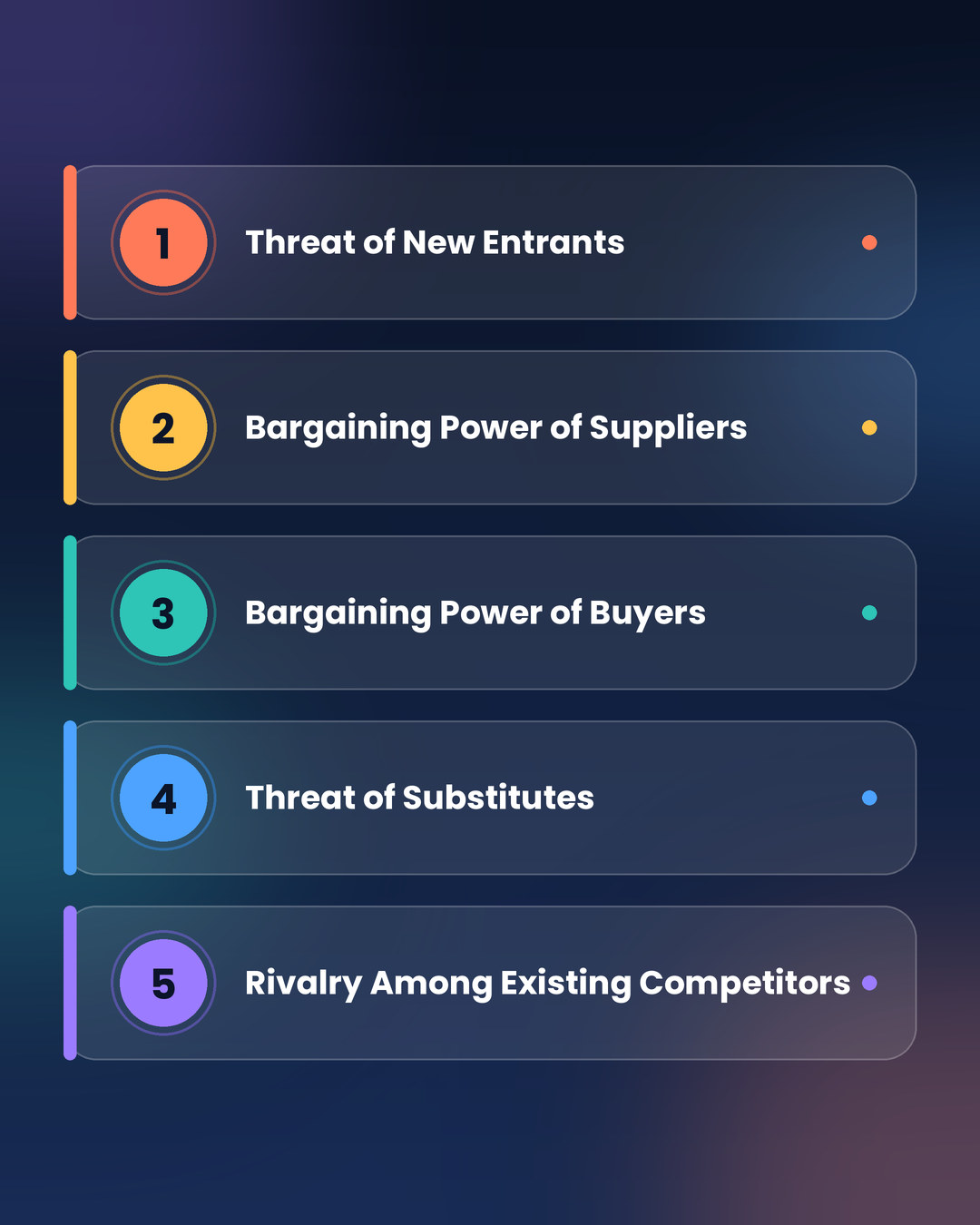
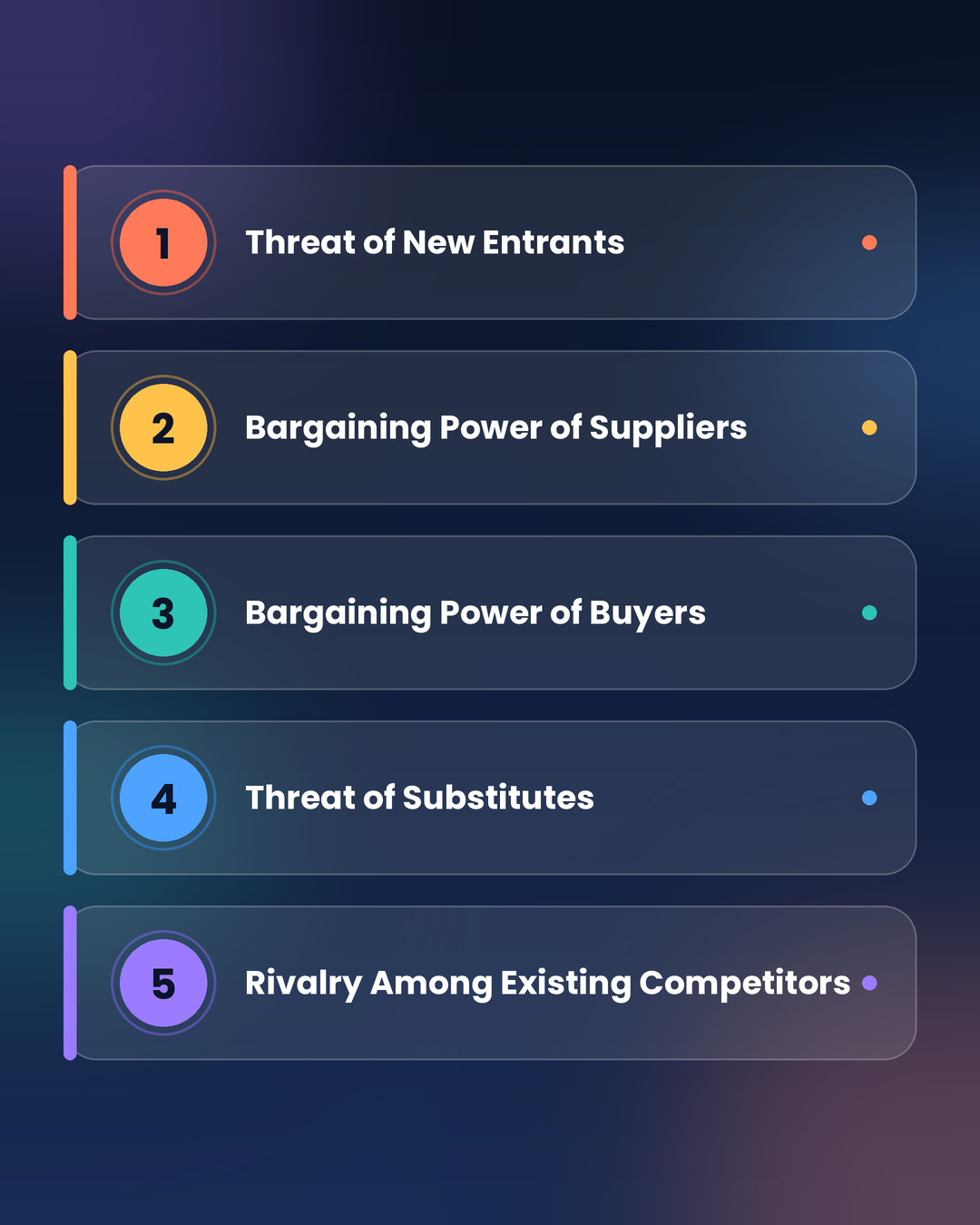
1. Threat of New Entrants
This force focuses on the ease of entry by new firms into the market and the ability to attract customers.
The threat is high where there are low capital requirements, easy regulations and customers have an easy time switching.
The threat is low where there is high capital requirement, strong brands, licenses or economies of scale.
Regulations, patents and access to distribution channels determine the difficulty of entering the market.
Where there is easy entry by new players, the prices fall and profit margins reduce.
2. Bargaining Power of Suppliers
The force considers the degree of bargaining power that the suppliers can control in determining the price and quality of the products or services offered.
Supplier power is high if the number of suppliers is low and if the product offered by the supplier is unique or difficult to substitute by other suppliers.
Supplier power is low if there are many suppliers and the inputs are easily substituted.
Suppliers with bargaining power will increase their prices and reduce profits for those firms buying from them.
The fewer options available, the higher supplier power becomes.
3. Bargaining Power of Buyers
This type of force is concerned with how much control customers have on pricing and terms of sale.
A strong buyer's power occurs in cases where there are numerous alternatives, the product is homogeneous or the buyer purchases products in bulk.
Low buyer's power results where the product is unique, buyer loyalty exists or few substitutes exist.
Availability of information on price comparisons on the Internet gives more power to the buyer.
A strong buyer squeezes profits by lowering prices.
4. Threat of Substitutes
This force examines if consumers have access to an alternative product or service that can satisfy their needs.
A substitute is not a competing force; for instance, a video conferencing service can substitute a business trip.
The presence of substitutes is high if they are inexpensive and available.
If there are no substitutes or if there are very high costs involved in switching from one product to another, then the substitutes are low.
Substitutes influence how much a firm can sell its product or service.
5. Rivalry Among Existing Competitors
The intensity of this force depends on the level of rivalry that exists in the market among existing firms.
There is high rivalry if there are many rivals, growth is low, and products are similar.
There is low rivalry if a few firms have a dominant position, the market is growing rapidly, or the products are dissimilar.
High cost of exiting the market, due to the presence of costly assets, may cause high rivalry.
High rivalry results in price wars, huge expenditures on advertising, and reduced profitability of all firms.
To strengthen your understanding of industry competition, business strategy, and market dynamics, explore the IIM Bangalore General Management for Young Leaders program.
How to Conduct a Porter’s Five Forces Analysis
Porter's Five Forces Analysis requires an individual to begin by defining the industry that he or she belongs to and examining each of the forces one after another to determine its strength. After analyzing all five forces, it becomes easier to formulate a strategy.
Step 1: Define the Industry
Define your target market first before conducting any research on it.
Be precise. “Online education in India” is better defined than "education".
Set the location, customer type, and product type.
Defining your industry makes all subsequent research easy and precise.
Step 2: Collect Information on Each Force
The next step is to collect information about each of the five forces.
Find information in industry reports, company annual reports, government publications, and news articles.
Consider the number of competitors, suppliers, customers, and substitutes.
Find out how easy it is to enter into the market.
With good information, you will base your analysis on reality rather than assumptions.
Step 3: Rate the Strength of Each Force
Now evaluate the strengths of the forces.
Rank each force according to low, medium or high levels.
Write one or two sentences justifying your ranking.
This can easily be done using a table.
Having clear levels makes it easier to identify the more important forces.
Step 4: Study the Overall Picture
Consider all five ratings as a whole.
If many forces are rated highly, the industry is difficult and profits will be low.
If many forces are rated lowly, the industry is attractive and profits will be high.
But pay particular attention to one or two dominant forces, which typically determine the entire industry.
This step will tell you whether the industry is worth your while.
Step 5: Build Your Strategy
Use your analysis for planning your next course of action.
Decrease supplier power through using multiple suppliers.
Decrease buyer power through establishing brand loyalty or uniqueness.
Prevent entry by competitors through creating powerful brands or reducing costs.
Differentiate yourself from competitors with higher quality or superior technology.
This type of strategic analysis takes into account your company's specific concerns.
Step 6: Review the Analysis Regularly
The industry evolves over time, so your analysis needs to evolve as well.
You should update it when new technologies, regulations or competitors emerge.
Compare both analyses to identify trends.
Updating your analysis on a regular basis ensures that your strategy is current.
Porter’s Five Forces Analysis Examples
Examples show how the model works in real industries. The ratings below are a simple, general view and can change over time.
Example 1: The Airline Industry
This business model is often used to illustrate using examples from the airline industry, since competition in it is particularly fierce.
Threat of new entrants: Moderate. It is expensive to purchase aircraft and obtain licenses, yet low cost airlines are entering many markets.
Power of suppliers: High. There are only a few companies that produce passenger jets, namely Boeing and Airbus. The cost of fuel increases pressure.
Power of buyers: High. Passengers do price comparisons on-line and change the airline at will.
Threat of substitutes: Moderate. Alternative means of transportation include trains, buses and video-conferencing.
In summary, there is a high level of competition in the industry, and the profit margins tend to be low.
Example 2: The Indian Telecom Industry
The Indian telecom industry is an example where the entry of just one new company affects all the five factors.
Threat of new entrants: Currently low since entry in terms of cost of purchasing bandwidth and setting up infrastructure involves a high level of expenditure. Nonetheless, the entry of Reliance Jio in 2016 demonstrated how an effectively funded entrant can disrupt the industry.
Supplier power: Moderate. Suppliers of telecom network hardware and towers have some power.
Buyer power: High. Telecom consumers can easily switch to a different operator and retain their mobile numbers.
Threat of substitutes: Moderate. Communication applications substitute voice calling and texting through conventional phones.
In general, the industry became highly competitive and consisted of a few major firms.
Example 3: The Streaming Industry
The streaming video industry is an industry where content and choice determine competition.
Threat of entry: Medium. There is room for entry in the market but it will cost money to secure good content.
Suppliers’ bargaining power: High. Studios and creators control the video and film programs that entice users and some of them even create their own platform.
Bargaining power of buyers: High. Subscription fees can be refunded so there is a high chance for switching platforms.
Threat of substitutes: High. Other entertainment channels like free video streaming websites, TV, gaming, social media are substitutes for streaming video.
Level of rivalry: High. Big platforms in the industry compete by creating new content and offering low subscription fees.
All in all, the firms need to keep spending money on creating content.
Strengthen Your Business Strategy Skills with IIM Bangalore’s IIMBx ProgramsReady to build your management and strategic thinking skills? Explore IIM Bangalore’s Young Leaders Program (YLP), an 11-month, 100% online program designed for professionals with 1 to 5 years of experience. If you have 5 to 8 years of experience, the Emerging Leaders Program (ELP) offers an 8-month blended learning experience. Choose the program that aligns with your career goals and take the next step towards becoming an effective business leader. |
|---|
Advantages & Limitations of Porter’s Five Forces Model
Like any other business tool, Porter’s Five Forces has its own advantages and limitations. Understanding both helps you use the model effectively and know when it may not give you the full picture.
Advantages of Porter’s Five Forces Model
Porter’s Five Forces Model helps businesses understand their competition and make better decisions. Here are some key advantages of using this model.
The model is widely used due to its simplicity and practicality.
Simple to understand: The five forces are simple to identify and memorize.
Whole industry approach: It provides a comprehensive competitive picture, not only that of rivals.
Good decision making tool: It allows managers to take decisions on entering or leaving an industry.
Development of strategy: It indicates areas where the company can protect its profit.
Versatility: It can be applied to practically any industry – finance, retail, etc.
These benefits make it one of the most widely taught strategy tools.
Limitations of Porter’s Five Forces Model
It also has several limitations :
Snapshot in time: It portrays the picture only once, and, hence, could become outdated very soon.
Industry perspective: It fails to analyze the internal weaknesses and strengths of the firm.
Subjective ratings: Ratings of low, average, and high are subjective in nature.
Not well-suited for rapidly evolving industries: Industries like technology are highly dynamic in nature.
Poor dataset quality: A poor quality dataset will result in a poor analysis.
Due to these limitations, it is better used along with other techniques.
Porter’s Five Forces vs. SWOT Analysis
Porter's Five Forces focuses on the competitive forces that exist outside the business, whereas SWOT analysis considers both internal and external elements of an organization. This means they address different questions, which makes their combination effective.
Basis | Porter’s Five Forces | SWOT Analysis |
Full form | Five competitive forces of an industry | Strengths, Weaknesses, Opportunities, Threats |
Focus | The industry and its competition | The company and its surroundings |
View | External only | Both internal and external |
Main question | How attractive and profitable is this industry? | Where does our business stand, and what can we do? |
Best used for | Market entry and industry study | Overall business planning |
Created by | Michael E. Porter | Developed through strategic planning practice, with no single known creator |
Here is how they can be used together.
Use Five Forces analysis initially to analyze the industry.
Subsequently use SWOT analysis to evaluate how your company fits into that industry.
Combine both results to build a stronger plan.
Conclusion
The Five Forces model by Porter will give you an insight into why certain industries are more profitable than others. Through the analysis of new entrants, suppliers, customers, substitutes, and competition, you will be able to gain a good understanding of the pressures that exist in a company.
It is very easy to learn, useful both for students and professionals and applicable to all industries. It does have its limitations and should be combined with such tools as SWOT analysis.