What Is Management and Why Is Management Important?
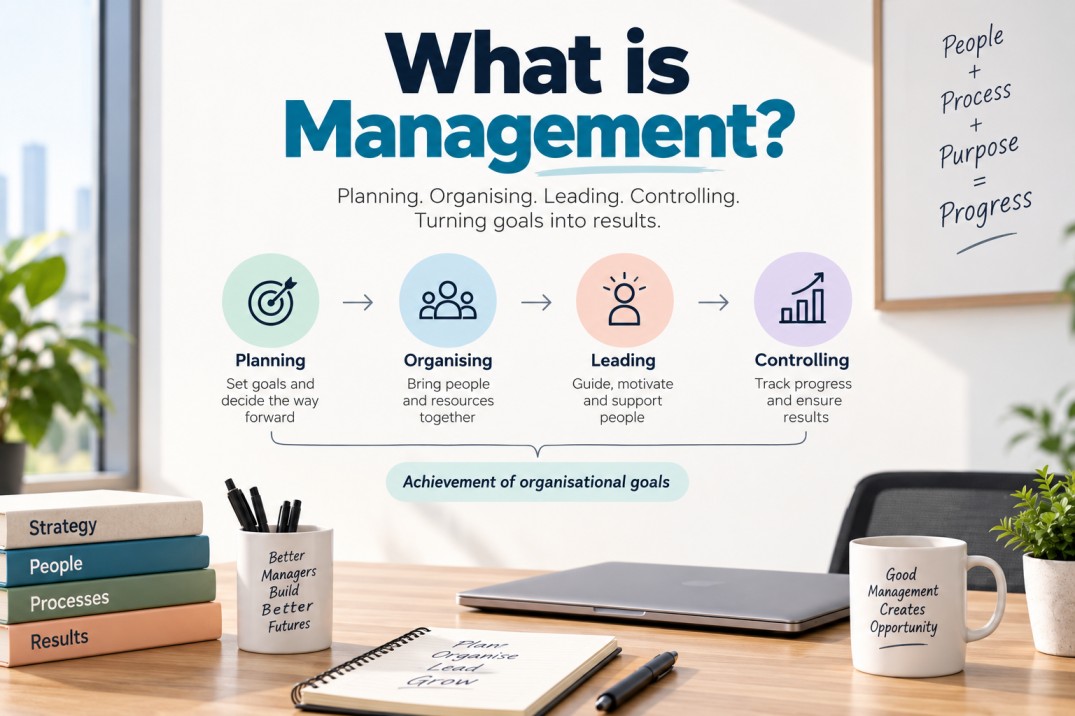
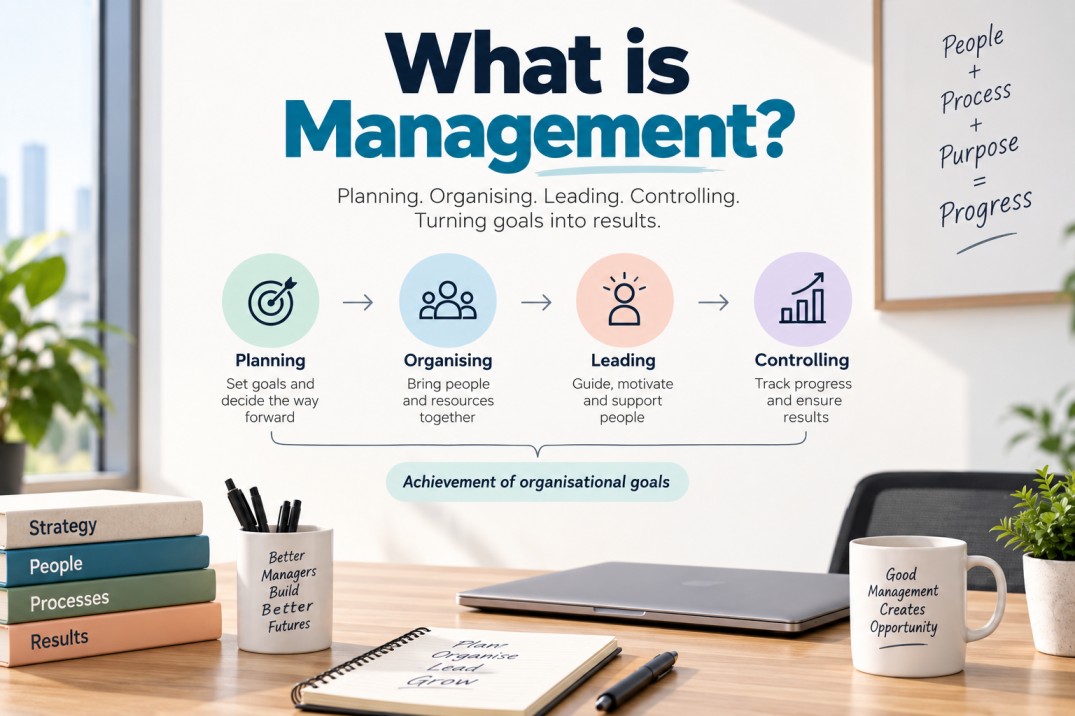
In very simple terms, management is the process of planning, organizing, and leading resources to make sure the goals are met for the organization.
Management as a discipline is very different from its practice. Because it has concepts, theories, principles, and frameworks which are already established and written in textbooks. Researchers usually study subjects such as organisational design, strategy, decision-making, motivation, operations, and leadership. But in reality, in practice, it’s always hard to manage people, share bad or difficult news with a client, or fire someone.
Managers must learn how to apply the concepts they learned to real-life situations. A theoretically sound plan may still fail if people on your other end change their preferences, resist a decision, or resources are limited. It's the judgement that matters as to how to utilise your resources.
Business schools teach discipline. But real jobs teach you how to utilize them.
Why Is Management Important?
Management is important as organisations need people to run them effectively. And how to utilise limited resources to the best of their capability. Time, money, talent, information and attention should be prioritised. Good management helps an organisation to make informed decisions and work efficiently.
The purpose is to make the work smooth, not the other way around. It's to create coordination between the objectives, resources, decisions and the final results. Here are the reasons why it is important for any organisation:
Achieving Goals of Organisation
Using Resources Effectively
Coordinating People and Functions
Improving Organisational Performance
Responding to Change and Uncertainty
Balancing Organisational and Stakeholder Interests
What Are the Characteristics of Management?
Management isnt a fixed thing. It changes depending on the organisation, the industry, and even the day of the week.
Here are the characteristics of management:
| |
| Management focuses on achieving defined objectives and setting clear priorities. |
| Management is an ongoing process of planning, acting, reviewing and improving. |
| Management involves balancing tasks, people and resources at the same time. |
| Management involves coordinating people to work towards common goals. |
| Management changes as business conditions, technology, customers and regulations change. |
| Management approaches depend on the organisation, industry, people, resources and situation. |
What Are the Objectives and Functions of Management?
Every manager, whether running a five-person team or a multinational, works toward similar core goals.
Management typically works towards three broad categories of objectives.
| |
| Growth, efficiency, profitability, survival and performance |
| Responsible conduct and contribution to society |
| Employee development, satisfaction and personal goals |
The core functions are planning, organising, staffing, directing and controlling.
Planning: Deciding what needs to happen and how to get there.
Organising: Structuring roles, teams, and resources.
Staffing: Recruiting and placing the right people in the right roles.
Directing: Guiding, motivating, and supervising the team.
Controlling: Measuring results against goals and correcting course.
What Are the Major Areas of Management?
The application of management is spread across different functions. Each has its own tools and metrics.
Here are the different areas:
| |
| Long-term direction and competitive position |
| Customer needs, markets and demand |
| Financial planning, investment and risk |
Human resource management | Talent, capability and employee relations |
| Production, processes and service delivery |
| Technology choices and digital systems |
| Defined objectives, timelines and resources |
| Organisational transitions and adoption |
What Are the Principles of Management?
Management principles give guidance to managers in making decisions and organizing work. These aren’t any rigid rules.
Henri Fayol's Classical Principles
Henri Fayol also known as the Father of Modern Management Theory, gave a new perception on the concept of management in 1916. He identified 14 principles of management as follows:
| |
| Divide tasks so people can specialise and improve efficiency. |
Authority and responsibility | Managers need the authority to make decisions and the responsibility to deliver results. |
| Employees should follow agreed rules, standards and commitments. |
| Each employee should receive instructions from one direct manager. |
| Activities with the same objective should follow one plan and direction. |
Subordination of individual interest | Organisational interests should take priority over individual interests when they conflict. |
| Employees should receive fair and reasonable compensation for their work. |
| Decision-making authority should be balanced appropriately between senior leaders and lower levels. |
| There should be a clear line of authority from senior management to lower levels. |
| People and resources should be placed where they are needed and best suited. |
| Managers should treat employees fairly and respectfully. |
| Organisations should avoid unnecessary employee turnover and support continuity. |
| Employees should have opportunities to suggest ideas and take appropriate action. |
| Managers should build teamwork, unity and a sense of shared purpose. |
Are Fayol's Principles Still Relevant?
Some of them are still relevant, but not all. Unity of command is maintained in most companies, since reporting to two bosses doesn't work. Strict centralization do not work well in organizations since in most places teams need to make quick decisions. Using these principles as a foundation, not a fixed script is a better idea.
What Does a Manager Actually Do?
A manager turns an organisation's goals into a clear action plan. The exact extent of work depends on the manager's role and level. But most managers plan work, make decisions, guide people, solve their problems and track results.
Set priorities and make decisions
Allocate people, money, time and other resources
Coordinate teams and functions
Monitor performance
Communicate expectations
Resolve conflicts and operational problems
Respond to uncertainty and change
Review results and adjust plans
The best managers aren't the ones who avoid chaos. They're the ones who handle it without losing sight of the bigger goal.
Their work also changes across different organizational levels. Senior managers generally deals with developing strategies. While operational managers focus more on execution and day-to-day performance.
The role doesn't only involve analytics. Managers work with people, and that introduces judgement, negotiation, and competing expectations into everyday decisions.
What Skills Are Required for Effective Management?
Good management requires more than technical knowledge. Managers need to understand tasks, people and the wider organization.
Three classic managerial skills are particularly useful:
| |
| Understanding processes, tools and functional work |
| Communicating, motivating and working effectively with people |
| Understanding the organisation and its wider environment |
| Explaining decisions clearly and listening to different perspectives |
| Choosing a suitable course of action with available information |
| Identifying issues and finding practical solutions |
| Understanding emotions and responding appropriately to people |
| Setting priorities and focusing on important tasks |
| Assigning responsibilities and trusting others to complete their work |
A technically capable manager can still struggle if they can't communicate priorities or handle disagreement.
Skills also change with responsibility. As managers take on broader roles, they need to understand how decisions in one function affect the organisation as a whole.
Management in Practice: How Management Concepts Are Applied
Management becomes easier to understand when viewed through actual organisational situations. The same principles can produce different decisions because the constraints and objectives aren't always the same.
Case 1: Managing Business Growth
Imagine a growing company whose sales have increased sharply. Demand is encouraging, but its existing team can't handle the additional workload. Management now involves deciding whether to hire, automate processes, outsource work or change the operating model.
Each option has different costs and risks.
Case 2: Managing Operational Constraints
A manufacturer receives more orders than its current production capacity can handle.
The operations manager must examine capacity, labour, inventory, equipment and delivery commitments. Increasing production isn't automatically the answer if it creates quality problems or raises costs beyond acceptable levels.
Case 3: Managing Organisational Change
A company introduces a new enterprise system. The technology works, but employees aren't adopting it consistently.
The management challenge has shifted from technology to implementation. Managers need to communicate the reason for change, train employees, identify resistance and monitor adoption.
Case 4: Managing a Cross-Functional Decision
Suppose a company wants to launch a new product quickly. Marketing wants speed, finance wants cost control and operations wants enough time to protect quality.
There isn't a perfect answer. Management requires the team to weigh competing priorities, assess evidence and make a decision that fits the organisation's objectives.
Common Challenges in Management
Managers rarely work with unlimited resources or complete information. Their challenges usually arise from competing objectives, human behaviour and changing external conditions.
Common challenges include:
The difficulty is that solving one problem can create another. Cutting costs might improve short-term financial performance but affect service quality or employee morale.