What Are Leadership Theories?
Leadership theories are frameworks that explain how leadership works and why some leadership approaches are more effective than others in specific situations. They examine factors such as a leader’s personal qualities, behavior, team dynamics, motivation, relationships, and workplace conditions.
Theories of leadership help answer practical questions. Why does one manager perform well with a particular team but struggle with another? Why does a leadership approach succeed during routine work but fail during organizational change? Different theories offer different ways to examine these questions.
Leadership wasn't always studied this way.
Early approaches focused heavily on the individual leader. Researchers wanted to identify the qualities that separated leaders from others. This thinking gave rise to approaches such as the trait theory of leadership, which examines characteristics associated with effective leadership.
Later research shifted toward behavior. Instead of asking what leaders possess, researchers examined what leaders actually do. This led to behavioural approaches that explore how leaders balance tasks, relationships, and employee needs.
The focus then became broader.
Researchers began recognizing that leadership effectiveness also depends on the situation. A manager leading an experienced team may need to give people considerable independence, while the same manager may need to provide closer guidance to a new team.
This is where approaches such as contingency theory and situational leadership theory become useful. They recognize that leadership doesn't happen in isolation. The task, people, organizational environment and circumstances can all influence which approach works best.
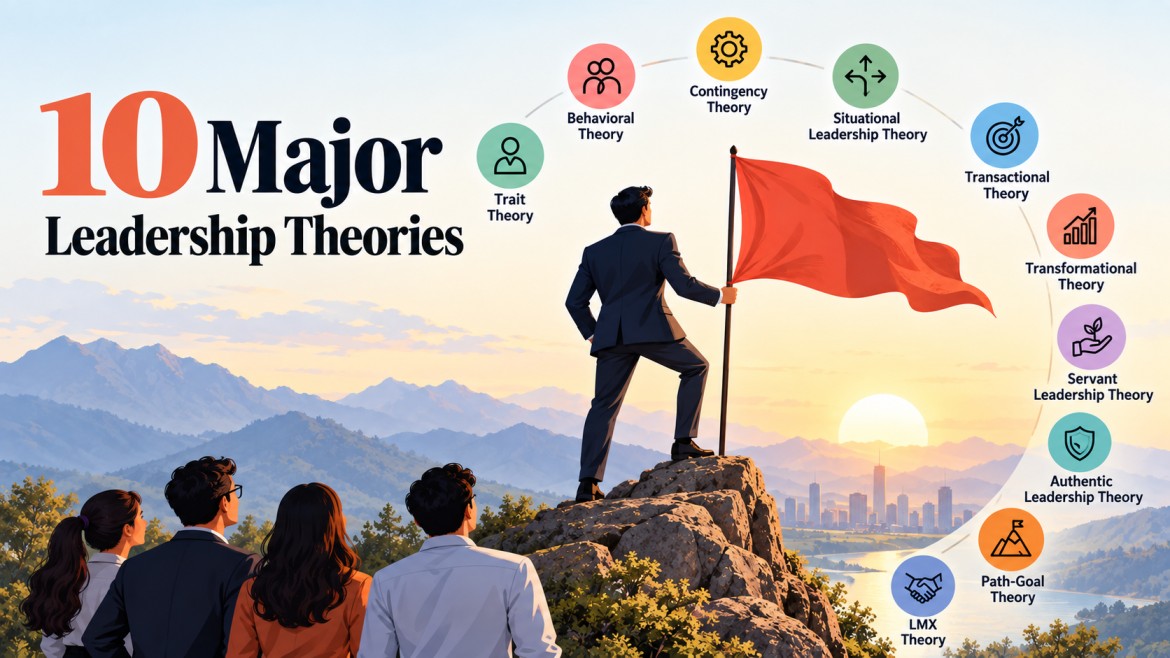
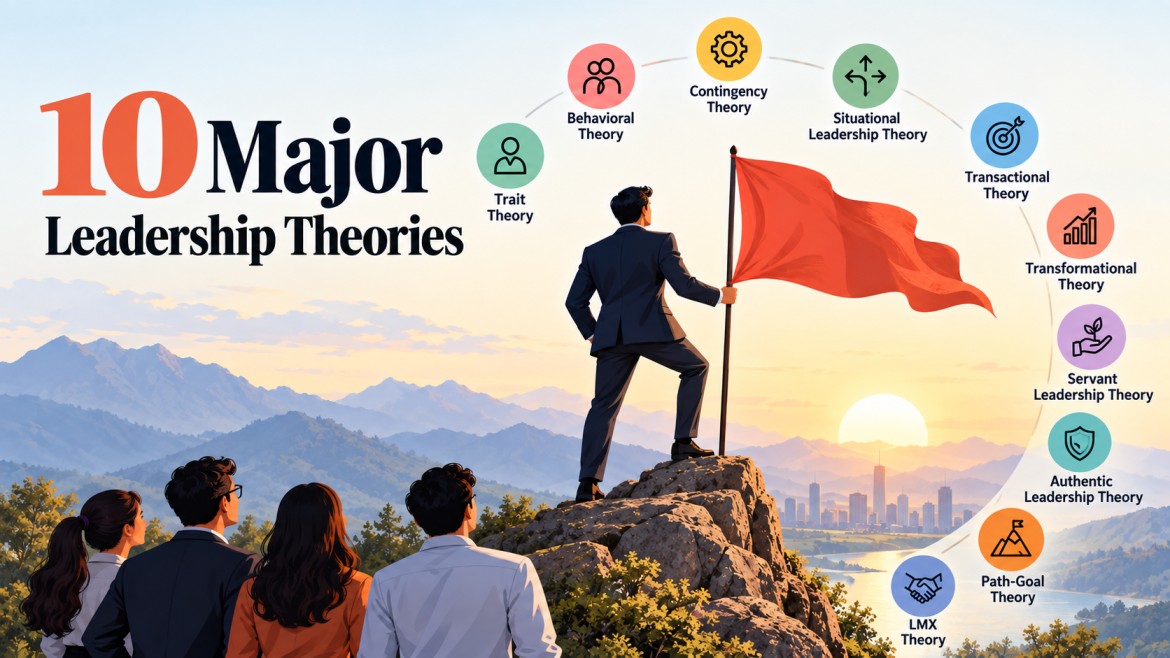
Here's a quick view of the 10 theories covered in this blog.
| | |
| | Understanding leadership characteristics |
| | Improving leadership behaviour |
| | Matching leadership to context |
Situational Leadership Theory | | |
| | Goals and standards are clear |
| | Teams need direction and motivation |
Servant Leadership Theory | | People development matters |
Authentic Leadership Theory | Values and self-awareness | Trust and consistency matter |
| | Employees need support toward goals |
| Leader-follower relationships | Relationships affect team outcomes |
10 Major Leadership Theories
Leadership theories explain the different ways to make leadership effective. They range from personal traits and behaviors to situational, relational, and motivational factors. There is a theory to explain every kind of leadership.
Each theory investigates leadership from a different angle. So, understanding the differences matters to understand all the leadership styles.
Trait Theory of Leadership
The trait theory of leadership focuses on the qualities of effective leaders. This is one of the oldest ideas for leadership research. The Trait Theory of Leadership was developed from the Great Man Theory which was first proposed by historian and philosopher Thomas Carlyle in the mid-1800s. This was further shaped by early researchers like Francis Galton.
It holds that people are born with these qualities rather than developing them. Qualities like confidence, intelligence, decisiveness, and integrity don't just develop overnight. People are born with it.
So, the question is, what inherent traits does the leader bring to the table?
But there is only one limitation. Having certain traits doesn't automatically make someone effective in every situation. A confident manager still might struggle when his team needs him to listen rather than make hasty decisions. Plenty of people fail as leaders because they never try to read a room or manage conflicts.
Trait theory laid out the groundwork for every theory that came after it. And hiring managers still look for these traits during interviews even today.
Behavioral Theory of Leadership
The Behavioral theory of leadership shifted the attention from personality to actions. Instead of asking who the natural leader is, researchers began asking what good leaders actually do. It says leadership isn't about who you are, it's about what you do in certain situations.
Researchers studying this theory grouped leaders into the following categories
According to this, behavior can be observed and learned. Which means, if leadership is a set of behaviors, then it can be taught. It may or may not produce identical results for every team.
This theory opened the door to modern leadership training programs.
Contingency Theory of Leadership
The contingency theory of leadership says that there's no single best way to lead. What works depends on the situation, the team, and the task at hand.
The Contingency Theory of Leadership was developed by the Austrian-American psychologist Fred Fiedler in the 1960s. It argues that the relationship between a leader's orientation and factors such as task structure, leader-member relations and positional power is important.
A leader who performs well in one setting might not get the same results if the situations change. Fred Fiedler argued that a leader's style is fixed, so the real work is matching the right leader to the right context. A leader who thrives during a crisis might fail during a slow, steady quarter.
Situational Leadership Theory
The situational leadership theory was developed by Dr. Paul Hersey and Dr. Ken Blanchard in 1969.
It focuses on adapting leadership behavior to the needs of the circumstances around them. It says leaders should adjust their own leadership style based on how ready or capable their team members are for a given task.
Imagine a new employee joining a team. They may need clear instructions at the beginning. An experienced employee, on the other hand, can handle familiar work and would probably need less direction and more independence.
Leaders who keep using the same approach with everyone create unnecessary problems. The challenge is judging what the person and situation actually demand.
People often confuse this with the contingency theory. This theory treats leadership as a flexible skill, not fixed, which is the key difference from contingency thinking.
Transactional Leadership Theory
The Transactional leadership theory focuses on expectations, performance, and exchanges between leaders and employees.
Its roots are often traced to sociologist Max Weber's 1947 work on rational-legal authority, later framed as transactional leadership by James MacGregor Burns in 1978. It was then further expanded by psychologist Bernard Bass in the 1980s.
Transactional leadership runs on a simple, straightforward arrangement. Employees do the work that is expected of them in return for the rewards linked to performance. If they fail, they face the consequences.
This approach works well only where targets, procedures, and responsibilities are stated clearly. And nothing else is expected from them other than the work they have signed up for.
The only catch is that it doesn't work well for long-term motivation or creativity. It keeps the machine running, but it doesn't inspire anyone to go beyond the job description.
Transformational Leadership Theory
The Transformational leadership theory focuses on vision, motivation, and meaningful change. Rather than only managing existing performance, transformational leaders try to inspire people to pursue a broader goal.
Transformational Leadership Theory was originally introduced by political sociologist James V. Downton in 1973. It was later coined and established as a major political and leadership concept by James MacGregor Burns in 1978. Bernard M. Bass further expanded it into an organizational psychology framework in 1985.
Transformational leaders paint a vision and genuinely inspire others to chase it.
That doesn't mean charisma alone creates the transformation. Leaders back it with credible plans, communication and follow-through. Without those, an inspiring vision is just another presentation.
They lead by example, push their teams to grow, and often reshape company culture in the process. Employees under transformational leaders tend to report higher engagement and lower turnover.
The trade-off? It takes real emotional energy, and not every manager has the bandwidth or personality for it.
Servant Leadership Theory
The Servant leadership theory changes the perspective of the traditional hierarchy upside down. Robert K. Greenleaf founded and coined the Servant Leadership Theory in his 1970 essay titled "The Servant as Leader".
It states that the leader's job is to serve the team, not the other way around.
That means prioritizing employee growth, well-being, and development ahead of personal authority. Companies like Southwest Airlines are often cited as an example of a people-first culture that reflects principles associated with Servant Leadership Theory.
But it isn't the right answer for every situation. A crisis may require fast direction, and a servant approach still needs clear accountability.
Authentic Leadership Theory
The Authentic leadership theory is about self-awareness and consistency. The idea is that leaders build credibility when their actions align with what they say.
Authentic Leadership Theory was popularized by practitioner Bill George in his 2003 book Authentic Leadership. Academic scholars Fred Luthans, Bruce Avolio, and William Gardner further developed and expanded the formal organizational theory
A manager who openly acknowledges a difficult decision, explains the reason and accepts responsibility, is an authentic leader. It doesn't mean saying anything that comes to mind. Leaders still need judgement, boundaries, and professionalism. Being genuine doesn't remove the responsibility to lead well.
Leaders following this theory build trust through transparency. They admit mistakes. They stay true to their values even under pressure. This theory resonates a lot right now, especially with the Gen Z employees who can smell inauthenticity from a mile away.
Path-Goal Theory of Leadership
The Path-Goal theory says the leader's core job is to remove obstacles. Clear the path, and the team reaches the goal faster.
Robert J. House introduced the Path-Goal Theory of Leadership in 1971. He later refined the theory with Terence R. Mitchell in 1974 and updated it again in 1996.
A manager might give detailed guidance to someone who is doing an unfamiliar task. But should take a more participative approach when experienced employees need room to shape a solution.
Depending on the situation, a path-goal leader might be directive, supportive, participative, or achievement-oriented. It connects leadership behavior with employee motivation and the demands of the task.
It's very similar to situational leadership theory. But the key difference is that it's built specifically around motivation and goal clarity rather than task readiness.
Leader-Member Exchange Theory
The Leader-Member Exchange theory, commonly called LMX, doesn't treat a team as one unit. It treats leadership as a series of individual relationships, where some of those relationships are stronger than others.
Leader-Member Exchange (LMX) Theory was originally introduced in 1975 by Fred Dansereau, George B. Graen, and William J. Haga.
It's a very realistic theory. This is how most workplaces actually operate. The risk is favoritism from a leader, if the leader isn't careful about how those relationships form. Unequal access to information or opportunities can damage trust across a team.
Leadership Theories vs Leadership Styles
The terms leadership theory and leadership style are related, but they aren't interchangeable.
A leadership theory provides a framework for explaining leadership. A leadership style describes how a leader actually behaves when managing people.
For example, situational leadership theory explains why a leader might adapt their approach according to circumstances. A leadership style describes what that adapted behaviour looks like in practice.
This distinction matters for students and managers. You don't have to choose between theory and practice. Theory helps you understand the reason behind an approach, while style describes its visible expression.
A manager might also use different styles at different times. That's very normal. Teams change, tasks change and people develop.
How Do These Leadership Theories Differ?
The easiest way to understand the theories is to look at the differences:
Trait vs Behavioral Theory
Trait theory says leaders are shaped by inherited qualities. Behavioral theory says leaders are shaped by what they choose to do. One is about identity. The other is about action, and action can be trained.
A confident person isn't automatically a strong leader. A manager who listens well, sets expectations clearly and responds appropriately to problems demonstrates behaviours that can directly affect team performance.
Contingency vs Situational Theory
Both approaches agree that context matters, but they disagree on who adapts. Contingency theory says the leader's style is fixed, so you match the leader to the situation. Situational theory says the leader adapts their own approach as the team's readiness changes.
That's why the terms aren't synonyms. They overlap in context, yet they offer different ways of analyzing leadership.
Transactional vs Transformational Leadership
| | Transformational Leadership |
| Performance and clear expectations | Vision, motivation and change |
| Achieve defined targets and maintain standards | Create long-term commitment to a shared vision |
| Rewards, recognition and corrective action | Purpose, inspiration and personal growth |
| | Long-term goals and organisational change |
| Sets expectations and monitors results | Inspires, guides and motivates the team |
| Structured tasks, clear targets and routine operations | Change, innovation and long-term organisational goals |
| “What needs to be achieved?” | “What can we achieve together?” |
A sales manager setting monthly targets and linking performance to incentives is using a transactional approach. A leader asking the team to rethink how it serves customers and connecting that effort to a larger purpose is closer to transformational leadership.
Servant vs Transformational Leadership
Both styles care about people.
| | Transformational Leadership |
| Employee needs and development | Shared vision and organisational change |
| Puts the team's needs first | Inspires people to work toward a larger goal |
| More listening and support | More vision-driven and motivational |
| Serves, supports and develops employees | Inspires, guides and motivates employees |
| Quieter and people-centred | More visible and change-oriented |
| Building trust, growth and strong relationships | Driving change, innovation and collective momentum |
| “How can I help my team grow?” | “How can I inspire my team toward this vision?” |
There can be overlap. A transformational leader may invest heavily in employees, while a servant leader can inspire people toward ambitious goals.
How Are Leadership Theories Applied in the Workplace?
Theories only matter if they help managers make better decisions about real people and real situations.
A few practical examples:
Don't apply a theory mechanically.
Ask what problem you're trying to solve, what the team needs, and what the situation demands. Then use the theory as a way to think through the decision.