
University Logo
Admissions Open for the 2026 Cohort
Phone1800 210 2020
IIMBx - Digital Learning Foundation

Transformational Leadership Style: Meaning, Characteristics, and Benefits

  1. Home
  2. Transformational Leadership Style: Meaning, Characteristics, and Benefits

Key Highlights

  • The Transformational leadership style is a management approach where leaders motivate and inspire people to achieve more than they thought they could 

  • It's how they influence the mindset of employees or followers to create a clear purpose, motivate people to work toward shared goals, and encourage them to find better ways of doing things. 

  • Rather than focusing only on tasks and rewards, this approach focuses on vision, personal growth, trust, and meaningful change. 

  • This blog explores the meaning of transformational leadership style, its four core components, key characteristics, benefits, limitations, workplace applications, and real-life examples. 

Ready to strengthen your leadership and management skills, the IIMBx Certificate in General Management for Emerging Leaders  can help you develop practical capabilities in leadership, decision-making, strategy, and business management. 

Define Transformational Leadership Style

Transformational leadership is a leadership approach in which leaders inspire people to work toward a shared vision while encouraging personal development and new ways of thinking. These leaders build trust and motivate people to achieve big things. They are very much invested in the personal growth of their employees or team members, so much so that they can overcome their personal setbacks to achieve the common goal.

The success then feels like the whole team’s success, because each one has taken up ownership and invested in achieving the common goal. This kind of leadership, if applied correctly, can turn a team into a highly productive and successful team. 

The leader identifies the strengths and weaknesses of the team members and guides them to overcome those hurdles. He is personally very involved in each team member’s work progress. He takes the team from individual members and motivates them to work as a single unit. 

Origins and evolution of transformational leadership

James V. Downton coined the term “transformational leadership” in 1973 in his book Rebel Leadership: Commitment and Charisma in the Revolutionary Process 

James MacGregor Burns later introduced the idea of transformational leadership in 1978 through his work on political leadership. He described leaders who inspire people to go beyond their usual expectations and work toward a greater purpose. 

Bernard Bass later expanded Burns' work, added measurable traits, built the framework, and distinguished transformational leadership from transactional leadership. He identified four key elements of transformational leadership, known as the Four I's.

The idea has since then moved beyond politics. Organisations now use it to develop leaders, manage change, improve employee engagement, and encourage people to contribute beyond their regular responsibilities.

What transformational leadership means in the modern workplace

In today’s scenario, we can still see what a transformational leader can do for the company.  This kind of leadership turns a manager into a coach or a mentor. People look up to them. A successful transformational leader can change the fate of any workplace. It can create higher employee engagement, greater motivation, more innovation, stronger ownership, better collaboration, employee development, smoother organisational change, and stronger overall organisational performance.

A modern transformational leader doesn't simply announce a new direction. They explain why the change matters, involve people in the process, and create room for employees to question existing practices.

Also Read: 10 Major Leadership Theories for Workplace Success 

What Are the Four Components of Transformational Leadership?

The four components provide the foundation of the transformational leadership style. They describe how leaders influence employees through example, purpose, fresh thinking, and individual attention.

Component

What it means

Workplace behaviour

Idealised influence

Leading through credibility and example

Acts consistently with stated values

Inspirational motivation

Creating purpose and enthusiasm

Communicates a clear, meaningful vision

Intellectual stimulation

Encouraging new thinking

Questions assumptions and welcomes ideas

Individualised consideration

Supporting individual development

Coaches people according to their needs

1. Idealised influence

This is when the Leaders show the behaviour they expect from others.  They become role models for the others. They build credibility through consistent decisions and ethical behaviour.

People don't simply follow the leader's position. They pay attention to what the leader actually does. They follow people who actually do as they say.

2. Inspirational motivation

This focuses on creating a clear direction. The leader paints a vision that people can actually follow and personally connect with. Leaders explain where the organisation is going and why the journey matters. It also connects organisational goals with employees' own goals, giving them a clear reason to contribute and something meaningful to work toward. 

3. Intellectual stimulation

Transformational leaders encourage people to question existing practices. They don't punish employees for raising uncomfortable questions. This kind of culture brings a sense of accountability and innovation. 

New ideas, even the most risky ones, are heard and taken into consideration. It means creating a space where people feel safe proposing something new. 

4. Individualised consideration

Every employee have different strengths, goals, experience levels, and development needs. Leaders who recognise those differences provide more relevant coaching, feedback, and support. This means giving people support based on what they need to grow. 

Must read: Leadership Management: Meaning, Skills, Styles & Importance 

What Are the Characteristics and Skills of a Transformational Leader?

A transformational leader is someone who combines clear direction with an understanding of people. Charisma is an important characteristic, though, but alone isn't enough. This leadership style also requires practical skills that leaders can develop through experience, feedback, and regular practice.

Characteristic

What it looks like in practice

Vision and strategic thinking

Connects today's decisions with long-term goals and explains the bigger picture clearly.

Inspirational communication

Communicates in a clear, relatable way that helps people understand and connect with the vision.

Emotional intelligence and empathy

Understands how people respond to pressure, listens to concerns, and recognises when someone needs support.

Creativity and intellectual curiosity

Questions existing approaches, explores new ideas, and encourages the team to think differently.

Coaching and mentoring

Helps employees develop their skills through regular guidance, feedback, and support.

Empowerment and delegation

Gives employees real responsibility and allows them to make decisions and own the results.

Adaptability and change management

Adjusts plans when circumstances change while keeping the team focused on the larger goal.

Integrity and role modelling

Leads by example and makes sure actions match the values and expectations shared with the team.

Also Read: Assistant General Manager Salary in India 2026: Pay Guide 

How Does Transformational Leadership Work?

Transformational leadership works when a leader establishes direction, connects people to that direction, encourages better thinking, and supports employees as they take greater responsibility.
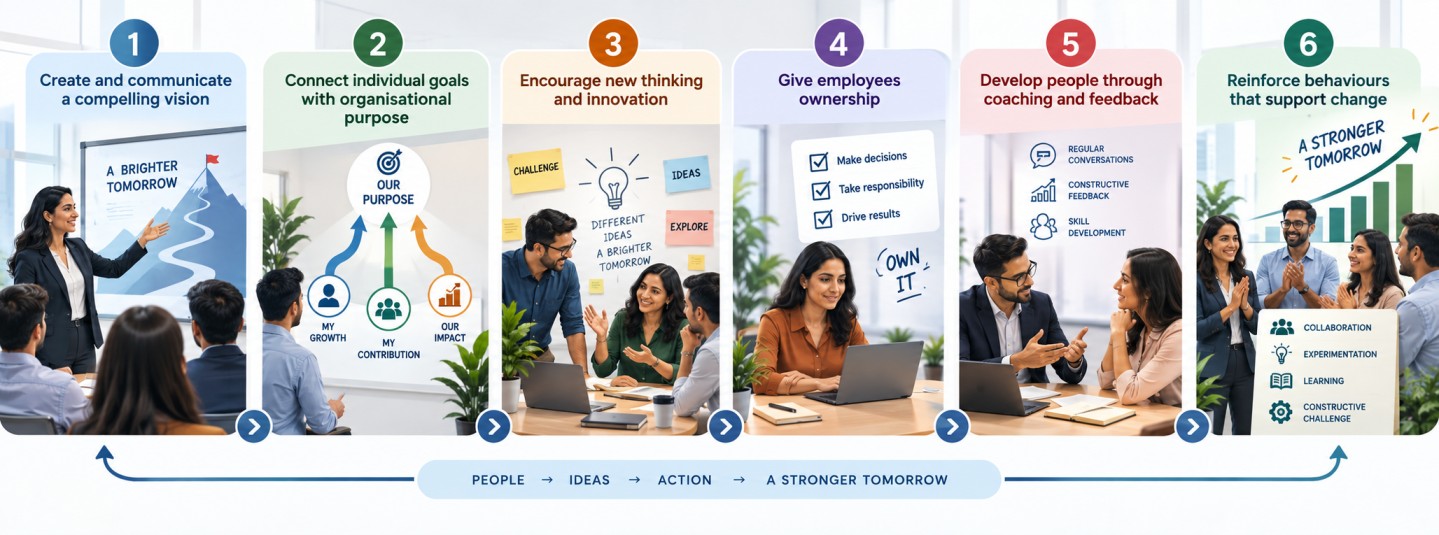
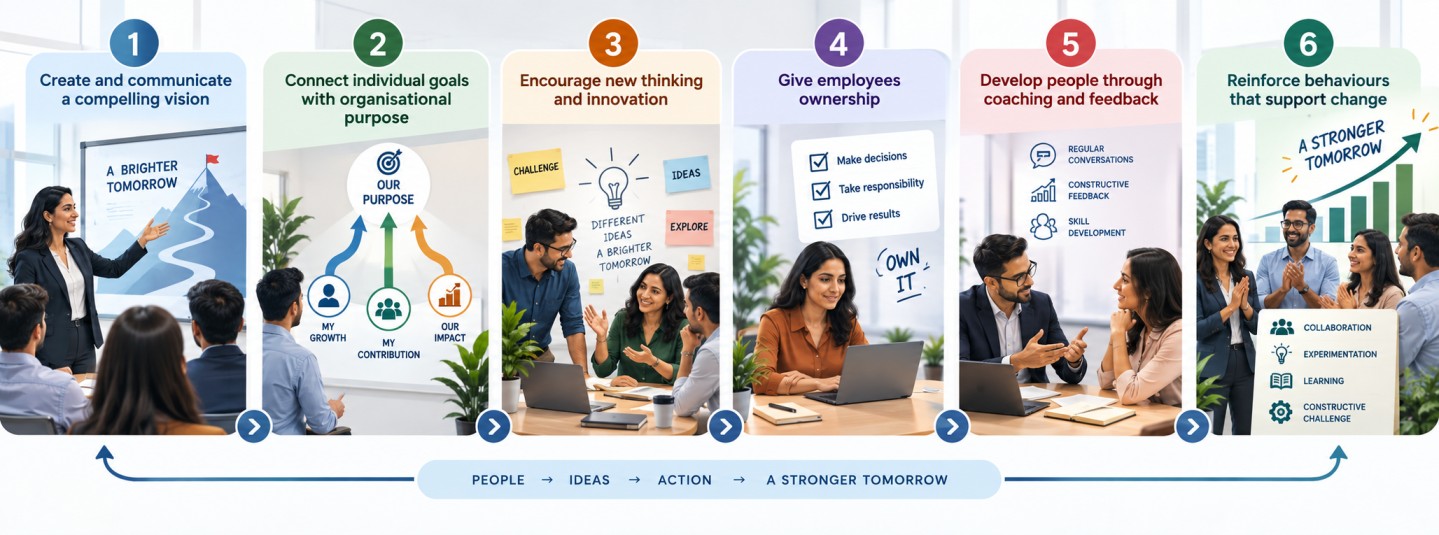
Six-step transformational leadership process showing vision, shared purpose, innovation, employee ownership, coaching and feedback, and behaviours that support organisational change.Six-step transformational leadership process showing vision, shared purpose, innovation, employee ownership, coaching and feedback, and behaviours that support organisational change.

What Are the Disadvantages and Advantages of Transformational Leadership Style?

Here are the disadvantages and advantages of transformational leadership style:

Advantages

Disadvantages

Builds a stronger sense of purpose

Can create change fatigue

Encourages employee engagement

Can lead to dependence on one leader

Supports creativity and new ideas

May create unrealistic expectations

Develops future leaders

May reduce focus on routine operations

Helps teams adapt to change

Vision may not translate into execution

Strengthens commitment to shared goals

Leadership impact can be difficult to measure

Improves collaboration and ownership

Can create pressure when resources or time are limited

How Can These Limitations Be Addressed?

Transformational leadership works best when it’s supported by clear processes for everyday tasks. A strong vision shouldn’t replace structure. It should guide it. Clear goals, realistic timelines, regular feedback, and shared decision-making can also help prevent the organisation from relying too heavily on one person. 

Leaders should also build a support system for themselves. Coaching, peer groups, or a mentor can prevent the burnout that comes from carrying a team's motivation alone. 

Finally, succession planning matters. Leaders can document the organisation’s vision and values so they continue even when the leader moves on. 

Also Read: General Manager Salary Per Month in India 2026: ₹5 Lakh+? 

Transformational Leadership vs Other Leadership Styles

Several leadership styles share traits with transformational leadership, but each has a different focus and approach. Here’s how they differ:

1. Transactional and Transformational leadership styles

Here are the major differences between transformational and transactional leadership styles:

Factor

Transformational leadership

Transactional leadership

Main focus

Vision and change

Performance and expectations

Motivation

Purpose and development

Rewards and consequences

Innovation

Encouraged

Less central

Time focus

Longer-term change

Immediate performance

Employee relationship

Growth and ownership

Clear exchange

Best fit

Change and development

Stability and defined processes

2. When should a leader use transformational vs transactional leadership style?

Use transformational leadership when a team needs a clear direction, stronger commitment, or support through major change.

Transactional leadership works well when tasks and expectations are clearly defined, and consistency is the priority. For example, a manufacturing team may need clear standards and performance checks to maintain quality.

3. Transformational and charismatic leadership style

Here are the major differences between transformational and charismatic leadership styles

Aspect

Charismatic Leadership

Transformational Leadership

Main focus

Personal appeal and influence

Shared vision and employee growth

Motivation

Personality and communication

Purpose and shared goals

Employee development

Not always a main focus

Strong focus on development

Innovation

May encourage new ideas

Encourages new thinking

Long-term impact

Often linked to the leader

Aims for lasting organisational change

Key difference

Influence comes mainly from the leader

Focuses on developing people and driving change

Transformational vs servant leadership style

Here are the major differences between transformational and servant leadership styles:

Aspect

Servant Leadership

Transformational Leadership

Main focus

Serving and supporting employees

Vision, motivation, and change

Leader's role

Supports employee needs and growth

Guides people toward shared goals

Employee needs

Central to the approach

Important for individual development

Decision-making

Values listening and employee input

Encourages ownership and independent thinking

Change

Supports personal and organisational growth

Strong focus on organisational change

Key difference

Leads by serving people

Leads by inspiring people toward a shared vision

What Are Some Real-World Examples of Transformational Leadership?

Here are some real-life examples of people who have used transformational leadership to make some positive changes in the world:

1. Steve Jobs and Apple

Steve Jobs is frequently mentioned in transformational leadership because of his strong product vision and his ability to connect teams around ambitious goals. 

Steve Jobs pushed his teams to create products that didn't exist yet. His high standards could frustrate people, but his ability to communicate a strong vision helped Apple reshape industries such as music and smartphones. His example also shows the limitations of relying heavily on an individual leader's influence.

2. Oprah Winfrey and media leadership

Oprah built her media career by connecting personal stories with a larger purpose. She also gave her teams room to take creative risks and try new ideas that challenged traditional broadcasting. 

Oprah Winfrey's leadership illustrates the role of communication, personal connection, and a strong sense of purpose in building influence. Her work also demonstrates how leaders can develop trust with audiences and teams over time.

3. Jeff Bezos and Amazon

Jeff Bezos encouraged his teams to think beyond short-term results. His focus on customers and long-term growth helped Amazon keep experimenting and changing as the company grew. Amazon's growth provides an example of how ambitious goals, experimentation, and organisational systems can work together.

How Can a Transformational Leader Handle Resistance to Change?

Resistance is very normal. People fear losing control, status, or comfort, and no vision speech erases that overnight. 

A leader should first understand the reason of resistance.

A practical process looks like this:

  1. Listen to concerns without dismissing them.

  2. Explain why the change is needed.

  3. Involve employees in solving practical problems.

  4. Provide the training or support they need.

  5. Set achievable milestones.

  6. Track progress and adjust the approach.

Enthusiasm won’t appear after one presentation. Trust develops over time.

Ready to move beyond your current role and take on broader business responsibilities? Explore the IIM Bangalore Young Leaders Programme (YLP) to strengthen your skills in strategy, finance, operations, people management, and leadership.

What Are the Common Mistakes Transformational Leaders Make?

Even a strong leadership approach can fail over few mistakes. Here are the common mistakes in transformational leadership.

Common mistakes include

  • Creating a vision without measurable goals

  • Trying to change too many things at once

  • Ignoring employee concerns

  • Relying too heavily on personal charisma

  • Neglecting routine operations

  • Giving responsibility without adequate authority

  • Failing to measure progress

  • Treating disagreement as disloyalty

How Can You Develop a Transformational Leadership Style?

Developing this approach can take practice and time. Here is what you can do to develop the skills:

  • Develop a clear leadership vision: Write down where you want your team to be a year from now, in one simple sentence anyone can understand.

  • Strengthen communication and emotional intelligence: Ask your team for feedback on how clearly you communicate. 

  • Encourage independent thinking and innovation: Give people space to share their ideas, question existing approaches, and suggest better ways to work.

  • Coach, empower and develop employees: Set aside time each month for one-on-one conversations about growth. Keep these discussions separate from regular work updates so employees can focus on their development.

  • Practise leading through change: Take on a project where the outcome isn't fully clear. Working through uncertainty can help you build confidence in making decisions, supporting others, and adapting when plans change.

How Is Transformational Leadership Measured?

Here is how transformational leadershipcan be measured:

1. Multifactor Leadership Questionnaire (MLQ)

The Multifactor Leadership Questionnaire (MLQ) is a widely used tool based on the leadership research of Bernard Bass and Bruce Avolio. It helps assess different leadership behaviours, including transformational and transactional leadership.

The MLQ looks at four key areas of transformational leadership: idealised influence, inspirational motivation, intellectual stimulation, and individualised consideration.

It can give useful feedback on leadership behaviour, but one score shouldn't be treated as a complete measure of leadership effectiveness.

Organisations can combine leadership assessments with employee feedback, engagement measures, team outcomes, retention patterns, innovation activity, and progress against strategic goals.

Conclusion

Transformational leadership isn't about giving big speeches or being the most charismatic person in the room. A transformational leadership style is built around vision, purpose, development, and change. Its four components provide a practical framework for understanding how leaders influence people and create stronger commitment to shared goals.

The approach works best when inspiration is matched with clear expectations, realistic execution, and accountability. Leaders who develop these habits can help teams think differently, grow their capabilities, and respond more effectively when the organisation needs to change.

It takes time to develop, and it can be demanding for leaders. But when teams are going through change or growth, this approach can help build trust, encourage new ideas, and strengthen commitment.

Start with one of the Four I's and practise it with your team this week.


Frequently Asked Questions

General

Latest Blogs

How to Become a Project Manager: Skills and Career Path
Oct 5th, 2026

How to Become a Project Manager: Skills and Career Path

Learn how to become a project manager with the right skills, qualifications, experience, certifications, and career steps to grow in project management.

Read More
Product Strategy: Definition, Types, Process & Examples
Oct 5th, 2026

Product Strategy: Definition, Types, Process & Examples

Product strategy explained for beginners. Learn what it is, the main types, how to build one in 8 steps, real examples from Tesla and Spotify, and a template.

Read More
People Management Skills: Top 10 Skills for Leaders
Oct 1st, 2026

People Management Skills: Top 10 Skills for Leaders

Discover the top 10 essential people management skills every leader needs, why they matter, the types, the challenges, and practical steps to develop them.

Read More
Copyright 2026 of [University Name]