

Key Highlights
The top 10 People management skills are communication, emotional intelligence, active listening, delegation, conflict resolution, feedback, motivation, trust-building, decision-making, and adaptability.
These skills help managers to communicate effectively, build trust, solve workplace problems, empower their people, and focus the team toward common objectives.
Good people management skills help managers improve the performance of their team, strengthen employee relationships, support professional development, and handle workplace challenges.
You’ll need some practical steps to improve people management skills, such as identifying skill gaps, improving communication, practising active listening, seeking feedback, and reflecting on management outcomes.
In this blog, you’ll explore the top 10 people management skills, their importance, types, common challenges, practical applications, and ways to develop these skills.
Ready to strengthen your business knowledge and leadership capabilities? Explore the IIMBx Certificate in General Management for Emerging Leaders and gain practical insights to navigate business challenges, make informed decisions, and prepare for greater leadership responsibilities.
What Are People Management Skills?
People management is a soft skill that is vital for a manager or a leader. This involves more than just assigning tasks to people or giving instructions to people on how to do things. People management is about creating a trusting environment, making people feel valued, and helping them grow.
Good leaders possess people management skills, which help them manage, guide, support, and work with people.
If you are a manager and you want your employees to perform better and be motivated, you have to develop people management skills.
For example, if a team is missing targets again and again. The problem is not only with the team or their lack of effort. The team leader should also introspect and see if he or she is doing enough as being a leader. A manager with people management skills will set clear expectations; workloads will be balanced, team members will be motivated to work, and they will not hesitate to speak up in front of him or her.
These skills are essential, as a manager you have to interact with so many people on a daily basis, and you need these skills on a daily basis.
So who needs these skills? Managers, team leads, supervisors, or anyone leading a project will require these key skills.
Why Are People Management Skills Important?
Businesses are made of people who come from different backgrounds, are of different age groups, and different cultures. They have to maneuver through different situations like a change in management, a structural change, or maybe just battling the stress of work. A manager should know how to handle all kinds of people in his organisation, which requires him to be skilled in people management.
Gallup has repeatedly reported that managers account for about 70% of the variance in team-level employee engagement. Effective people management affects the overall team performance, increases employee engagement, improves work relations, and facilitates professional development.
A manager who communicates poorly causes confusion even if the goals of the team are clear, while a manager who listens will recognize the problem before it becomes serious.
Strong people management also reduces the number of employees leaving the organisation. When people leave, it is a loss of resources. And there is a popular saying that people don't leave companies; they leave managers.
Strong people management skills help managers:
Boost people’s morale
Set clear expectations and priorities
Build trust with employees
Handle workplace disagreements
Give useful and timely feedback
Delegate work appropriately
Support employee development
Recognise good performance
Address performance concerns
Keep teams engaged during difficult periods
Also Read: General Manager Salary Per Month in India 2026: ₹5 Lakh+?
What Are the Top 10 Key People Management Skills?
Here are the top 10 core people management skills:
Communication Skills
Communication is the foundation of people management. Clarity in communication helps employees understand their roles and responsibilities better and clears confusion. They also understand how their work affects the organisation, in what way, and what the organisation’s expectations are of them.
Good communication skills ensure
Misunderstandings between team members are fewer
Stronger professional relationships
Encourages open communication between team members
This also means that the work flows smoothly in the organisation between different teams and between employees and management. This leads to better efficiency of work.
Do read: Leadership Training Programs: Types, Skills & Guide
Emotional Intelligence and Empathy
A good manager or leader knows their emotions and has strong emotional intelligence. He is empathetic and is aware of others’ emotions too.
This skill affects the team’s behavioral aspect.
When a manager recognises his team members' emotional situation, it helps in building trust; employees feel validated, and productivity increases when mutual respect is shown within a team. This reduces workplace stress by preventing small disagreements before they become larger conflicts.
This also supports an employee’s emotional well-being, improves collaboration, creates loyalty, and encourages openness.
The managers also get a perspective before reacting to others.
Active Listening
To achieve the above two people management skills, one has to have active listening skills first. When people are heard, they value their work better.
They feel their opinions matter. So they involve themselves more. And a sense of belonging develops.
A good manager or leader listens actively; they give their full attention when someone speaks and ask relevant questions to show that they care.
When employees raise concerns about workload, conflict, career development, or workplace relationships, a good leader or manager has to actively listen to everything. This will make sure there is less friction between team members.
Delegation and Empowerment
Delegation is an important aspect for managers. When a manager delegates important work to other team members, it shows trust. And this is how he empowers the employees by giving them important responsibilities.
Delegation means matching responsibilities with a person's skills and capacity. It allows the manager to focus on other broader responsibilities and employees to grow and develop leadership skills, build confidence, and improve the overall efficiency of the whole team, including the manager.
Good delegation also requires regular follow-up. This should not be confused with micromanagement. If managers keep all the work to themselves, they risk burnout and can create over-dependency of the team members on them.
Must read: What Is Servant Leadership? Meaning, Benefits & Examples
Conflict Resolution
Conflicts are very natural in any place. Be it an organisation or a small team. When different kinds of people work together, they are supposed to have different opinions. That is why an organisation takes people from different backgrounds. To have a variety of perspectives for work.
The manager's people skills are essential here as he has to resolve these issues. He knows how to handle each employee in what way. Someone may need a stern warning, and someone may just require a nudge. A useful approach is to understand each person's perspective, identify the specific point of disagreement, separate facts from assumptions, and agree on what needs to change.
Ignoring conflicts just makes them turn into bigger issues.
Feedback and Recognition
Regular feedback tells employees what they're doing well and what they need to work on. Recognition of good work boosts an employee’s morale and confidence. An employee’s job satisfaction depends on these two factors. If they are not recognised for their good work, they will feel unseen and unworthy of recognition.
Everyone wants a little pat on their back once in a while to feel that they are able to make positive change in the organisation.
Motivation and Employee Engagement
Motivating someone is a difficult task. Good managers or leaders are capable of doing that. They know that people don't get motivated by the same things. Someone may value their personal growth, whereas someone else may value more autonomy or challenging work to attain personal growth.
Managers need to understand that one approach doesn't work for everyone. A highly motivated team shows more enthusiasm and energy, has high team spirit, and contributes more to collaboration and growth.
Employee Engagement improves when employees understand their contribution, have reasonable ownership of their work, and feel that their manager takes their concerns seriously.
Do read: Business Continuity Management: Process and Importance
Trust, Accountability and Integrity
Trust, accountability, and integrity are the skills that a manager should possess if he wants to become a good leader too. Trust develops through consistent behaviour. It is built by keeping commitments, applying expectations fairly, admitting mistakes, and treating confidential conversations responsibly.
Accountability works both ways.
A manager who holds employees accountable but refuses to acknowledge their own mistakes will quickly lose credibility.
Integrity shows up in small decisions, especially when nobody is watching. Integrity is when you do the right thing even when no one is watching. If you do good by others, are fair to everyone, and give credit when it's due, all this tests your integrity.
Decision-Making and Problem-Solving
Managers regularly make decisions involving deadlines, workloads, employee concerns, priorities, and team resources. Strong decision-making involves gathering relevant information, considering the people affected, and acting within a reasonable timeframe.
Good problem-solving means breaking a messy situation into smaller pieces, weighing trade-offs, and moving forward even when the answer isn't obvious yet.
Adaptability and Flexibility
Different employees need different forms of support. A new employee may need more direction, while an experienced employee may perform better with greater autonomy.
Managers also need to adjust when teams change, priorities shift, or unexpected problems arise.
Flexibility doesn't mean changing expectations constantly.
It means changing the approach when the situation genuinely requires it.
Also Read: 10 Major Leadership Theories for Workplace Success
Types of People Management Skills
People management skills can be grouped into several areas. These categories make it easier to identify which capabilities a manager already has and which ones need more attention.
Do read: What Is Slack in Project Management? Types & Calculation
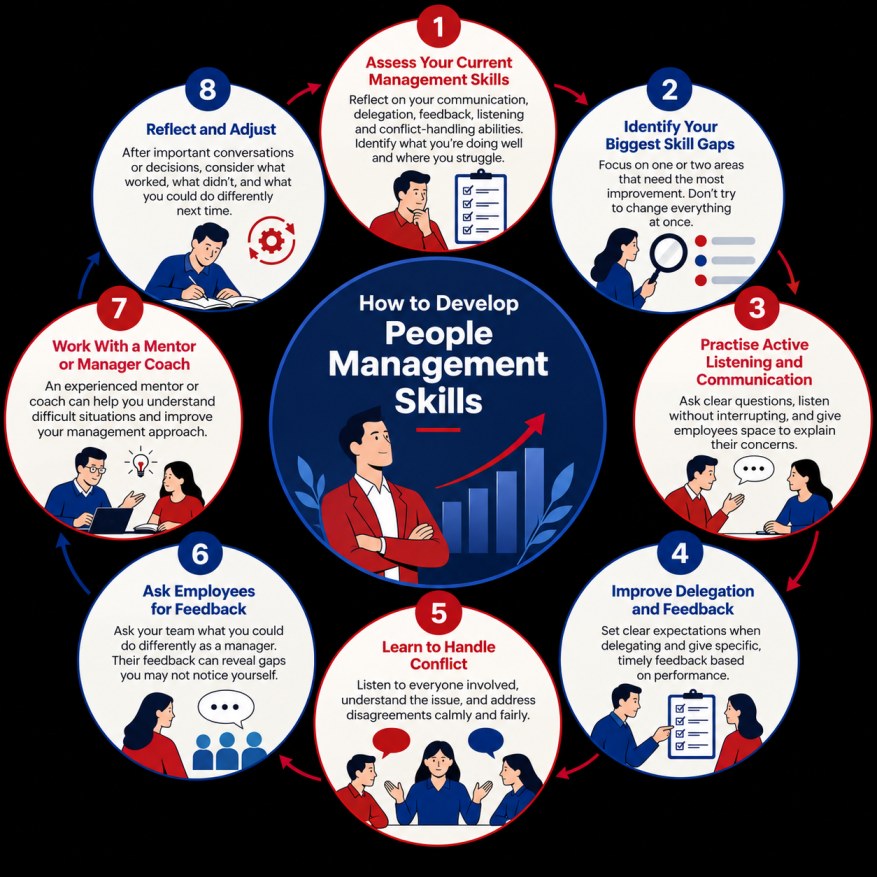
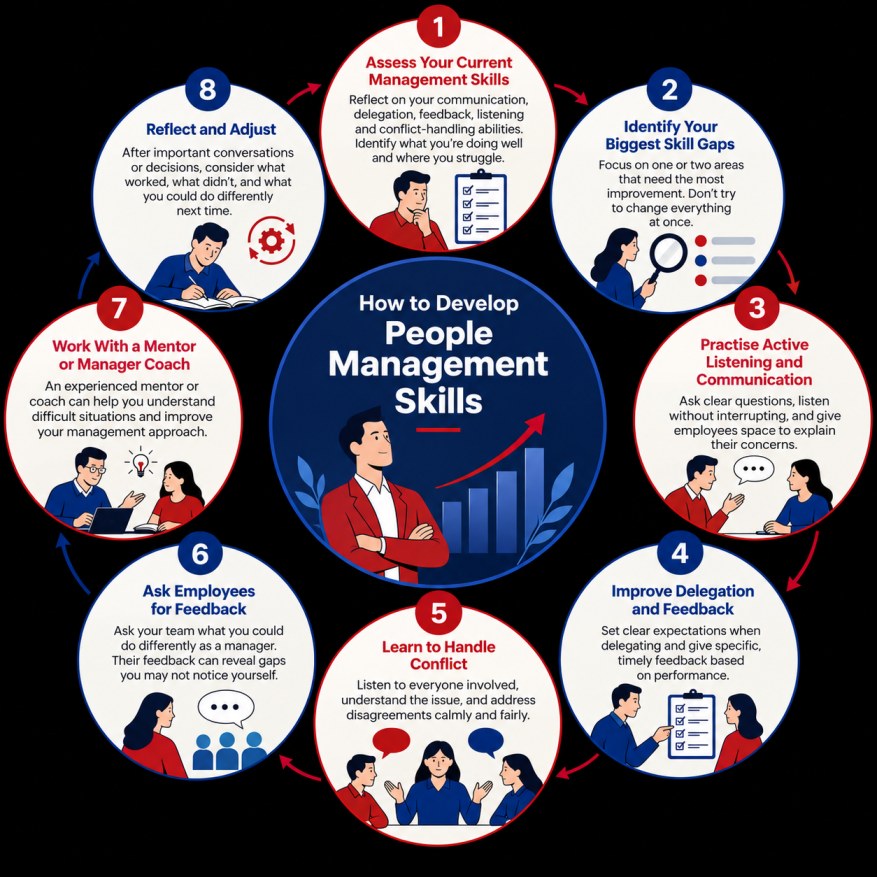
How to Develop People Management Skills
Improving people management skills requires practice. Reading about communication or conflict resolution can help, but real development happens when managers apply those ideas during actual workplace situations.