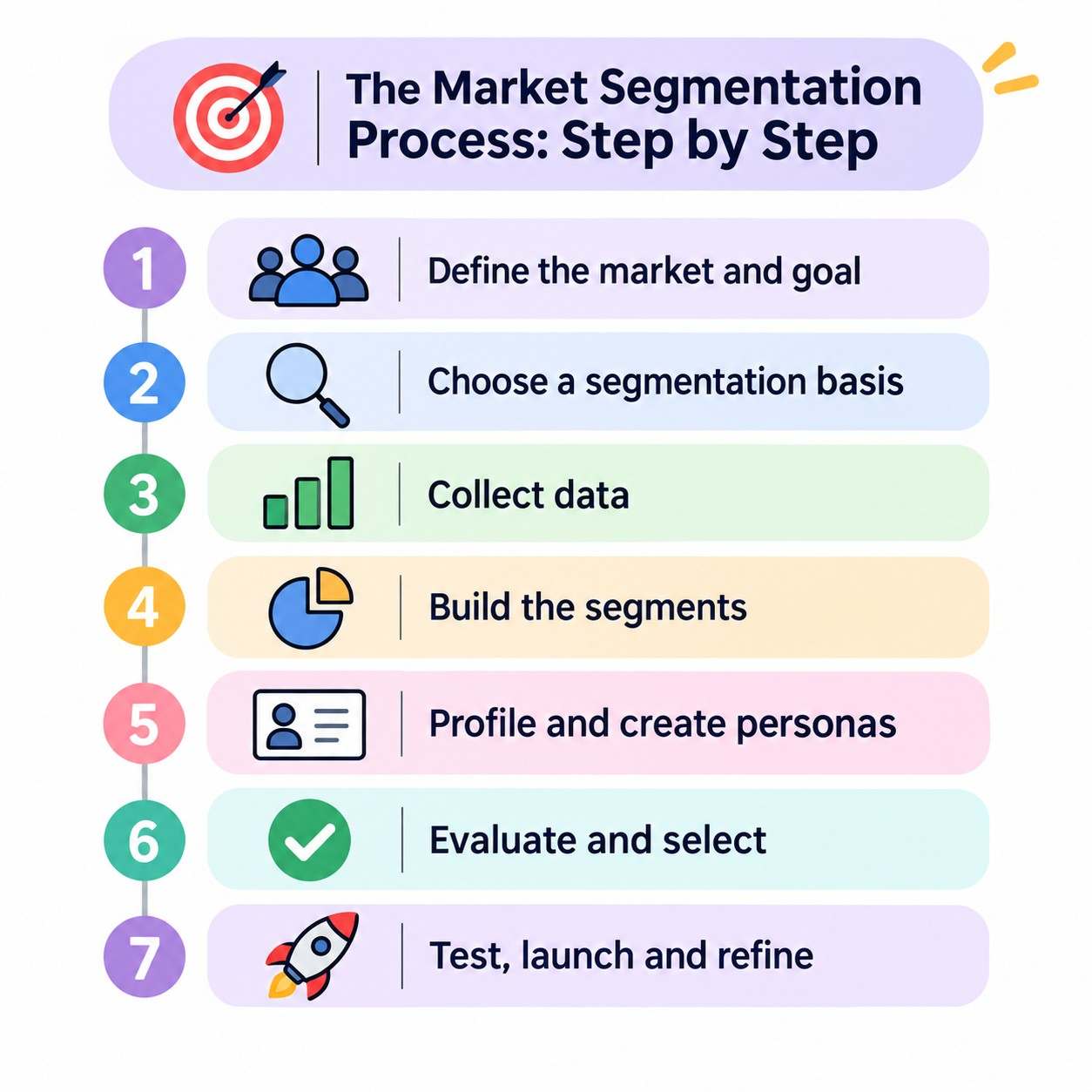
Step 1: Define the Market and Your Objective
Before you split anything, decide who you are studying and why. Without a clear goal, you will collect a lot of information and use none of it.
Market boundary: Set limits on what you sell, where you sell and who you sell to. For example, “online tutoring for learners in India” is clear. “Everyone who wants to learn” is too wide.
One business goal: Pick a single aim, such as winning new customers or keeping the ones you have. This goal will guide every choice in the next steps.
Step 2: Choose a Segmentation Basis
A “basis” is simply the way you decide to split people. You can split by age, city, income, interests or buying habits. Pick the one that fits your goal.
Match it to your goal: If you want to launch a new course for office workers, splitting by age or job type makes sense. If you want to stop users from leaving, splitting by how often they log in works better.
Start simple: Beginners should begin with one or two bases. The types of market segmentation explained earlier give you the full list, and the section “How to Choose the Right Segmentation Basis” helps you pick.
Step 3: Collect Data
Data is just information about your buyers. You do not need fancy tools here, only a clear idea of where to look.
Ask people directly: Use short surveys, customer calls and website analytics. A simple question like “Why did you join our app?” can teach you a lot.
Check your own records: Look at past purchases, customer support chats and feedback from your sales team. You often already have more data than you think.
Step 4: Build the Segments
Now put buyers with similar traits into the same group and give each group an easy name. The name helps your whole team remember who they are talking about.
Group by shared traits: Our tutoring app notices two clear groups. “School students” want help with exams. “Working adults” want to learn new skills after office hours.
Keep the number small: Three to five segments are enough for most businesses. Twelve groups will confuse your team, and you can always split a group later.
Step 5: Profile Segments and Create Personas
A profile describes what a group needs and how it buys. A persona goes one step further and turns that group into one made-up but realistic person.
What to write in a profile: Note their needs, what motivates them, what annoys them and how they decide to buy. Working adults, for example, want short lessons and flexible timings.
Build a persona: Give your typical buyer a name, a job and a daily problem. “Rohit, 27, works in sales, has only 30 minutes at night to study” is much easier to design for than “working adults”.
Step 6: Evaluate and Select Target Segments
You cannot chase every group, and not every group is worth your time. Test each segment with these five questions.
Question | What it means | Quick check for working adults |
Measurable | Can you estimate its size? | Yes, job data is easy to find |
Accessible | Can you reach them? | Yes, through LinkedIn and Instagram |
Substantial | Is it big enough to earn profit? | Yes, many professionals want to upskill |
Differentiable | Do they respond differently from others? | Yes, they want evening classes |
Actionable | Can you build offers for them? | Yes, we can create short courses |
Do the maths: Your expected sales should cover the cost of reaching and serving the group. A small group can still work if each buyer pays well, but check the numbers first.
Step 7: Test, Launch and Refine
Do not go all in on day one. Try your idea on a small scale first, see what happens, then improve.
Run a pilot: Offer your new plan to a small group from one segment only. Our tutoring app tries evening classes for working adults for two weeks.
A/B test your message: Show two versions of an advert to similar people and keep the one that works better. For example, compare “Learn after work” with “Upskill in 30 minutes a day”.
Keep reviewing: Buyers change over time. Check your results regularly and update your segments when needed.
What happened in our example: Sign-ups from working adults went up compared with the app’s general offer. So the app keeps the evening-class message and tests it with a bigger group. This is a made-up example, but it shows how the steps work together.
Identifying your target customer groups is an important step in building a business model. Learn how the Business Model Canvas connects customer segments with value propositions, revenue streams and other essential parts of a business.
Market Segmentation Examples
Real brands show how segmentation works in practice. The market segmentation meaning becomes clear when you see these companies use it, one for each main type. Together, these market segmentation examples show that the best groups are based on how people really live, buy and think.
Company | Segmentation type | What they did | Why it works |
Hindustan Unilever (India) | Demographic (income) | Sells shampoo brands such as Sunsilk and Clinic Plus in small, low-price sachets | Price-conscious shoppers, especially in semi-urban and rural areas, can buy in small amounts |
McDonald’s India | Geographic | Runs a menu without beef or pork, keeps vegetarian and non-vegetarian kitchen sections apart and offers items like the McAloo Tikki (potato patty) and Maharaja Mac (a chicken take on the Big Mac) | The menu fits local food habits and beliefs |
Starbucks Rewards | Behavioural | Gives Stars on purchases, with higher tiers that earn Stars faster | Frequent buyers feel rewarded and have a reason to return |
Patagonia | Psychographic | States its mission as being in business to save the home planet and has pledged 1% of sales to environmental groups since 1985 | It speaks to buyers who care about the environment |
AWS | Firmographic | Offers separate solution pages for small and medium businesses, startups, enterprises and the public sector | Companies of different sizes have different needs and budgets |
Each brand chose one clear basis and built its offer around it. That is why each group feels understood.
Here are a few quick cases from other industries:
Travel: Family, business and budget travellers get different packages, prices and messages.
Skincare: Brands design products for oily, dry or sensitive skin and for different age groups.
Software tiers: A simple market segmentation strategy example is free, pro and enterprise plans, each matched to a different company size and need.
Take the Next Step Towards Strategic Leadership with IIM Bangalore’s General Management for Emerging Leaders Programme Build the business knowledge and leadership skills needed to take on broader management responsibilities with the 8-month General Management for Emerging Leaders (ELP) from IIM Bangalore. Designed for first-time managers and experienced professionals stepping into cross-functional roles, the programme combines leadership, financial acumen, customer value, strategy and data-driven decision-making. Key Highlights IIM Bangalore Recognition: Learn from IIM Bangalore faculty at India's #1 Business School (QS and FT, 2025). Comprehensive Curriculum: Explore 10 faculty-led courses across five key business themes, including leadership, finance, customers, strategy and AI. Practical Learning: Apply your knowledge through a faculty-guided action learning project and live business simulation. Blended Learning: Combine live online sessions, self-paced learning and three campus immersions at IIM Bangalore. Certification & Alumni Status: Earn an IIMBx certificate and Affiliate Alumni Status upon successful completion. Program Details: Explore the ₹2,95,000 programme fee, eligibility criteria and admission process.
Visit IIM Bangalore's General Management for Emerging Leaders (ELP) to explore the curriculum and take your next step towards becoming a confident business leader. |
Market Segmentation Strategies
Once the groups are ready, you need a plan for reaching them. Top market segmentation strategies are the choices a business makes about which segments to serve and how closely to tailor each offer, which links to the levels of market segmentation below. This section helps explain market segmentation strategies in simple terms.
Targeting Strategies
There are three main marketing segmentation strategies for choosing your targets.
Undifferentiated marketing: One offer and message for the whole market. Use it when buyers’ needs are very similar, such as for table salt.
Differentiated marketing: Separate offers for several segments. Use it when you have the budget and each group clearly wants something different. A phone maker selling budget, mid-range and premium models is a market segmentation strategy example of this.
Concentrated marketing: All effort on one segment. Use it when resources are limited or one group is a perfect fit.
These are the different market segmentation strategies most courses teach. Choose based on budget, competition and how different your segments really are.
Levels of Segmentation
The levels of market segmentation run from broad to personal.
Segment marketing: Treat a group with similar needs as one unit, such as college students.
Niche marketing: Serve a smaller, more specific group, such as vegan protein snacks for gym-goers.
Local marketing: Tailor offers to a city, area or even a single store.
Individual (one-to-one) marketing: Customise the offer for each person, such as personal product suggestions in a shopping app.
Moving down the list means more personal offers but also more effort and cost. Strategies for effective market segmentation usually start broad, test the results and get more specific only where the return justifies it.
How to Choose the Right Segmentation Basis
A “basis” is simply the way you decide to split your buyers into groups. You could split them by age, city, job, shopping habits or lifestyle. The right choice is not the same for every business. It depends on what you want to achieve and what information you actually have.
Remember the market segmentation definition: you are grouping buyers by traits that affect what they buy. So the real question is, “Which trait matters most for my situation?” These four checks help you answer it.
Start with your goal: Ask what you want to achieve first. If you are launching something new, you need to reach many people, so broad traits like age or location work well. If you want customers to stay longer, you need to know how they behave, such as how often they buy or log in.
Check your data: Only pick a basis if you can get reliable information for it. If you have no way to learn about people’s lifestyles, then splitting by lifestyle is just guessing, and guessed groups lead to wasted money.
Think about action: Choose traits you can actually act on. If you learn that one group is price-sensitive, can you offer them a lower-priced plan? If the answer is no, that trait will not help you much.
Keep it simple: Begin with one basis. Add a second only when it clearly makes your groups sharper and more useful.
Which Basis Suits Which Business?
Here are five common situations, so you can see how the choice works in real life.
New product launch (demographic or geographic): Imagine a company launching a new budget smartphone. It does not know its buyers yet, so it starts with easy facts like age, income and city. This data is simple to find in surveys and market reports, and it shows how big each group is.
B2B software (firmographic): B2B means selling to other businesses. A company selling accounting software would group buyers by industry, company size and yearly revenue. Firms of similar size usually have similar problems, so they tend to buy in similar ways.
Local retailer (geographic): Think of a neighbourhood grocery store. Its customers are the people who live within a few kilometres, so area and neighbourhood matter most. Knowing that one colony has many young families and another has many retired couples helps it stock the right products.
E-commerce store with purchase history (behavioural): An online shop can see who buys often, who only browses and who leaves items in the cart. These real actions show real interest, so grouping by behaviour works best. It can then send a gentle reminder to the cart-leavers and a loyalty offer to the regulars.
Brand-led product (psychographic): Psychographic means grouping people by values, interests and lifestyle. A sports shoe brand might split buyers into “serious runners” and “weekend fitness lovers”. Both may be the same age, but they care about very different things, and the brand’s message should change for each.
Treat these examples as a starting point, not a strict rule. Different market segmentation strategies often need different bases, and a real business often needs more than one.
Can You Combine Bases?
Yes, and it often gives sharper groups. For example, “age plus buying habits” is better than age alone. Instead of “people aged 25 to 35”, you get “people aged 25 to 35 who buy online every month”.
But do not go too far. Stop at two or three layers. Each extra layer cuts your group into smaller pieces, and tiny groups are expensive to reach and may not bring enough sales to be worth the effort. If your segment is so narrow that you can hardly find anyone in it, it is time to remove a layer.
Why Market Segmentation Matters (Benefits)
The benefits of market segmentation come from focus. When you know who you are serving, every choice from message to budget becomes clearer. Segmentation does not guarantee growth, but it helps you stop guessing.
Targeted messaging: You speak to each group’s real needs, so your message feels relevant. Students and working adults, for example, respond to different offers.
Smarter budget allocation: Your money goes where returns are likeliest, such as putting more ad spend behind the group that buys the most.
Better product development: Segments show unmet needs. A gap in budget-friendly plans, for instance, can lead you to launch a new plan.
Stronger retention: You can keep loyal buyers with offers that suit them, like rewards for frequent customers.
Clearer competitive positioning: Focusing on one group helps you stand out. A niche brand can beat generic rivals for that audience.
Spotting growth gaps: Segmentation reveals groups you’re missing, like senior users of a banking app.
Segmentation won’t guarantee growth, but it helps you stop guessing. For your own goal, pick the two or three that matter most rather than chasing all six.
Customer segmentation is also useful for building stronger customer relationships and encouraging repeat purchases. Explore these customer retention strategies to learn how businesses can keep customers engaged and give them reasons to return.
Data Sources and Tools for Segmentation
Segmentation is only as good as the data behind it. Data shows which groups really exist, and tools help you sort buyers into them. Most marketing segmentation work can start with simple sources and basic tools, then grow as your needs grow.
Where Segmentation Data Comes From
First-party data: Information you collect yourself, such as CRM records, website analytics and purchase history. It is usually the most reliable.
Surveys and interviews: Direct questions reveal needs, values and opinions that numbers alone cannot show.
Secondary research: Industry reports, government data and published studies help you size a market and fill gaps.
Consent and privacy: Collect data with permission, explain how you will use it and follow the privacy rules of your region.
Types of Tools
Spreadsheets: Good for small data sets and first-round grouping.
CRM systems: Keep customer details and history in one place.
Analytics platforms: Show how visitors and users behave on your website or app.
Customer data platforms: Combine data from many sources into one profile per customer.
AI and predictive clustering: Software that finds groups in large data sets on its own. Humans still need to check whether the groups make sense.
No tools are recommended here, because the right choice depends on your size and budget. A dedicated article on segmentation tools is the best place to compare them.
How to Measure Whether Segmentation Is Working
Segmentation is working when your targeted groups respond better than the market as a whole. Track a few clear numbers for each segment, compare them over time and note what changed. Results can vary, so treat the numbers as guides, not promises.
Conversion rate: Shows the share of people who buy or sign up. A good sign is it rising for your targeted segment.
Customer acquisition cost: Shows what it costs to win one customer. It should fall over time.
Retention: Shows how many customers stay. More repeat buying is a good sign.
Average order value: Shows how much is spent per order. It should grow in the right segment.
Engagement by segment: Tracks opens, clicks and visits. Look for numbers higher than the general audience.
Compare segment by segment: Don’t rely on one overall average, because it can hide a weak group.
A basic test to run:
Pick one segment and one new message.
Keep a similar control group on your usual message.
Run it long enough to collect a fair number of responses.
Compare the KPIs and keep the winner.
Time to re-segment when: results flatten, new buyers don’t fit your groups, customer needs change, or you enter a new market.
Treat all numbers as guides, not promises.
Customer retention is one way to understand whether your segments are valuable over time. To measure the long-term revenue a customer generates, explore customer lifetime value (CLV), its calculation and ways to improve it.
Common Market Segmentation Mistakes and How to Avoid Them
Most segmentation problems come from doing too much or knowing too little. Each mistake below has a simple fix, and avoiding them saves money and keeps your groups useful. Strategies for effective market segmentation always include avoiding these traps.
Segments that are too broad: Broad groups lead to generic messages. Add a second basis, such as age plus buying behaviour, to sharpen the group.
Thin or stale data: Weak or outdated data leads to wrong guesses. Refresh your data every year and keep collecting more.
Relying on demographics alone: Age and income miss why people actually buy. Add behaviour or values to understand their motives.
Ignoring reachability: A segment is useless if you cannot contact it. Check your channels before choosing a segment.
Every extra segment adds cost, so create a new one only when its benefits clearly outweigh the added work
Why Choose General Management for Emerging Leaders (ELP) from IIM Bangalore?
The General Management for Emerging Leaders Programme (ELP) from IIM Bangalore is designed for professionals preparing to take on broader leadership responsibilities. It combines IIMB faculty expertise, a cross-functional curriculum and practical learning through live sessions, campus immersions and real-world projects. Here’s what makes the programme a valuable step towards developing your general management skills.
IIM Bangalore’s reputation: IIM Bangalore is ranked India’s #1 B-School by QS and FT (2025), and 8th in Asia in the QS Global MBA Rankings 2025. The certificate is issued by IIMBx, the institute’s digital learning arm.
Core IIMB faculty: The same professors who teach in IIMB’s flagship MBA teach this programme, so you get the same academic rigour across leadership, finance, strategy, innovation and AI.
Complete, cross-functional curriculum: Ten courses across five themes (leadership, financial acumen, value through customers, strategic thinking and innovation, and data-driven decision making) build the breadth needed to lead beyond one function.
Hands-on, blended learning: The 8-month format combines live online sessions, self-paced study and three campus immersions. A faculty-guided action learning project and The Arena live simulation let you apply each concept to real business problems.
Alumni status and network: Successful graduates earn Affiliate Alumni status and join the wider IIM Bangalore community across industries. The programme is built for first-time managers, specialists stepping across functions, and founders or senior ICs moving into general management.
Conclusion
Market segmentation helps businesses understand who their customers are, what they need and why they buy. By dividing a broad market into smaller groups, businesses can create more relevant products, offers and marketing messages.
The main types include demographic, geographic, behavioural, psychographic and firmographic segmentation. Choosing the right bases, following a clear market segmentation process and using reliable customer data makes it easier to identify the most valuable audience.
With the right market segmentation strategies, businesses can improve customer engagement, use marketing budgets wisely and build stronger customer relationships. Start with simple segments, test your approach and keep improving based on results. The key is to understand your audience and give each group a reason to choose your brand.