
University Logo
Admissions Open for the 2026 Cohort
Phone1800 210 2020
IIMBx - Digital Learning Foundation

What Is Financial Management? Objectives, Functions &Types

By Khushi Upadhyay

Updated on Oct 28, 2026

Share:
  1. Home
  2. Blog
  3. What Is Financial Management?

If you are interested in money and how businesses work, you might want to know what what is financial management?

  • Financial Management Definition: It involves planning, organising, managing, and controlling the finances of a business. This helps a company identify where to raise money from, how to use it, and also control how much it spends.

  • Aim: To have stable profits, use money wisely, and have a secure financial situation.

  • Functions: Planning, raising money, investing, cash management, and cost control.

This blog explains what financial management is, its objectives, functions, and types of financial management in simple terms.

If you want to build financial skills alongside strategy, operations and people management, explore the IIM Bangalore General Management for Young Leaders program. 

What Is Financial Management?

First lets define financial management to make you understand this concept better way, 

Financial management is the handling of money within a business. It includes how a business makes money, manages expenditure, invests in the future and arranges its finances.

To simplify, financial management can be described as answering these 4 questions:

  • Where will the money come from? Sales, loans, savings, or investors.

  • Where will it go? Rent, salaries, raw materials, and other costs.

  • What should we invest in? New equipment, a bigger shop, or a new product.

  • Is there enough cash to run smoothly? Bills and salaries must be paid on time.

Lets understand this with a simple example, Riya owns a small bakery.

  • She earns a total of ₹1,00,000 per month.

  • Out of this, she needs to spend a total of ₹60,000 on various things such as ingredients, rent, electricity and salaries of helpers.

  • Riya notices that she has more orders coming in. So she wants to invest in another oven costing ₹80,000.

  • In order to do so, she will save some of her monthly profits and take a small loan.

This shows that Riya is managing her finances. She is monitoring her income, keeping her costs low, putting money into investments and arranging to get funds to pay back. If she didn’t manage her finances properly she may have a lack of cash despite having good sales.

Large companies also do this but on a larger scale. They plan their budget, decide where to put their investments and decide how they will get the funds.

Also Read: What is Innovation Management

What Are the Objectives of Financial Management?

Objectives of financial management means what they want to achieve when handling their finances. They will help make decisions on how much to spend, where to put their mone,y and ways to protect themselves during difficult times. If they follow the objectives they will have better control of their finances and be able to plan for future growth.

Profit Maximisation

  • This objective will help a business to make the most profit possible.

  • It also helps to cover costs and keeps the business afloat.

  • This focuses on making as much profit as possible in a short period of time, so should be balanced out with other objectives.

Wealth Maximisation

  • This objective helps increase the value of the business over time to help the owners and shareholders.

  • This focuses on long term growth rather than profit in the current year.

  • It takes into consideration risk and when the profit will come in, therefore it is perceived to be a broader objective.

Effective Use of Funds

  • This ensures that the funds are being used in areas which will give the most benefit.

  • This avoids wasting any funds such as excess stock and idle cash.

  • This helps a business to get the most out of their resources.

Maintaining Cash Flow and Liquidity

  • This ensures that there is enough cash available to pay wages, rent and bills in a timely manner.

  • This helps the business deal with unexpected costs without rushing into borrowing.

  • This ensures that there is enough cash to avoid running short.

Budgeting and Risk Management

  • This help set budgets and targets for the future months and years.

  • This prepares the business for any risks such as decreased sales, increased costs and interest rate changes.

  • This helps to keep the business stable and makes them make informed decisions.

Learn about What is Management? Its Functions & Importance in detail 

What Are the Functions of Financial Management?

The functions of financial management are the day-to-day activities a finance team carries out to manage a business's money well. Objectives tell you what a business wants to achieve. Functions tell you what it actually does to get there. 

Each function below covers a different part of the process.

Financial Planning

  • To estimate the amount of money you will require in the future (months/years).

  • To create a sales, cost and expense budget.

  • This provides a framework for making financial decision.

Raising Finance

  • Where to raise the money from e.g., Owner’s Savings, Loans, investors, and Share Sales.

  • Compare the cost of the finance (Interest, Returns etc)

  • Choose a suitable mix between debt and equity.

Investment Decisions

  • Where to invest the money to make a gain in the future e.g. Machinery, New Branch and New Product.

  • Ensure that there are good returns and there isn’t too much risk.

  • Ensure you choose projects that are worth the investment.

Dividend Decisions

  • How much profit to give back to owners/shareholders.

  • How much to leave in the business to expand.

  • Ensure owners expectations are met but also consider the future of the company.

Working Capital

  • Manage the money needed to run day to day operations e.g. Stock, Paying Suppliers and Customer’s Money Owed.

  • Ensure you pay your bills and staff on time.

  • Speed up the collection of money and not hold too much stock that isn’t sold.

Financial Control

  • Compare what has actually happened to the budget.

  • Identify if any areas have gone over budget, been delayed or lost money.

  • If numbers aren’t as planned, change your plans.

Must read: Leadership Management: Meaning, Skills, Styles & Importance   

What Are the Types of Financial Management?

Financial management can be split into a few main areas. Each one focuses on a different money decision, from big long-term investments to day-to-day cash. The table below explains what each type means, with a simple example.

Type of Financial Management

What It Means

Example

Capital Budgeting

Working out what long term projects or assets to invest in based on expected return and risk.

An oven can be purchased to help increase output or a new outlet can be opened. The owner will decide which option will likely give increased profits.

Capital Structure Management

Choosing the right mix of debt (loans) and equity (owners' money or shares) to fund the business

A company decides to fund an expansion with half loan and half investor money, so loan repayments stay manageable

Working Capital Management

Managing short-term money, such as stock, supplier payments and customer dues, so daily operations run smoothly

A shop collects payments from customers faster and avoids buying too much stock, so it always has cash for salaries

Dividend Management

Deciding how much profit to pay out to owners or shareholders and how much to keep in the business

A company pays 30% of its profit as dividends and keeps 70% to open a new branch

Learn how Financial Statement Analysis supports capital budgeting, working capital, and other financial decisions

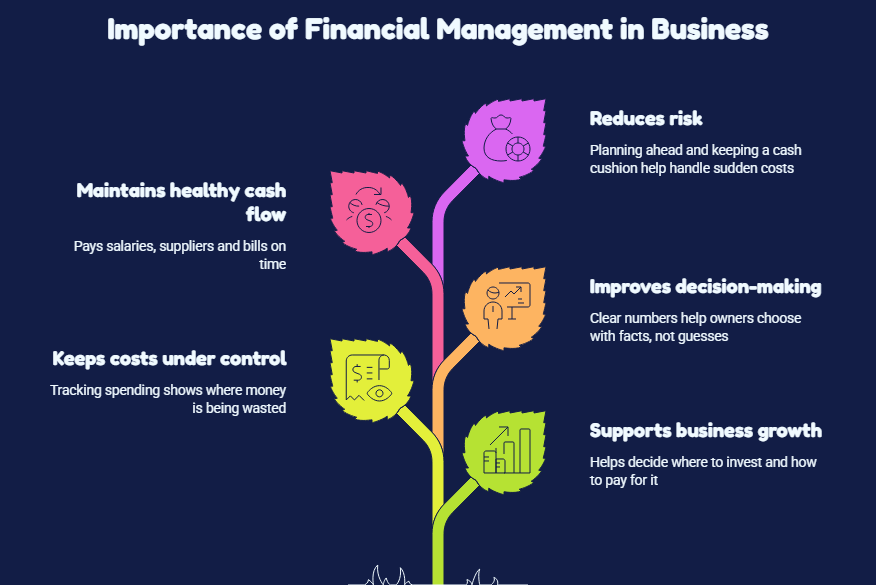
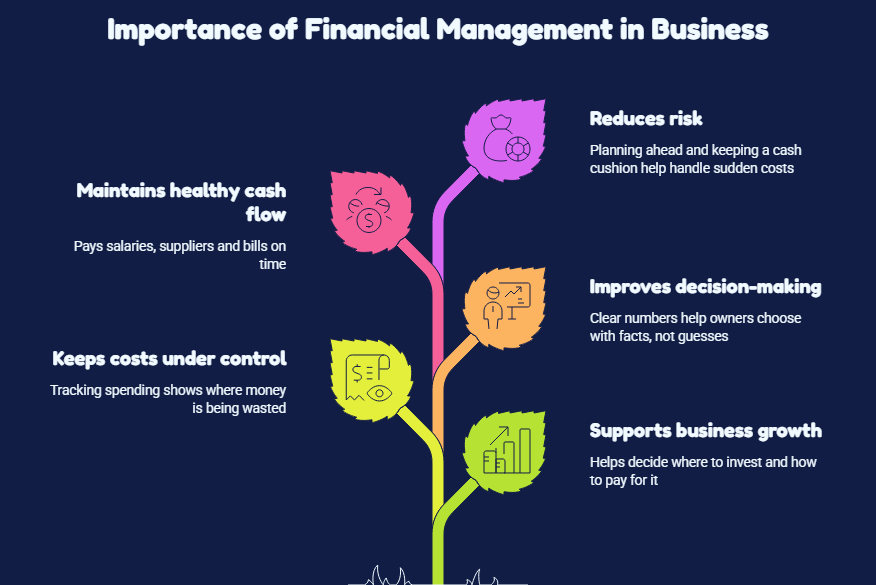
Why Is Financial Management Important for a Business?

Good financial management keeps a business steady today and ready for tomorrow. 

Here is how it helps.
Importance of Financial Management in BusinessImportance of Financial Management in Business
  • Growth: Helps the business know what to invest in (for example buying new equipment, creating a new product, or increasing the staff) and how they can raise money to do it.

  • Cost control: By keeping track of their spending they know where they are wasting money and can reduce costs without affecting quality.

  • Better decisions: Knowing exactly how much profit, costs and cash they have makes it easier for owners to make informed decisions.

  • Good cash flow: Ensures that the business can pay their wages, suppliers and bills on time even if they aren’t making much money.

  • Low risk: If they plan ahead and build up some cash then they will be able to cope with any unexpected costs, lower sales or higher loan costs.

Financial Management Examples in Real Life

Below are four simple examples from different small businesses. Each one shows how planning helps decide where money should go first. All names and numbers are made up and used only for explanation.

Example 1: A Clothing Store

Meera has ₹2,00,000 for the month. The festive season is coming, and she is also thinking about a second shop.

  • Inventory (₹80,000): Buys festive stock, but avoids over-buying.

  • Salaries (₹60,000): Set aside first, so staff is paid on time.

  • Marketing (₹20,000): Runs ads and offers for the busy season.

  • Expansion (₹20,000): Saves a small amount for the second shop.

  • Cash cushion (₹20,000): Kept for sudden costs.

Lesson: Essential costs come first. Growth plans get what is left.

Example 2: A Small Café

Arjun runs a café and has ₹3,00,000 to plan for the next quarter. Customers are growing, but the kitchen is getting crowded.

  • Inventory (₹90,000): Buys ingredients in the quantity he can use quickly, since food spoils.

  • Salaries (₹1,00,000): Pays his cook and service staff.

  • Marketing (₹30,000): Promotes a new weekend menu on social media.

  • Expansion (₹50,000): Puts money toward a bigger kitchen counter.

  • Cash cushion (₹30,000): Keeps it for repairs and slow weeks.

Lesson: When stock can spoil, buying less and more often protects cash.

Example 3: An Online Brand

Sana starts a small online skincare brand with ₹5,00,000 from savings and a family loan.

  • Inventory (₹2,00,000): Orders her first batch of products from a supplier.

  • Salaries (₹1,50,000): Pays a packing helper and a part-time designer.

  • Marketing (₹1,00,000): Spends on ads, since a new brand needs customers to find it.

  • Expansion (₹30,000): Improves her website to handle more orders.

  • Cash cushion (₹20,000): Keeps a small reserve for returns and delays.

Lesson: A new business may spend more on marketing, but it should still keep money for stock and salaries.

Example 4: A Small Factory

Imran runs a unit that makes plastic containers. He has ₹10,00,000 to plan for the next three months.

  • Raw material and inventory (₹4,00,000): Buys material for confirmed orders only.

  • Salaries (₹3,00,000): Pays workers and supervisors.

  • Marketing (₹50,000): Reaches out to new buyers and distributors.

  • Expansion (₹1,50,000): Sets aside money to upgrade one machine.

  • Cash cushion (₹1,00,000): Covers late payments from buyers.

Lesson: Buyers often pay late, so a cash buffer keeps production running.

What these examples show

  • Pay for essential costs, like salaries and stock, before anything else.

  • Spend on growth with the money that remains.

  • Always keep a small cushion for surprises.

  • Check the numbers regularly and adjust the plan.

Build Your General Management Skills with IIM Bangalore’s Emerging Leaders Program

Ready to move from doing the work to leading it? The IIM Bangalore Emerging Leaders Program (ELP) for Working Professionals helps you build working depth in leadership, finance, customers, strategy and data. It prepares you to take on broader, cross-functional ownership in your organisation.

Why choose this program?

  • Build leadership skills to manage people, performance and conflict

  • Strengthen your financial acumen and understanding of customer value

  • Sharpen strategic thinking and data-driven decision making

  • Apply leadership concepts in The Arena, a live business simulation

  • Work on a real problem in your own organisation through a faculty-guided action learning project

Skills Required for Financial Management

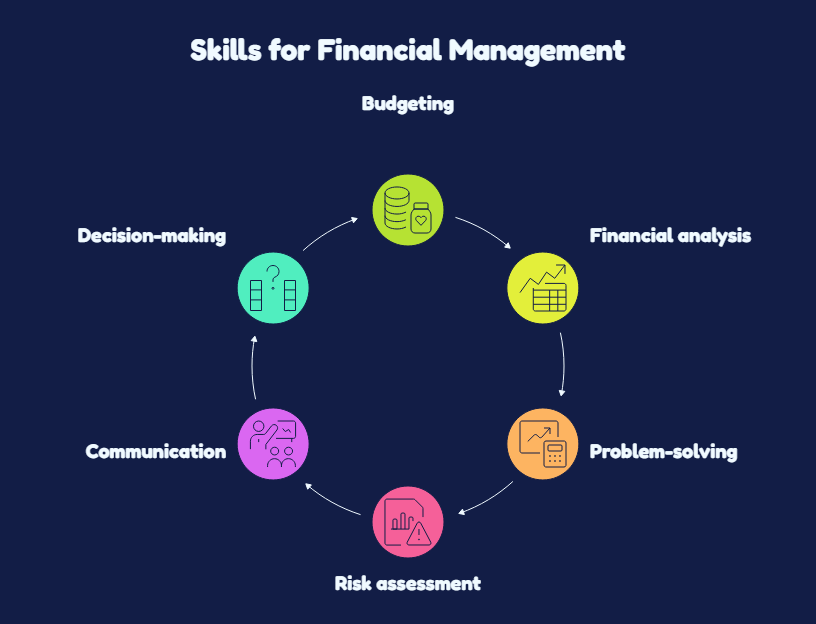
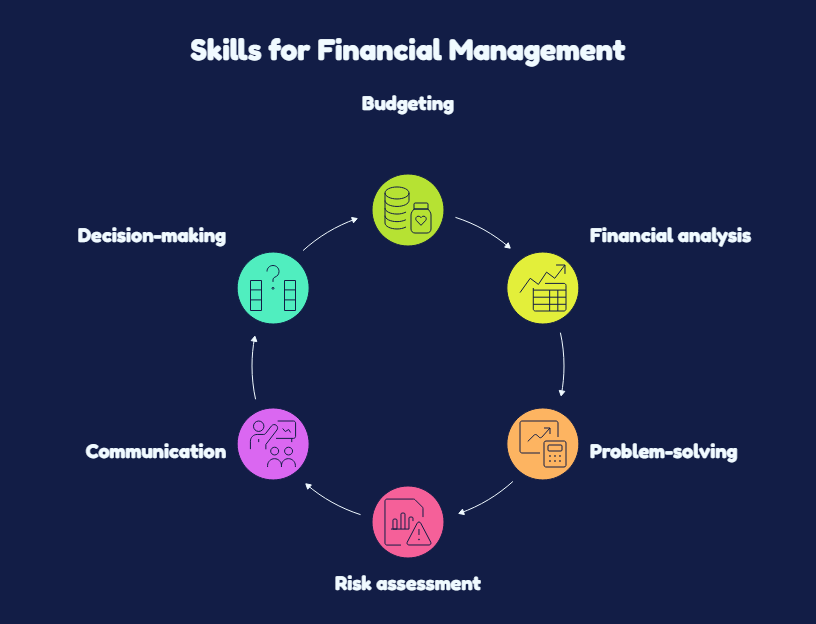
Managing a business’s money takes a mix of number skills and people skills. Here are the key skills that help.

Skills Required for Financial ManagementSkills Required for Financial Management
  • Budgeting - planning your spending and saving and keeping track of your spending.

  • Financial analysis - using financial statements and ratios to understand how well the business is doing.

  • Problem solving - providing solutions to problems faced such as increased costs, decreased sales or lack of cash.

  • Risk management - identifying risks (such as late payments, market changes) and preparing for them.

  • Business Communication skills - being able to explain numbers in an easy way to non-finance people such as the owners, teams and investors.

  • Decision making - using data and facts to help decide which option will be the best, such as buying equipment or saving cash.

Career Opportunities in Financial Management

Financial management skills are useful in many roles across banks, companies, consulting firms, and startups. The table below explains various job roles and their annual salary range.

Role

Annual Salary Range

Financial Analyst

INR 6.5-7.2 LPA

Finance Manager

INR 16.7-18.5 LPA

Investment Analyst

INR 12.6-13.9 LPA

Treasury Manager

INR 17.1-19 LPA

Financial Controller

INR 27.2-30 LPA

Sourced from Ambitionbox

Scope of Financial Management

Financial management affects many areas of business to do with planning, spending and managing money. The different areas are:

  • Business and Corporate Finance: Managing finances, keeping costs down and growing within your business whether its a small shop or large business.

  • Banking and Financial Services: Managing loans, deposits, investments and risk within banks and financial companies.

  • Government and Public Finance: Managing budgets, tax revenue and public spending.

  • Personal Finance: Managing income, savings, loans and investments in a household.

  • Startups and New Ventures: Raise funds, manage cash flow and plan growth with little money available.

  • Non Profits: Manage donations and grants so they can be used effectively for their cause.

  • International Business: Managing foreign exchange, international payments and investments.

Conclusion

Financial management consists of making wise decisions on how you manage your money. Whether you are running a small shop or large company financial management helps you plan your finances, control your spending, maintain cash flow, and manage risk. Once you are aware of what the aims, roles and types of financial management are you will find it much easier to understand the numbers.

If you are interested in this topic then why not start by keeping track of your income and expenditure for a month. Create a basic budget. This will help develop your skills in financial management. Which could help to support a career in finance, banking, and business.

Khushi Upadhyay

Khushi Upadhyay

4+ of articles published

Top Contributor

Associated with upGrad since 05 Nov 2024


Current role in the industry :

Senior Associate - Content

Education Qualification :

B.Com

Tools & Technologies :

SemrushGrammarly

Certifications :

Master's Certificate in Digital Marketing

About

Khushi Upadhyay is a Senior Associate - Content with 3+ years of experience in SEO, content strategy, blogs, and program pages. She creates engaging, search-focused content that improves organic visibility and connects with readers.

No blogs published yet.

Latest Blogs

minimum viable product
Nov 1st, 2026

minimum viable product

A Minimum Viable Product (MVP) refers to the most fundamental form of a product with basic features, intended to prove an idea among initial users.

Read More
PESTEL Analysis: 6 Factors, Framework & Examples
Nov 1st, 2026

PESTEL Analysis: 6 Factors, Framework & Examples

Learn what PESTEL analysis is, explore its six key factors, understand how the framework works, and discover examples, benefits, and limitations.

Read More
Supply Chain Management: Meaning, Process and Benefits
Nov 1st, 2026

Supply Chain Management: Meaning, Process and Benefits

Learn what supply chain management means, how it works, its five stages, different models, key benefits, common challenges, and ways to improve efficiency.

Read More

Frequently Asked Questions

General

Copyright 2026 of [University Name]