

Key Highlights
Innovation management is the systematic approach to convert ideas or opportunities from just ideas to the implementation stage, such as productive goods, services, processes, or business models.
Effective innovation management involves aligning creative activities and ideas to the goals of a business, helping organizations spot, evaluate, develop, implement, and analyze innovative ideas.
Some of the key elements of innovation management include strategy, leadership, collaboration, innovation culture, idea evaluation, resources, processes, and continuous improvement.
A systematic innovation management process helps organizations go from spotting opportunities and ideas to implementing and improving innovation.
In this blog, you will learn about the meaning, types, elements, six-step process, strategy, advantages, drawbacks, and best practices of innovation management.
Ready to move beyond your current role and take on broader business responsibilities? Explore the IIM Bangalore Young Leaders Programme (YLP) to strengthen your skills in strategy, finance, operations, people management, and leadership.
What Is Innovation Management?
Innovation management is the process by which an organisation takes an innovative idea from the ideation stage to the implementation stage. It involves deciding which ideas deserve attention, assigning resources, testing assumptions, and tracking outcomes.
Let's take the example of Netflix. It moved the whole world from DVD rentals to online streaming. They found an opportunity when they realised people want to see shows and movies in their own time. They introduced streaming and tested how customers used it. Then improved the service based on their feedback and used the learnings to create original shows.
This is how innovation management works. A company spots an opportunity, tries an idea, checks the results, improves it, and looks for the next opportunity.
Why Is Innovation Management Important for Organizations?
Organizations have to keep up with the changing needs and expectations of the customers. New operational challenges, changing market conditions, and the introduction of new technologies push them to develop their systems if they want to be in business. Innovation management helps organizations respond to these changes by finding new ideas, testing them, and putting useful solutions into practice.
Innovation management supports development of better products, improved processes, new services, and alternative business models. This also provides organizations with a means of ensuring an appropriate balance between experimentation and organizational priorities, especially when resources are limited.
Let’s take BlackBerry as an example. The company was well known for its smartphones and secure messaging services. But as customers started preferring touchscreen phones and mobile apps, the market changed. BlackBerry was slow to adapt to these changes, which is why it lost a significant share of the smartphone market and eventually stopped making smartphones.
What Are the Key Principles and Elements of Innovation Management?
Here are the key principles and elements of Effective innovation management:
Innovation Strategy and Business Alignment
There should be a clear goal for innovation. The business should know the problem that it wants to solve and the outcome that it wants to produce.
For example, the goal may involve the improvement of customer service, reduction of costs, entry to a new market, or generation of income from a new source. Without it, teams will generate plenty of ideas but will not know which ideas to select.
People, Leadership and Collaboration
Innovation does not belong to an individual employee. Employees, leadership, clients, and even different teams can contribute their ideas and knowledge to it.
It is essential that leaders give employees enough opportunities to experiment. In addition, each idea requires a person to be accountable for its implementation.
Innovation Culture
Innovation culture means the development of an environment in the company that will motivate employees to share and test their ideas. Employees should be allowed to try something new and receive feedback on their failures.
At the same time, not all ideas have to be accepted.
Idea Management and Evaluation
Organizations need a simple way to collect and review ideas.
They should check whether an idea solves a real problem, whether customers need it, how much it might cost, and whether the organization can make it work. This helps teams choose the most useful ideas.
Resources and Innovation Processes
To be implemented successfully, good ideas need appropriate resources. Teams require financing, people, technology, time, and client feedback among other things. An appropriate process allows teams to know when it is necessary to test, improve, or abandon an idea.
Measurement and Continuous Improvement
Measurements enable organizations to see whether what they are doing is working or not. Useful measures consists of adoption, implementation time, customer feedback, revenue impact, cost savings, or operational improvements.
Learning does not stop when the initiative begins. Lessons from the outcomes must influence future decisions and allow people to adjust course if the current strategy is not working.
Must read: Performance Management Process: Steps & Best Practices
What Are the Types of Innovation?
There are different types of innovation based on what an organisation needs. Here are the types explained with some examples.
Also read: What Is Change Management? Process, Types & Models
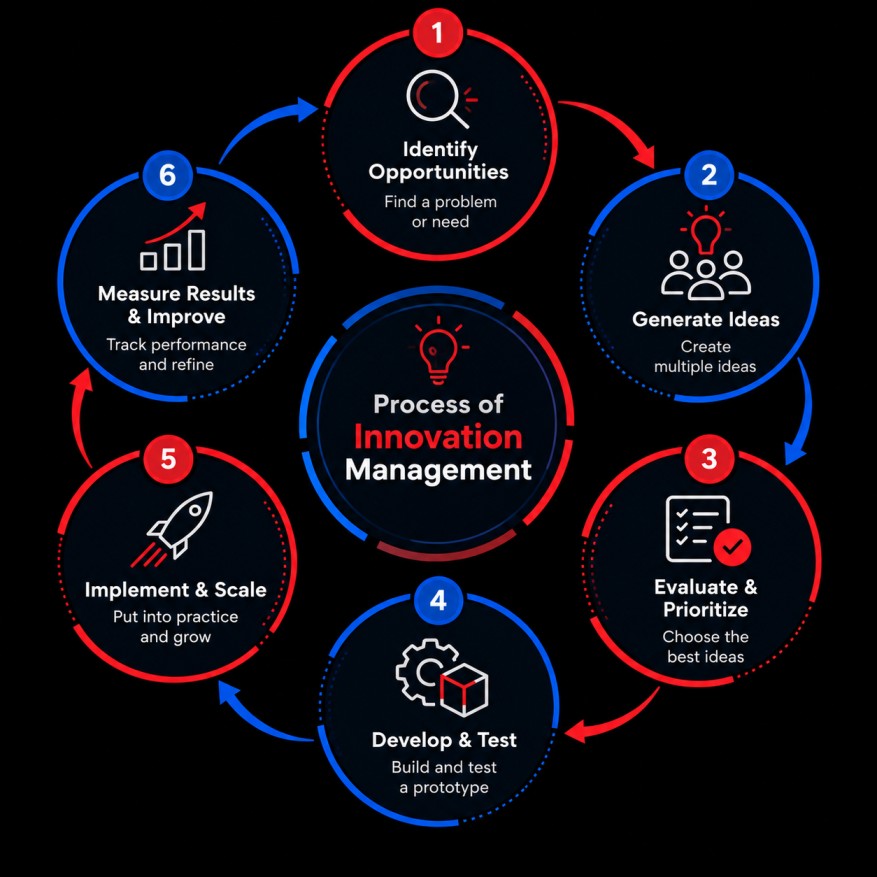
Process of Innovation Management: 6 Important Steps
The process of innovation management gives the organisation a step by step way of turning an opportunity from testing stage to implementation stage. Each stage is hence very important for the process of innovation:
Step 1: Identify Opportunities
Start with a problem, unmet demand, market change, operational issue, or emerging opportunity. Sources can include customer feedback, employees, research, competitor activity, technology developments, and performance data.
Start with understanding the problem. Investigate it. This will prevent wastage of resources.
Step 2: Generate Ideas
Once the opportunity becomes clear, teams start to generate possible solutions. Ideas can come from employees, or by doing brainstorming, using customer interviews, or dedicated innovation workshops. The main goal here is the quantity of ideas.
Do read: Data Driven Decision Making: Guide for Better Decisions
Step 3: Evaluate and Prioritize Ideas
Not every idea will flourish. Teams need criteria for deciding which ideas deserve further development.
Useful criteria include:
Strategic fit
Customer value
Feasibility
Cost
Risk
Expected impact
Available resources
This step will make sure no bad ideas are selected.
Do read: Strategic Management: Process, Importance & Examples
Step 4: Develop and Test the Innovation
In this step, teams can create prototypes, minimum viable versions, pilots, simulations, or controlled experiments depending on the type of innovation.
Testing should focus on the assumptions that could make the idea fail. What do customers actually want? Can the solution work technically? Can the organization deliver it at a reasonable cost?
Small tests can answer these questions before a large investment is made.
Also read: Entrepreneurial Leadership: Meaning, Skills & Benefits
Step 5: Implement and Scale
After testing proves that the idea works, it can be implemented in the business. This phase requires thorough planning because new challenges may emerge during the implementation stage. Teams will have to think about the cost, customer reaction, resource, and risk factors.
Step 6: Measure Results and Improve
This final stage is about learning from real-world performance. Compare the results against the original objectives and see what worked, what didn't, and what needs to change.Track adoption, revenue impact, or efficiency gains
Must read: Business Communication Skills: Types and How to Improve