What Are the Types of Business Communication?
Business communication can be classified in several ways. Here are the main categories:
Internal vs External Communication
Internal communication takes place within an organisation. For example, team meetings, employee emails, project updates, and manager briefings.
External communication involves people outside the organisation. Client emails, supplier discussions, customer support, media communication, and investor updates are common examples.
Also read: Strategic Management: Process, Importance & Examples
Formal vs Informal Communication
Formal communication follows an established professional structure. Reports, official emails, presentations, and policy announcements fall into this category.
Informal communication is less structured. A quick conversation with a colleague or an informal team message can help people exchange information quickly.
Verbal, Written, and Nonverbal Communication
Verbal communication includes conversations, meetings, calls, presentations, and interviews.
Written communication includes emails, reports, proposals, messages, and business documents.
Nonverbal communication includes facial expressions, posture, gestures, eye contact, and tone. These signals can affect how people interpret a spoken message.
Must read:Organizational Management: Meaning, Functions & Types
Upward, Downward and Horizontal Communication
Upward communication moves from employees towards managers or senior leaders.
Downward communication moves from managers to employees. Instructions, expectations, and organisational updates often follow this direction.
Horizontal communication happens between colleagues or teams at similar levels. It supports coordination and problem-solving.
Also Read: What Makes a Good Leader? 10 Essential Qualities and Skills
What Are the Essential Business Communication Skills?
Strong professionals don't rely on one communication skill. They combine several skills depending on the situation.
Active Listening
Active listening means paying attention to what someone is saying instead of interrupting the conversation in between. It includes understanding what they intend to mean and not just go by the words. Asking relevant questions and confirming crucial information helps you to avoid any misunderstandings.
Active listening doesn’t mean to stay quiet and being lost in your own world. This is the skill that helps you prevent misunderstandings, missed details, incorrect assumptions, irrelevant responses, workplace errors, and strained professional relationships.
Verbal Communication
Good verbal communication means to convey your thoughts clearly to the other person in simple words so that they understand you.
You should organise your thoughts before you speak to be able to effectively communicate. The correct tone, words, pace and structure when speaking matters a lot in verbal communication. It decides how people are going to take your words and respond.
Be respectful.
Written Communication
Written messages need proper construction of words and sentences to be able to communicate clearly. Writing in clear and simple words, explaining the subject matter in a logical manner, and keeping the content to the point without being distracted from the main intent are some of the best practices.
Must read: Business Process Management: Types, Lifecycle & Benefits
Nonverbal Communication
Your body language, facial expressions, posture, and eye contact all constitute nonverbal communication. Even if you choose the right words, if your body language does not go well with your words, your communication will have a different response. It can totally change the way your words will be taken.
Emotional Intelligence
Emotional intelligence helps professionals recognise their own reactions and understand other people's perspectives. It's particularly useful during difficult conversations.
Giving and Receiving Feedback
Useful feedback helps someone work on their behaviour, outcomes, and specific improvements. Receiving feedback requires an open mind to receive the information rather than giving an immediate defensive reaction.
Must read: Transformational Leadership Style: Meaning and Benefits
Conflict Resolution
Workplace disagreements are normal. Good communication helps people focus on the issue, understand different viewpoints, and work towards a practical solution.
Negotiation and Persuasion
Negotiation involves understanding different interests and finding acceptable outcomes. Persuasion relies on clear reasoning, relevant evidence, and an understanding of what matters to the other person.
Also Read: 10 Major Leadership Theories for Workplace Success
What Makes Business Communication Effective?
Effective communication isn't simply about sending information. The message needs to be understood in the way the sender intended.
1.Clarity and Conciseness
Lead with the main point. Remove unnecessary details that could distract the reader.
2.Accuracy and Completeness
Facts, names, dates, figures, and instructions need to be correct. A message that's brief but missing essential information can create another problem.
3.Audience Awareness and Appropriate Tone
The same message won't work for every audience. You'll communicate differently with a client, colleague, senior leader, or new employee.
4.Active Listening and Feedback
Communication works in both directions. Listening and feedback help people check whether the message was actually understood.
5.The 7 C's of Business Communication
The 7 C's provide a useful quality check:
Clear
Concise
Concrete
Correct
Coherent
Complete
Courteous
Before sending an important message, ask yourself whether the reader can understand the purpose without needing several follow-up questions.
Must read: Leadership Management: Meaning, Skills, Styles & Importance
How to Choose the Right Business Communication Method?
The best communication method depends on the message, audience, urgency, and level of detail. Here is how you can choose the right method:
When to Use Verbal Communication
Use verbal communication for discussions that need immediate interaction, clarification, or a personal response.
When to Use Written Communication
Written communication works well for detailed information, instructions, records, and decisions that people may need to revisit later.
When to Use Visual Communication
Charts, diagrams, presentations, and other visual formats can help when you're explaining data, processes, or complex relationships.
Synchronous vs Asynchronous Communication
Synchronous communication happens in real time, such as meetings and calls. Asynchronous communication includes emails and recorded updates that people can review when available.
Situation | Suitable method |
Urgent discussion | Verbal |
Detailed instructions | Written |
Complex data | Visual |
Real-time problem-solving | Synchronous |
Routine project update | Asynchronous |
Also read: What Is Servant Leadership? Meaning, Benefits & Examples
What Are the Common Barriers to Business Communication?
Communication barriers can disrupt a good communication channel. Different backgrounds, technologies, emotions, and organisational structures can all affect how information is exchanged.
Communication Barrier | What It Means | How to Overcome It |
Language and Semantic Barriers | Different meanings, jargon, or unclear words can cause confusion. | Use simple language, avoid unnecessary jargon, and ask questions when something isn't clear. |
Physical and Technical Barriers | Poor internet, background noise, or technical issues can disrupt communication. | Use reliable tools, reduce distractions, and share information through accessible channels. |
Emotional and Psychological Barriers | Stress, fear, frustration, or defensiveness can affect how people communicate. | Stay calm, listen carefully, and give people space to explain their concerns. |
Cultural Differences | People from different cultures may have different communication styles and expectations. | Respect differences and adjust your tone and approach when needed. |
Organisational and Hierarchical Barriers | Employees may hesitate to speak up, or information may change as it moves between levels. | Encourage open communication and use clear channels for sharing feedback and concerns. |
Also read: What Is Business Management? Roles, Skills & Types
How to Improve Business Communication Skills?
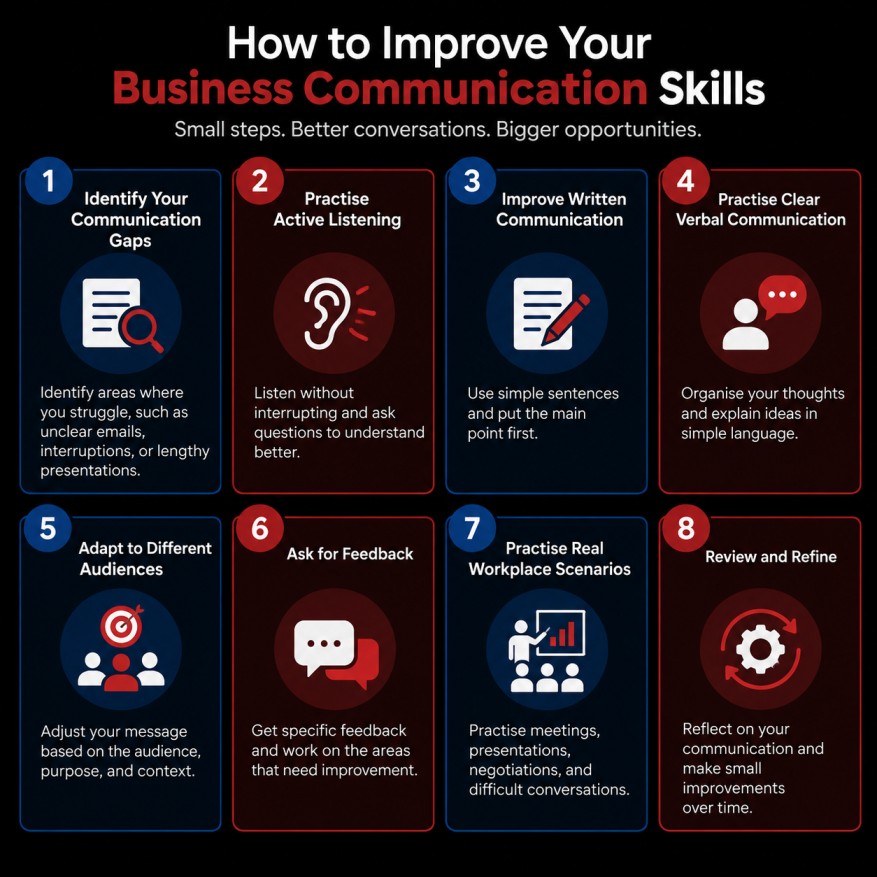
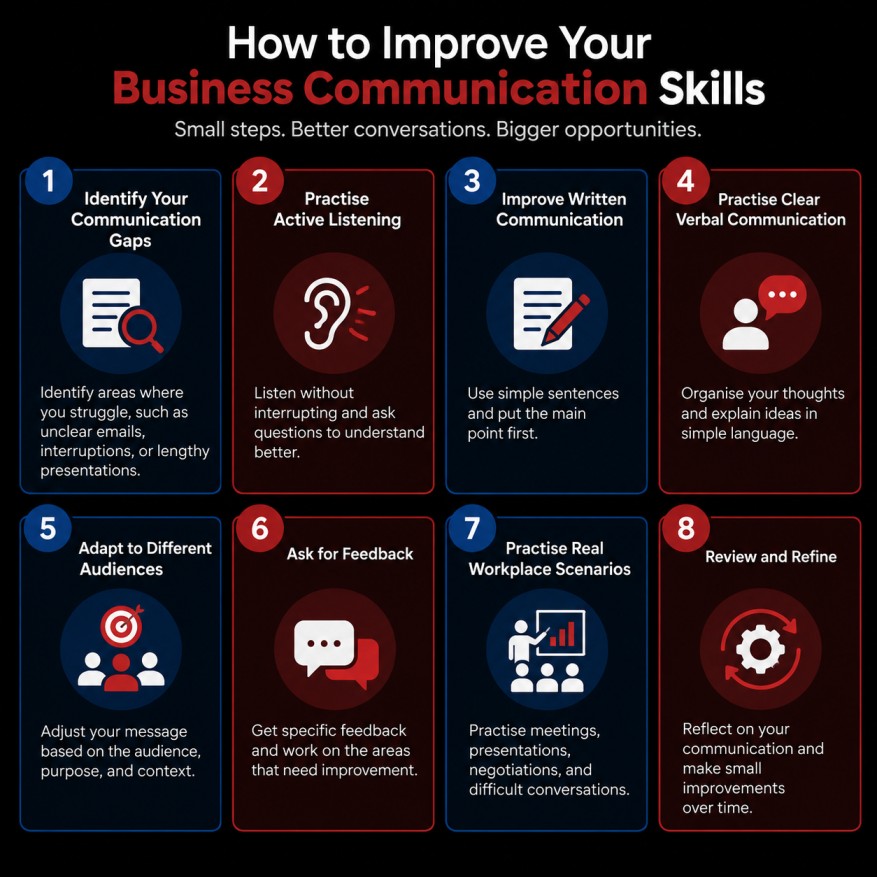
Improvement comes through repeated practice. Here is a step-by-step way to improve your business communication skills: