University Logo
Admissions Open for the 2026 Cohort
Phone1800 210 2020
IIMBx - Digital Learning Foundation

Organizational Management: Meaning, Functions, Principles & Types

  1. Home
  2. Organizational Management: Meaning, Functions, Principles & Types

Key Highlights

  • Organizational management is the process of planning, organizing, leading, and controlling people and resources to achieve an organization's goals.

  • It is the invisible system that decides who does what, when, and how well the whole thing holds together. 

  • It connects business objectives with the people, structures, processes, and decisions needed to turn those objectives into results.

  • This blog explains how organizational management works, its purpose, key functions, principles, elements, types, benefits, and common challenges.

Ready to move beyond your current role and take on broader business responsibilities? Explore the IIM Bangalore Young Leaders Programme (YLP) to strengthen your skills in strategy, finance, operations, people management, and leadership. 

What Is Organizational Management?

Organizational management refers to the way an organization manages its people, resources, activities, and processes to achieve their goals for the organisation. It is how managers at different levels of the organisation contribute together by setting priorities, assigning responsibilities, coordinating work, and reviewing results to reach the ultimate goals of the organisation.

In very simple words, it is the strategic way how you can get a group of people to work towards the same goal. It is not one single task, its a continuous cycle.

What Is the Purpose of Organizational Management?

The purpose is straightforward. An organization needs a practical way to turn goals into coordinated action.

Good management helps an organization:

  • Align employees with business objectives

  • Assign responsibilities clearly

  • Coordinate activities across teams

  • Allocate resources according to priorities

  • Monitor performance

  • Respond to changing business conditions

  • Improve how work gets done

Also read:  What Is Business Management? Roles, Skills & Types

What Are the Key Functions of Organizational Management?

There are four core key functions of organisational management. These are planning, organizing, leading, and controlling. They all work together to determine where the organization is going, arrange the resources required, guide people through execution, and check whether results match expectations.

1. Planning

Planning starts with clear objectives. It starts with planning and creating a roadmap for the organisation. This involves organisation’s long term plans, the strategy to reach there, short term and long term targets.

2. Organizing

Organizing is about structuring the organisationion, assigning responsibilities, creating reporting relationships, and deciding how resources will be utilised and where. This is where departments, job roles, and organizational charts come in. A clear structure makes it easier to know who can make decisions and who is responsible for the results. 

3. Leading

Leading involves guiding, motivating, and supporting employees towards the organisation's goals. It means understanding what employees need, helping them grow, and creating an environment where they can stay motivated, engaged, and perform well. 

4. Controlling

Controlling means checking whether the organization is on track to meet the planned goals. It’s about comparing the actual results with the plan and finding gaps. And then plan actions when something isn’t working as expected. But It’s not about watching every employee or micromanaging them. It’s about tracking their progress, finding problems early, and making changes before the issues turn into big problems

Do read: Transformational Leadership Style: Meaning and Benefits 

What Are the Core Principles of Organizational Management?

Effective management follows a few basic principles. These principles guide everyday decisions. They aren't strict rules. Instead, they help managers find the right balance between structure and flexibility. 

Too little structure creates confusion, while too much can slow decisions, delay work, and limit initiative.

Fayol's 14 Principles of Management

Henri Fayol, often called the Father of Modern Management, developed a set of principles to explain how organizations can be managed effectively. His ideas were designed to apply across different management levels and departments. His main focus was improving managerial efficiency. 

Many of his principles are still useful today for organizing work, assigning responsibilities, and managing an organization’s internal activities.

Henri Fayol's 14 principles remain a well-known foundation in management education. They are as follows:

Principle

What It Means

Division of Work

Specialization can improve efficiency and output

Authority and Responsibility

Authority should come with accountability

Discipline

Rules and agreements should be respected

Unity of Command

Each employee should have one direct manager

Unity of Direction

Teams working toward the same goal should follow one plan

Subordination of Individual Interest

Organizational goals should take priority over personal interests

Remuneration

Fair pay can support motivation and performance

Centralization

Decision-making power should be balanced across management levels

Scalar Chain

There should be a clear line of authority

Order

People and resources should be in the right place

Equity

Managers should treat employees fairly and respectfully

Stability of Tenure

High employee turnover can reduce efficiency

Initiative

Employees should be encouraged to share ideas and take initiative

Esprit de Corps

Team spirit and cooperation help build unity

Also read: Situational Leadership: Model, Styles & Examples Guide 

What Are the Main Elements of Organizational Management?

Organizational management brings several elements together. Here are they:

1. People

Any organisation is made up of their employees. Employees and management carry out the organization's work. Their skills, responsibilities, motivation, and collaboration therefore, affect performance of the whole organisation. People in an organisation are its foundation.

2. Organizational Structure

Structure is the framework that defines roles, responsibilities, reporting relationships, authority, and coordination within the organisation. It gives direction to the organisation’s efforts. It shapes how information and authority flow through a company. It defines the hierarchy which is essential for any company’s work flow.

3. Processes

Processes are the steps people follow to get work done. Clear processes reduce confusion, avoid delays, and help teams work together smoothly on regular tasks.

4. Resources

Resources include people, money, technology, information, equipment, and time. Any organisation’s success also depends on how much its resources are utilised to their full potential. How the resources are managed determines if the organisation will struggle or succeed. 

5. Goals and Performance

Goals give teams direction. Tracking the performance tells us whether those goals are being achieved.

6. Communication

Communication connects every element of the organisation. If priorities change and  teams don't know about them, even a carefully designed structure or plan can fail.

Also read: What Is Change Management? Process, Types & Models 


What Are the Different Types and Approaches to Organizational Management?

Organizations use different management approaches depending on their size, structure, objectives, and operating environment. There's no single right way to manage an organization. 

Different structures suit different business models and team sizes.

Common approaches include:

  • Functional management: Groups employees by their area of expertise, such as marketing, finance, or operations.

  • Divisional management: Organizes teams around products, regions, or specific markets.

  • Matrix management: Combines functional teams with project-based teams, so employees may report to more than one manager.

  • Team-based management: Gives cross-functional teams more responsibility for planning and delivering work.

  • Hierarchical management: Uses clear levels of authority, with decisions flowing through a defined chain of command.

  • Centralized management: Keeps major decisions with senior managers.

  • Decentralized management: Gives teams or business units more freedom to make decisions.

The types of organizational structure in management influence how these approaches work. A growing company might move from a simple structure to functional or divisional arrangements as responsibilities become more specialized.

Must read: Business Process Management: Types, Lifecycle & Benefits   

How Does Organizational Management Work in Practice?

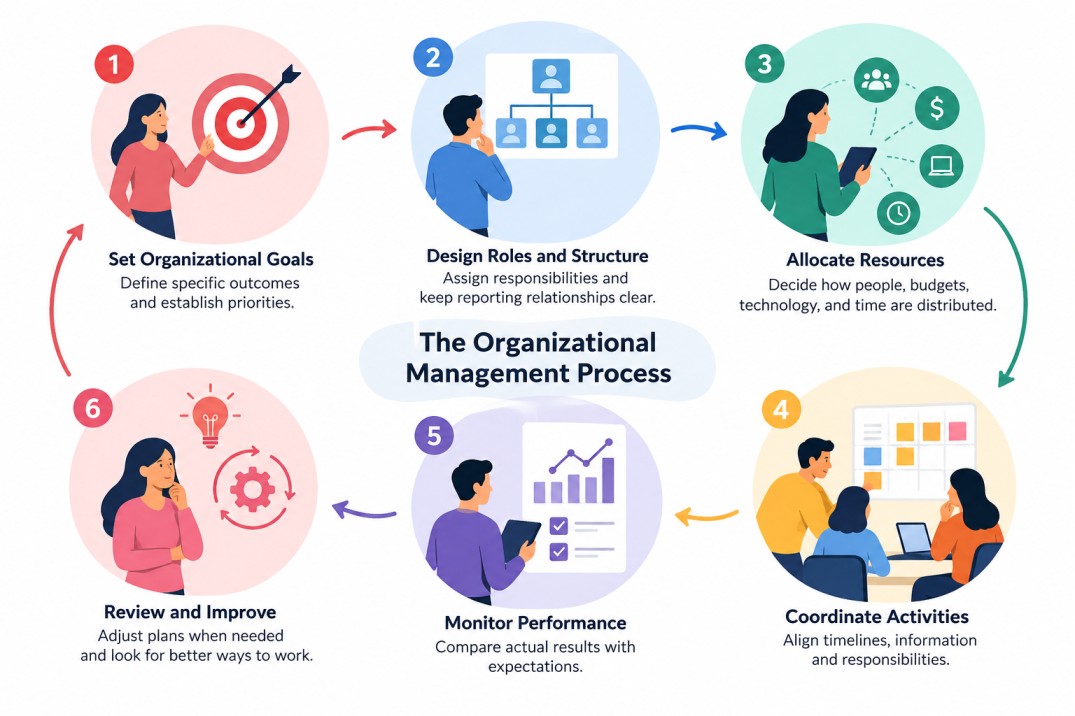
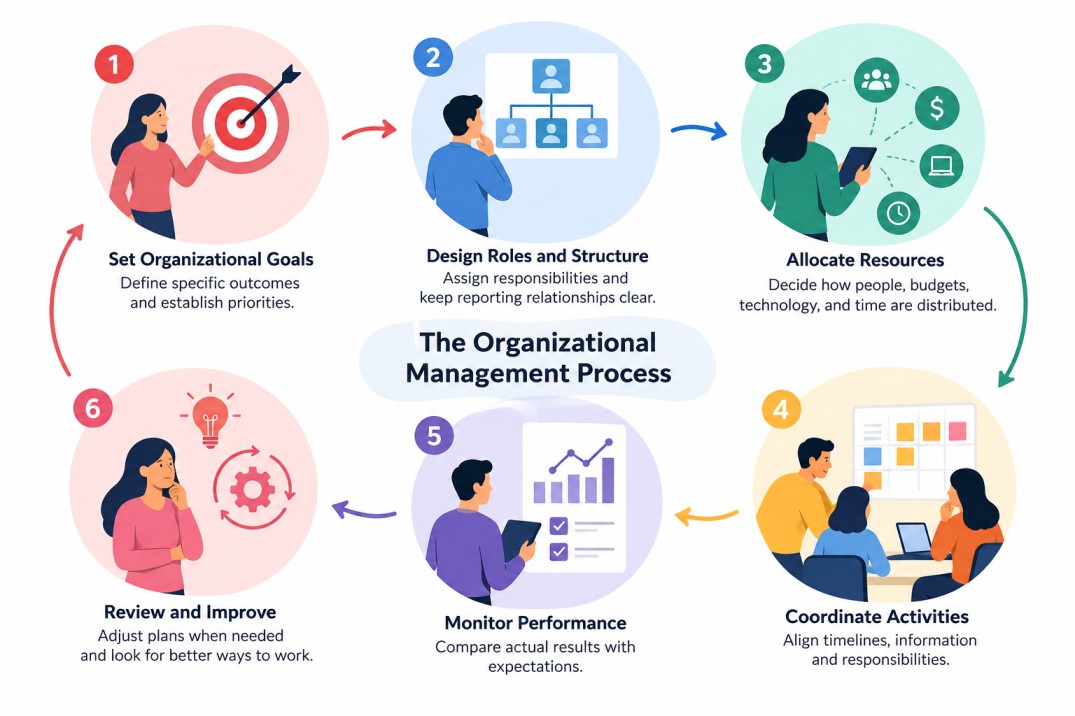
Organisational management process starts with a business objective and moves through the execution, measurement, and improvement part. 

Organizational management process showing six steps: setting goals, designing roles, allocating resources, coordinating activities, monitoring performance, and reviewing and improving.Organizational management process showing six steps: setting goals, designing roles, allocating resources, coordinating activities, monitoring performance, and reviewing and improving.

Organizational change management helps teams adjust when a company changes its structure, strategy, technology, or processes. 

Must read: Transformational Leadership Style: Meaning and Benefits 
What Are the Benefits and Limitations of Effective Organizational Management?

Here are the benefits and limitations of organisational management

Benefits

Limitations

Better alignment between teams and business goals

Too much structure can reduce flexibility

Clearer roles and accountability

Rigid processes can make change harder

More efficient use of resources

Excessive management can limit creativity

Better coordination between teams

Complex hierarchies can slow decision-making

Faster and clearer decision-making

Building effective management systems takes time and resources

Also Read: 10 Major Leadership Theories for Workplace Success  

What Are the Common Mistakes in Organizational Management?

Problems usually appear when the organization's structure, people, and processes stop working together in collaboration.

Common Challenge

What It Looks Like

Unclear Roles and Responsibilities

Teams may duplicate work or leave tasks unfinished because ownership isn't clear.

Poor Communication

Important information doesn't reach the right teams, leading to confusion and inconsistent decisions.

Resource Constraints

Limited budgets, people, time, or technology make it difficult to handle every priority.

Resistance to Change

Employees may struggle to adopt new processes when they don't understand the reason for the change.

Conflicting Priorities

Different teams may focus on their own targets instead of shared organizational goals.

Micromanagement and Poor Delegation

Too many decisions stay with managers, which can slow work and limit employee ownership.

Weak Performance Measurement

Too many or poorly chosen measures can make it difficult to see whether important goals are being achieved.

Ready to strengthen your business knowledge and leadership capabilities? Explore the IIMBx Certificate in General Management for Emerging Leaders and gain practical insights to navigate business challenges, make informed decisions, and prepare for greater leadership responsibilities.

Organizational Management vs Related Management Concepts

There are some related terms which have almost similar meaning but they aren’t the same, here are the concepts:

Concept

Primary focus

Organizational management

Coordinating people, structures, resources, and processes

Business management

Managing business activities to achieve commercial objectives

Organizational leadership

Providing direction, influence, vision, and people-focused guidance

Operations management

Managing the processes and activities that produce goods or services

These concepts are related, but they aren't the same. Organizational management covers the bigger picture of how people, resources, and work are managed.

Business management focuses on running the business, while leadership focuses on guiding people and setting direction. Operations management deals more with day-to-day business activities. Organizational structure in management is one part of the wider management system.

Conclusion

Organizational management helps bring people, resources, processes, and goals together. It gives teams clear direction and helps managers coordinate work, track progress, and make better decisions.

Good management isn't about adding more rules or layers. It's about creating enough clarity for people to know their roles, work together, and stay focused on shared goals.

Frequently Asked Questions

General

Latest Blogs

How to Become a Project Manager: Skills and Career Path
Oct 5th, 2026

How to Become a Project Manager: Skills and Career Path

Learn how to become a project manager with the right skills, qualifications, experience, certifications, and career steps to grow in project management.

Read More
Product Strategy: Definition, Types, Process & Examples
Oct 5th, 2026

Product Strategy: Definition, Types, Process & Examples

Product strategy explained for beginners. Learn what it is, the main types, how to build one in 8 steps, real examples from Tesla and Spotify, and a template.

Read More
People Management Skills: Top 10 Skills for Leaders
Oct 1st, 2026

People Management Skills: Top 10 Skills for Leaders

Discover the top 10 essential people management skills every leader needs, why they matter, the types, the challenges, and practical steps to develop them.

Read More
Copyright 2026 of [University Name]