Also Read: General Manager Salary Per Month in India 2026: ₹5 Lakh+?
What Are the Characteristics of a Situational Leader?
Here are the key characteristics:
Adaptability: They adjust their approach when the situation changes instead of sticking to a familiar style.
Strong observation skills: They notice changes in an employee's skills, confidence, motivation, or level of independence.
Active listening: They ask questions, listen to concerns, and understand what an employee needs before deciding how to respond.
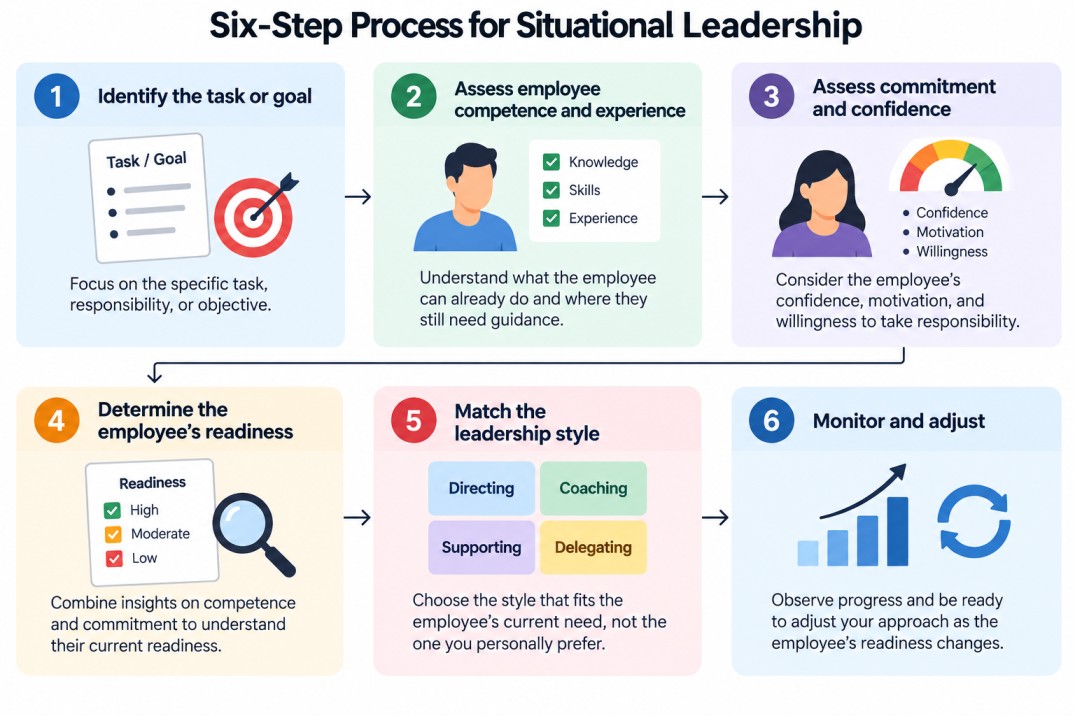
Assessment skills: They judge an employee's capability and commitment in relation to the specific task.
Coaching ability: They help employees develop their skills through guidance, feedback, and encouragement.
Comfort with ambiguity: They don't expect every employee or situation to fit the same playbook.
Self-awareness: They understand their own leadership preferences and know when to step away from them.
Balanced judgement: They know when to provide more direction and when to step back, avoiding both micromanagement and premature delegation.
Communication ties these qualities together. A leader needs to explain expectations clearly, ask useful questions, give constructive feedback, and know when to give an employee more room to work independently. A good situational leader also knows when to step back. The goal isn't to control every task. It's about giving employees the right level of direction and support for where they are at that point.
Sometimes the hardest move is knowing when not to step in. If an employee has the capability and commitment to solve a problem, taking control can slow their development rather than help it.
Do read: Assistant General Manager Salary in India 2026: Pay Guide
When Should Situational Leadership Be Used?
Situational leadership is particularly useful when employees have different levels of experience or when their responsibilities keep changing.
It can help when:
A new employee is learning an unfamiliar task
An employee is developing a new skill
Someone has the ability but lacks confidence
A high-performing employee is ready for more autonomy
A team is taking on a new project
Responsibilities change during organizational change
Employees need different levels of guidance on the same project
For example, imagine a project team with four people. One member is new to the work, another is learning quickly, a third is highly capable but uncertain about a major decision, and the fourth has handled similar projects independently.
Using one leadership style for the whole team wouldn't make any sense.
Do read: What Is Slack in Project Management? Types & Calculation
Situational Leadership Examples in the Workplace
The easiest way to understand situational leadership is through some everyday situations:
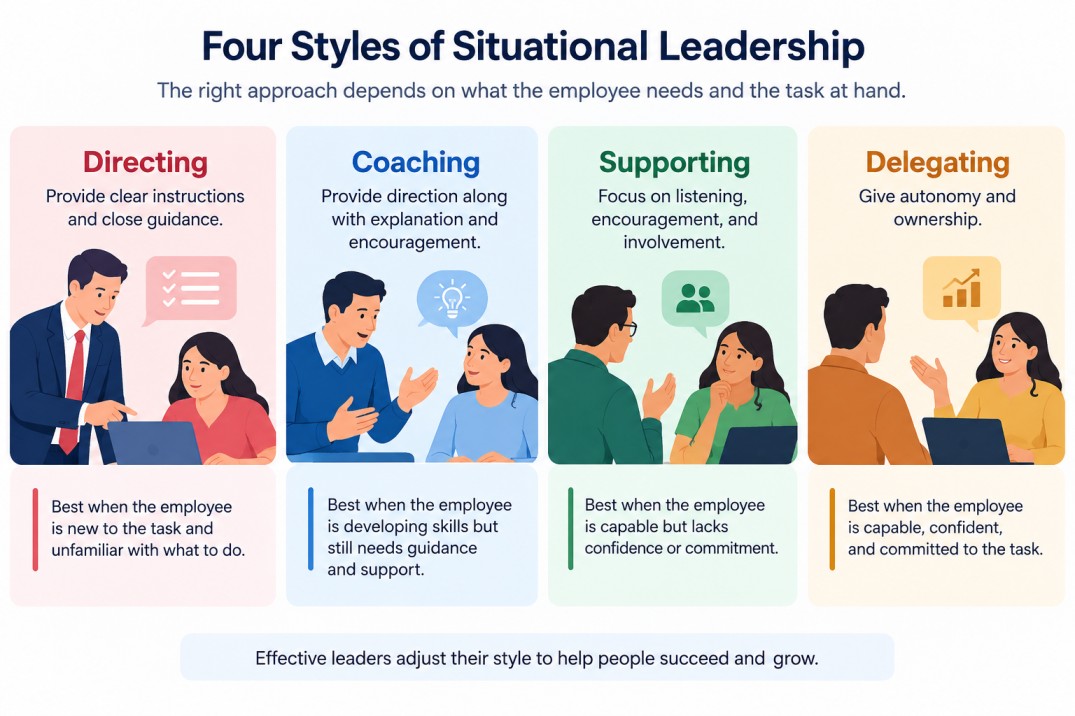
Training a New Employee: Directing
For example, a new employee is preparing their first monthly performance report.
They haven't used the reporting system before. So, their manager provides step-by-step instructions, shows the process, gives a deadline, and reviews the work closely.
The employee needs direction first.
Developing an Employee: Coaching
For example, the employee has now prepared several reports successfully but still struggles to interpret unusual results. The manager continues to provide guidance while asking questions, discussing possible explanations, and encouraging the employee to reach their own conclusions.
That's coaching.
Supporting an Experienced but Uncertain Employee
For example, an experienced employee is asked to lead a client presentation for the first time.
They understand the subject well but aren't confident about handling senior clients. Their manager doesn't take over the presentation. Instead, they discuss the approach, review key questions, offer reassurance, and encourage the employee to present it themselves.
That's supporting.
Delegating to a Highly Capable Employee
For example, a senior team member has handled similar projects successfully and understands the expected outcome.
The manager agrees on the goal, deadline, and key checkpoints, then gives the employee ownership of execution.
That's delegation.
The same person could need a different approach on another task. That's the point. Situational leadership focuses on the task-specific need, not a permanent label.
Ready to strengthen your business knowledge and leadership capabilities? Explore the IIMBx Certificate in General Management for Emerging Leaders and gain practical insights to navigate business challenges, make informed decisions, and prepare for greater leadership responsibilities.
Benefits and Limitations of Situational Leadership
Like every framework, situational leadership has several benefits and limitations.
Benefits | Limitations |
Adapts to individual employee needs | Requires regular and accurate assessment, which takes time |
Builds employee skills and confidence over time | Leaders may misjudge readiness and choose the wrong approach |
Reduces unnecessary supervision for skilled employees | Different leadership approaches may feel inconsistent to employees |
Provides a practical framework for day-to-day decisions | Doesn't account for wider organisational culture or systemic issues |
Works across different industries and team sizes | Requires leaders to be genuinely flexible and self-aware |
Improves communication between managers and employees | Assessing competence and commitment can be subjective |
Must read: Leadership Management: Meaning, Skills, Styles & Importance
Common Mistakes When Using Situational Leadership
The framework is simple to understand. But still, leaders can get the assessment wrong, stick with a familiar approach, or forget that an employee's needs can change.
Using one style for everyone: A manager might prefer delegation because they value independence. That doesn't mean every employee or task is ready for it. The approach needs to fit the agenda.
Assuming experience means readiness: An experienced employee can still be new to a particular responsibility.
Over-directing capable employees: Too much instruction can slow experienced employees and reduce their sense of ownership.
Delegating too early: Giving responsibility before someone has the required capability can create avoidable errors and frustration. Delegation works best when the employee is ready to take ownership of the task.
Confusing support with avoiding accountability: Support doesn't mean lowering expectations. Leaders can listen and encourage while still holding employees accountable for agreed outcomes.
Failing to reassess: An employee who needed close guidance three months ago might now be ready for greater autonomy. Regular check-ins help leaders adjust their approach as skills, confidence, and commitment change.
Must read: Business Process Management: Types, Lifecycle & Benefits
Situational Leadership vs Other Leadership Approaches
Situational leadership differs from other approaches mainly in what determines the leader's behaviour.
Situational Leadership vs Transformational Leadership
Here are the differences between the two:
Situational Leadership | Transformational Leadership |
Focuses on the needs of an individual employee and the task at hand | Focuses on a shared vision, motivation, and broader organisational change |
Adjusts leadership behaviour based on employee readiness | Inspires employees to work toward a larger purpose |
Changes the level of direction and support as needs change | Emphasises inspiration, commitment, and long-term goals |
Takes a task-specific and individual approach | Takes a broader team or organisational approach |
Can be used alongside transformational leadership | Can be combined with situational leadership |
Situational Leadership vs Contingency Theory
These approaches are very much similar but aren't the same.
Situational Leadership | Contingency Theory |
Focuses on adapting leadership behaviour to the employee and task | Focuses on matching a leader's style to the situation |
Assumes leaders can adjust their approach as needs change | Fiedler's model treats a leader's style as relatively fixed |
Looks at factors such as employee competence and commitment | Considers situational factors such as leader-member relations, task structure, and positional power |
Helps managers decide how much direction and support to provide | Helps organisations identify which situations best fit a leader's style |
Takes a practical, task-specific approach to leadership | Takes a broader approach to understanding leadership effectiveness |
Also Read: 10 Major Leadership Theories for Workplace Success
Conclusion
Situational leadership works best when leaders stop asking, "What's my leadership style?" and start asking, "What does this person need for this task right now?"
As mentioned earlier, Situational leadership works on the simple idea that different employees and tasks need different levels of direction and support. As employees gain skills and confidence, managers can step back and give them more responsibility. However, the framework doesn't remove the need for judgement.
It helps managers make that judgement by looking at an employee's competence, confidence, commitment, and the demands of the task. Leaders can choose an approach that fits the situation and adjust it as needs change. If used well, situational leadership can help managers avoid both micromanagement and a lack of support. It also gives employees room to develop while knowing their manager is there when they need guidance.