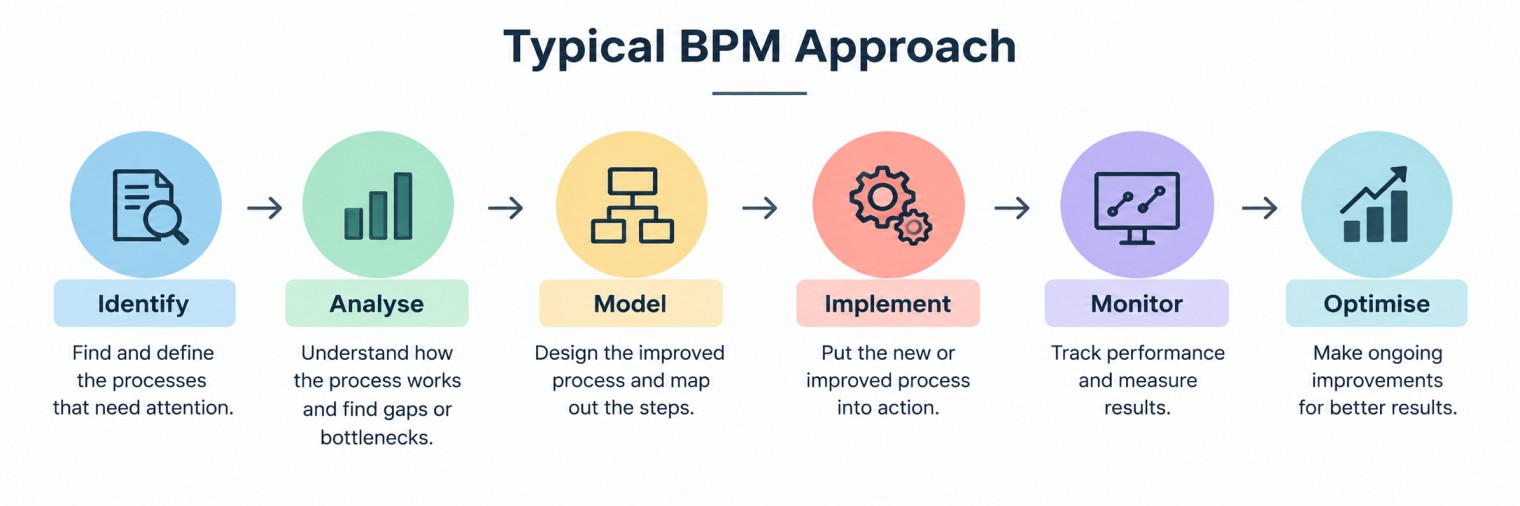
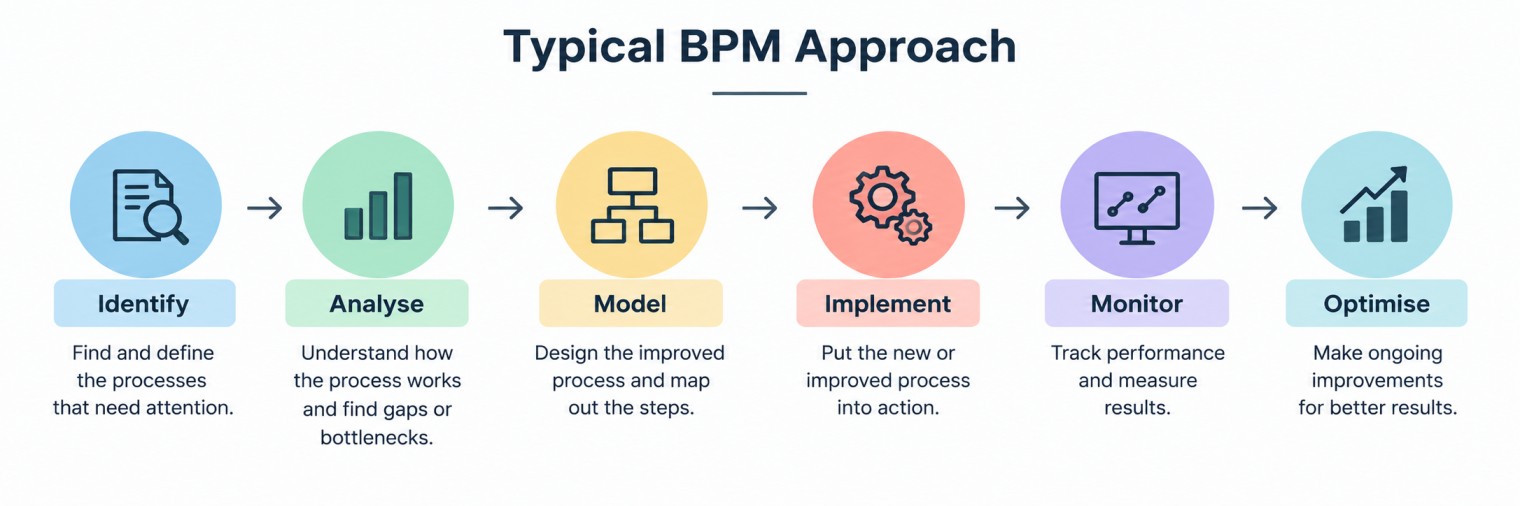
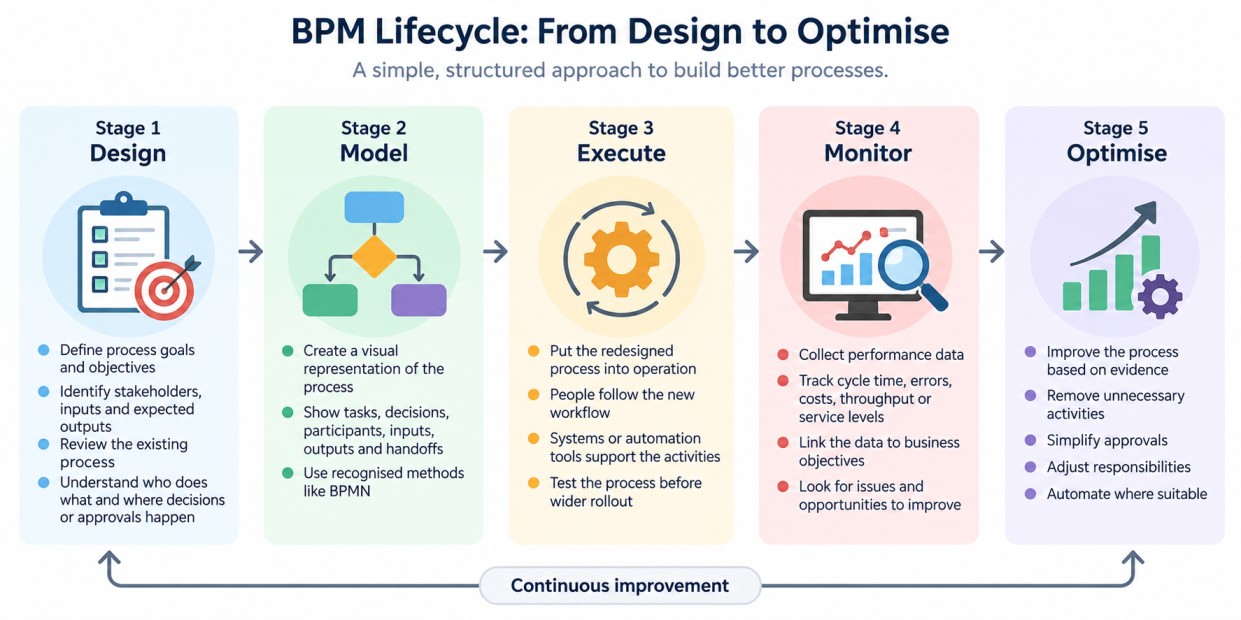
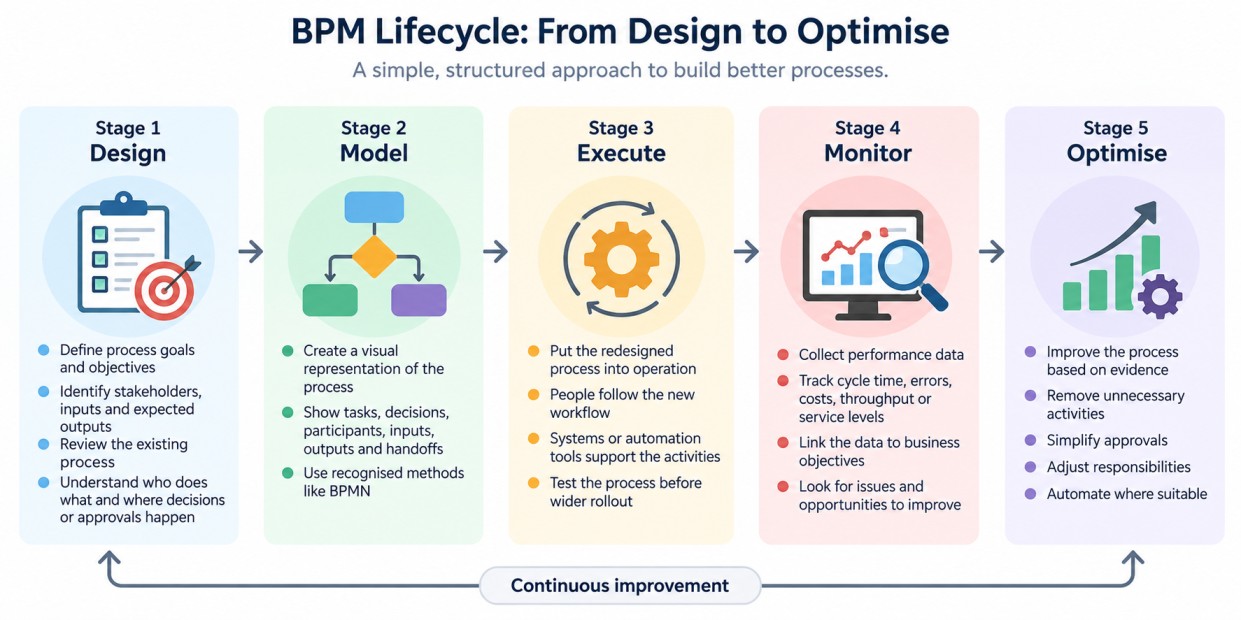
The cycle then restarts again. That's because a process that works well today might not work as well after the business, customers, or regulations change.
Also read: What Makes a Good Leader? 10 Essential Qualities and Skills
What Are the Types of Business Process Management?
The three common types of business process management are human-centric, document-centric, and integration-centric business process management. Each focuses on a different part of how work moves through an organisation.
Human-centric Business Process Management
Human-centric business process management focuses on processes where people make decisions, complete tasks, review information, or approve work.Even if automation is used still the final call is dependent on human judgement.
For example, in employee onboarding, several teams handle different tasks. The manager approves the employee’s request, HR checks and records their details, and the IT team creates their email, system accounts, and other required access. BPM helps connect these steps so the process moves smoothly from one team to another.
Document-centric Business Process Management
Document-centric business process management focuses on processes which involve documents, forms, records, reviews, and approvals. It helps teams track documents, see who needs to act, and know where each document is in the process.
For example, in contract management, a contract usually goes through several steps, from drafting and legal review to approval, signing, and final storage. BPM helps track each step and makes sure the contract reaches the right person at the right time.
Integration-centric Business Process Management
Integration-centric business process management focuses on processes that connect different applications, systems, and data sources. The goal is to make those connected activities work as one process. It reduces the need for employees to enter or move the same information between different systems manually.
For example, when a customer places an online order, the order details can move through different systems. The e-commerce system records the order, the inventory system checks stock, the payment system processes the payment, and the delivery system handles shipping.
Also Read: Assistant General Manager Salary in India 2026: Pay Guide
What Are the Benefits of Business Process Management?
Business process management helps in streamlining how work actually happens and then improving the parts that create delays, waste, errors, or unnecessary effort. This benefits the employees, customers, managers, and the wider organisation.
Improves efficiency and productivity
BPM removes redundant tasks and simplify complicated workflows. Hence, employees spend less time dealing with unnecessary steps and more time on work that requires judgement.
That's very useful when a process involves repeated approvals or manual data entry.
Reduces costs and process waste
Poor processes can consume more time and resources without creating any additional value. BPM helps identify duplicate activities, unnecessary handoffs, and delays that increase operating costs, thus identifying issues that can be avoided.
A shorter process doesn’t mean its automatically better. You'll need to retain controls to protect quality, security, and compliance.
Improves customer and employee experience
Customers notice slow approvals, repeated requests for information, and inconsistent service. Employees notice them too. A well-designed process can make responsibilities clearer and reduce frustration caused by unclear handoffs.
Increases visibility, scalability, and accountability
When a process is documented and tracked, everyone knows who owns what. BPM makes it easier to see who owns a process, where work is currently waiting, and how performance compares with expectations.
That visibility also helps organisations handle higher volumes without simply adding more manual steps.
Supports compliance, risk management, and business agility
Documented processes make it easier to identify required controls and demonstrate how work should be performed.
BPM can also help organisations respond when rules, customer needs, or business priorities change. You don't have to rebuild every process from scratch.
Also Read: General Manager Salary Per Month in India 2026: ₹5 Lakh+?
What Is Business Process Mapping and Modeling?
Business process mapping and modelling help organisations represent how work moves through a process. Although the terms are related, they aren't always used in exactly the same way.
What is business process mapping?
Process mapping gives you a clear visual view of how a process works. It shows the steps, decisions, people involved, and the order in which the work happens, often using a simple flowchart.
Even a basic process map can reveal problems. You can spot extra approvals, repeated steps, or bottlenecks that slow the work down.
What is business process modeling?
Process modelling gives a detailed view of how a business process works. It can show different scenarios, people involved, decisions, events, and how systems interact.
BPMN provides a standard way to represent process steps and logic. Process models can also help teams see how a process might work under different situations and test changes before putting them into practice.
Business process mapping vs modeling
Here are the differences between the two
Aspect | Process mapping | Process modeling |
Main purpose | Show how work flows | Represent process behaviour in greater detail |
Level of detail | Usually simpler | Often more detailed |
Typical use | Understanding current workflows | Analysis, design, and process improvement |
Representation | Flowcharts and process maps | BPMN and other modelling methods |
Also read: What Is Servant Leadership? Meaning, Benefits & Examples
What Is Business Process Automation?
Business process automation uses technology to handle repetitive tasks or move work from one stage to another with less manual effort. It’s a part of the BPM toolkit, but it can’t replace BPM. It can only be used to automate specific tasks within a larger business process.
Common technologies used with BPM include workflow automation, robotic process automation (RPA), process mining, low-code tools, analytics, and AI-based systems.
The right option depends on the process. Before automating a task, businesses should consider its cost, complexity, data needs, level of human judgement, and potential risks.
For example, take invoice processing. A business might automate data entry, validation, approvals, and notifications.
If a process has unnecessary steps or approvals, automation won't fix the problem. It might just make a poor process run faster.
Do read: What Is Slack in Project Management? Types & Calculation
How Do You Measure Business Process Management Success?
BPM success should be measured by the goal of the process. In simple terms, choose metrics that show whether the process is actually achieving what it’s meant to do. Here are the metrics used
Important BPM metrics
Metric | What it measures |
Cycle time | Time required to complete a process |
Processing time | Time spent actively working on tasks |
Error rate | Frequency of mistakes or failed outcomes |
Cost per process | Resources required for each completed process |
Throughput | Number of processes completed in a period |
SLA compliance | Whether agreed service levels are met |
Customer satisfaction | Customer perception of the process outcome |
Numbers alone don't tell the whole story. You'll need to compare performance with the original process objective.
How to choose the right BPM KPIs
Start with the outcome you want to improve. Then select measures that directly reflect that outcome.
For example, if the goal is faster loan processing, cycle time is more useful than simply counting how many employees completed training on the new process.
KPIs should also be reviewed regularly. If a metric isn't helping anyone make a better decision, it probably doesn't belong on the dashboard.
Build stronger management skills with the IIM Bangalore Young Leaders Programme (YLP) for Working Professionals . Learn practical business concepts and strengthen your ability to manage teams, processes, and business decisions.
What Are the Common Challenges in Business Process Management?
Business Process Management can fail when organisations focus too much on technology and overlook the process itself. People, data, systems, clear ownership, and communication all play a role in making a new process work.
Challenge | Solution |
Resistance to change | Explain why the change is needed and involve employees. |
Poor documentation | Document the current process before making changes. |
Lack of stakeholder involvement | Include process owners and users in the redesign. |
Siloed systems | Connect systems or simplify information flow. |
Choosing technology too early | Understand the process before selecting a tool. |
Poor monitoring | Set clear KPIs and track performance regularly. |
Automating inefficient processes | Improve the process before automating it. |
Fix the process first and then decide what should be automated.
Business Process Management vs Workflow Management vs Project Management
These three concepts overlap, but they are very different as they solve different problems.
Factor | Business Process Management | Workflow Management | Project Management |
Main focus | Managing and improving end-to-end processes | Coordinating tasks and work flows | Delivering a defined project |
Duration | Ongoing | Usually recurring | Temporary |
Scope | Can cross multiple functions | Usually narrower | Defined by project scope |
Primary goal | Improve process performance | Move work efficiently | Achieve project objectives |
BPM can include workflow management because workflows are part of many business processes. Project management is different because projects have a specific goal, timeline, and end date. BPM is also different from business process reengineering. Reengineering focuses on making major changes to how work is done, while BPM focuses on managing and improving processes over time.
Business Process Management Tools and Technologies
Business process management tools help teams design, automate, monitor, and improve business processes. The exact technology depends on how complex the process is and the organisation's needs.
Technology | Main role | Example |
BPM software | Manage and improve processes | Process orchestration |
Process modelling tools | Represent workflows | Process design |
Workflow automation | Route tasks automatically | Approval workflows |
Process mining | Analyse actual process behaviour | Bottleneck detection |
RPA | Automate repetitive computer tasks | Data entry |
Analytics tools | Monitor performance | KPI dashboards |
AI-enabled systems | Support decisions and automation | Document classification |
When choosing business process management tools, don't focus only on the number of features. Look at how well the tool fits your processes, works with existing systems, handles data securely, and supports the level of automation you need.
Business process management services can help with process analysis, redesign, implementation, automation, and monitoring. Organisations may use these services when they need expert help or extra support.
The best tool isn't the one with the most features. It's the one that fits your process and business needs.
Conclusion
Business process management gives organisations a structured way to understand how work gets done and improve it over time. Its lifecycle connects design, modelling, execution, monitoring, and optimisation.
The strongest BPM initiatives don't begin with software. They begin with a clear understanding of the process, its objectives, its users, and its problems.
When those foundations are clear, organisations can decide where mapping, automation, measurement, and technology actually add value. That's what makes BPM useful beyond a single process improvement project.