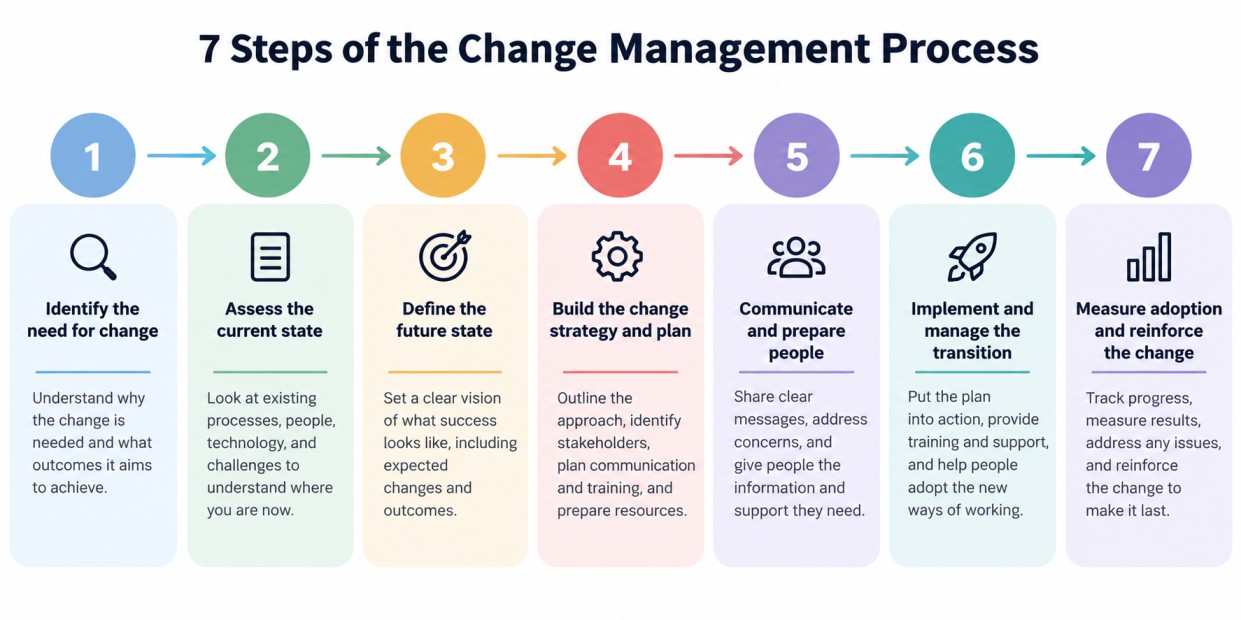
1. Identify the Need for Change
Start with a simple question. Why does the organization need to change?
It could be due to falling performance, new regulations, changing customer needs, new technology, stronger competition, or an inefficient process. When people understand the reason, the change feels more meaningful. Without a clear reason, employees may wonder why anything needs to change at all.
2. Assess the Current State
Before planning the change, understand how things work right now. Look at the people, processes, technology, skills, and risks involved. Identify which teams will be affected and where resistance might come from.
This gives managers a realistic starting point. They won't have to plan the change based on assumptions.
3. Define the Future State
Now decide what the organization wants to achieve.
Describe what work will look like after the change. This could include new processes, responsibilities, behaviors, technologies, or business outcomes.
Keep the goal clear and practical. People need to know what's actually going to be different.
4. Build the Change Strategy and Plan
Once the goal is clear, decide how you'll get people there.
A change management plan can include
Stakeholders
Communication
Training
Resources
Risks
Timeline
Adoption measures
The plan doesn't have to stay the same. If employees raise concerns or circumstances change, it's better to adjust the plan than push ahead with something that isn't working.
5. Communicate and Prepare People
Don't wait until the launch to tell people what's happening. Employees want to know why the change is happening, what's going to change, when it'll happen, and how it will affect their work. They also need to know where they can get help.
One announcement won't answer every question. Give people a chance to ask questions, share concerns, and provide feedback.
6. Implement and Manage the Transition
This is when the change moves from planning to action. Employees may need training, coaching, technical support, or time to get comfortable with the new way of working. Managers should also watch for problems and respond quickly.
A new system can work perfectly and still fail to deliver results. If employees find it difficult to use and return to the old system, the change hasn't really been adopted.
7. Measure Adoption and Reinforce the Change
The work doesn't stop once the change is launched.
Track whether people are actually using the new process, system, or way of working. You can look at usage, skills, compliance, performance, feedback, and business results. Completion shows that the change was introduced. Adoption shows that people are actually using it.
If adoption is low, find out why. More training, better communication, or changes to the process might be needed to make the new way of working stick.
Must read: Leadership Management: Meaning, Skills, Styles & Importance
Common Change Management Models
Change management models give organizations a clear way to plan and handle change. They don't all work the same way. They also don’t replace judgment. Some focus on the overall organization, while others look closely at how individuals respond to change. Each model approaches change differently, so the right choice depends on the situation.
Lewin's 3-Phase Change Model
Kurt Lewin's model breaks change into three simple phases: Unfreeze, Change, and Refreeze.
Unfreeze means preparing people to move away from the current way of working. Unfreeze means preparing people to let go of the current way of doing things. Change is the actual transition period. Refreeze focuses on making those new ways part of everyday work.
The simplicity of this model is both its strength and its limit. Large or ongoing changes can be more complicated than three broad stages suggest.
Kotter's 8-Step Change Model
John Kotter's model expands on Lewin's idea with eight detailed steps: create urgency, build a guiding coalition, form a strategic vision, enlist volunteers, remove barriers, generate short-term wins, sustain acceleration, and institute change. It's widely used in large organizations because it addresses both the emotional and logistical sides of transformation.
The model is useful for large changes where leadership support and employee involvement matter. However, it can take more time and effort to apply, so it may not suit a small or urgent change.
ADKAR Model
ADKAR, developed by Prosci, focuses on the individual rather than the organization. It stands for Awareness, Desire, Knowledge, Ability, and Reinforcement. The idea is that organizational change only happens when enough individuals successfully move through these five stages.
This model works particularly well when you need to diagnose exactly where a change effort is breaking down, whether that's a lack of awareness or a lack of ability to perform the new task.
The idea is straightforward. People need to understand why a change is happening, want to support it, know what to do, have the ability to do it, and receive enough reinforcement to keep going.
ADKAR is especially useful when managers need to understand where an employee is struggling. Someone might understand the reason for a new system but still lack the skills to use it confidently.
Each model has a different focus. Lewin keeps things simple, Kotter takes an organization-wide approach, and ADKAR focuses on individual adoption.
Do read: Assistant General Manager Salary in India 2026: Pay Guide
How Do You Manage Resistance to Change?
Resistance doesn't always mean employees are unwilling to cooperate. It can come from confusion, poor timing, limited training, fear of losing control, or concerns about how the change might affect their role.
Resistance doesn't always mean employees don't want to cooperate. Listen first.
Managers should find out what's really causing the resistance instead of assuming people simply don't like change. Someone struggling with new software, for example, might need better training or support rather than more convincing.
Practical ways to reduce resistance
Explain why the change is needed
Involve affected employees early
Give people time to prepare
Provide relevant training
Create channels for feedback
Address concerns directly
Give managers clear guidance
Reinforce new behaviors
Communication matters, but it’s not enough. Employees also need the right skills, tools, resources, and support to adapt. People won’t adopt a change if it makes their work harder and they don’t get the help they need.
Also read: What Makes a Good Leader? 10 Essential Qualities and Skills
How Do You Measure Change Management Success?
Measurement shows whether a change has moved beyond implementation into actual adoption.
Useful measures include
Metric | What It Shows |
Awareness | How well employees understand the change |
Readiness | How prepared employees are for the change |
Training | Training completion and skill levels |
Adoption | How many employees are using the new process or system |
Proficiency | How well employees can perform new tasks |
Employee Sentiment | Employee feedback and attitudes toward the change |
Speed of Adoption | How quickly employees adapt compared with the plan |
Adoption rate doesn’t tell the whole story. Someone might use a new system but still rely on old methods to get the job done.
Use both data and employee feedback to understand how well the change is working.
Also Read: General Manager Salary Per Month in India 2026: ₹5 Lakh+?
Benefits and Challenges of Change Management
A structured approach can make organizational change easier to understand and adopt, but it won't remove every difficulty.
Benefits | Challenges |
Smoother transitions with less downtime | Requires time and resources |
Better employee morale and trust | Leadership support may vary across teams |
Faster adoption of new tools and processes | Communication can become difficult in large organizations |
Lower risk of failed initiatives | Measuring the real impact can be difficult |
Better teamwork during periods of change | Too many changes can lead to change fatigue |
The biggest benefit is clarity. People know what’s changing, why it matters, and what they need to do. But change takes time and effort. Employees may already have full workloads, managers may struggle to communicate clearly, and several changes may happen at once.
That’s why change management isn’t a one-time message. People need ongoing support as they adjust.
Also read: What Is Servant Leadership? Meaning, Benefits & Examples
Change Management vs Project Management
These two areas are often confused, but they have different roles.
Project management focuses on tasks, timelines, budgets, and deliverables. Change management focuses on people, helping them understand, accept, and adapt to the changes a project brings.
Change Management | Project Management |
Focuses on people and adoption | Focuses on project delivery |
Manages behavioral change | Manages scope, time, cost, and resources |
Tracks adoption | Tracks project performance |
Prepares employees | Delivers the project or solution |
Reinforces new behaviors | Controls project execution |
Consider a company introducing new customer service software. Project management handles the system implementation, timeline, budget, and technical delivery. Change management prepares employees to use that system effectively. Both are needed if the organization wants the project to produce its intended result.
Ready to strengthen your business knowledge and leadership capabilities? Explore the IIMBx Certificate in General Management for Emerging Leaders and gain practical insights to navigate business challenges, make informed decisions, and prepare for greater leadership responsibilities.
Common Mistakes & Best Practices of Change Management
Small mistakes can create large adoption problems.
One common mistake is announcing a change without explaining the reason behind it. Another is treating training as a one-time event when employees need support after implementation.
Other mistakes include ignoring feedback, underestimating resistance, and measuring completion instead of adoption.
Better practices include
Start with a clear reason for change
Identify affected stakeholders early
Communicate before implementation
Match training to actual job requirements
Give employees ways to raise concerns
Track adoption after launch
Reinforce the new behavior
Adjust the approach when evidence shows it's not working
The best approach isn't necessarily the most complicated one. It should fit the size, urgency, and impact of the change.
Do read: What Is Slack in Project Management? Types & Calculation
Conclusion
What is change management? It's a structured way to help people and organizations adopt and sustain change.
Successful change requires more than a new system, policy, or process. People need a clear reason, practical support, useful training, strong communication, and time to adjust.
When organizations measure adoption rather than simply implementation, they get a clearer picture of whether the change has actually worked.