University Logo
Admissions Open for the 2026 Cohort
Phone1800 210 2020
IIMBx - Digital Learning Foundation

What Is Servant Leadership? Meaning, Characteristics, Benefits, and Real-Life Examples

  1. Home
  2. What Is Servant Leadership? Meaning, Characteristics, Benefits, and Real-Life Examples

Key Highlights

  • Servant leadership is the type of leadership that prioritises the employees, their growth, well-being, and needs while keeping organisational goals in focus.

  • Servant leaders listen, support people, share responsibility, and help employees, encouraging greater ownership and independence.

  • This leadership approach focuses on building trust, strengthening collaboration, developing people, and helping teams perform effectively.

  • Servant leadership doesn't mean avoiding authority or difficult decisions. Leaders still set expectations, make decisions, and maintain accountability.

  • This blog explains what Is Servant Leadership,how it works, key characteristics, benefits and limitations, and what this type of leadership looks like in real workplace situations.

Ready to strengthen your leadership and management skills, the IIMBx Certificate in General Management for Emerging Leaders can help you develop practical capabilities in leadership, decision-making, strategy, and business management. 

What Is Servant Leadership and How Does It Work?

Servant leadership is based on the philosophy that the leader’s primary role is to serve the needs of the employees to make them feel valued so that they can explore their full potential in the workplace.  The basic idea is that a leader serves first and leads second. 

A servant leader doesn't treat employees as people who simply follow instructions. The leader listens to their concerns, helps remove obstacles, gives them responsibility, and creates opportunities for growth. Authority still exists, but it's used to help people and the organisation succeed. It usually starts with the question, "What does my team need from me to do their best work? 

Origin of Servant Leadership

The term servant leadership was coined by Robert K. Greenleaf in 1970 in his essay, “The Servant as Leader.” His idea came from years of observing how organisations worked and how leaders influenced the people around them. His main idea was simple. A good leader serves others first. Leadership should come from a genuine desire to help people, not from a need for power, status, or control.

Greenleaf also raised an important question. Do people grow under a leader? Do they become more capable, confident, and independent? For Greenleaf, the growth of the people being served was one of the clearest ways to judge a leader.

The idea gained wider attention during the 1980s and 1990s as organisations placed more focus on employee engagement and people development. It is now widely discussed in management education and leadership studies.

Servant leadership doesn't mean giving up authority. A manager can still make the final decision. The difference is in how that decision is made. Instead of deciding everything alone, the manager now listens to his employees, understands their concerns, and gives them ownership where appropriate.

That's the servant-first approach of this leadership style.

Greenleaf also applied the idea to organisations. His concept of the institution as servant suggests that an organisation should consider how its actions serve employees, customers, and the wider community, rather than focusing only on its own interests.

Also read: What Makes a Good Leader? 10 Essential Qualities and Skills 

Why Is Servant Leadership Important?

Workplaces have changed in recent years as Gen Z has become a larger part of the workforce. The younger employees value open communication, meaningful work, growth opportunities, and managers who listen to their concerns. This has made people-focused leadership more relevant. Servant leadership supports these expectations by giving employees a voice, encouraging development, and creating more trust between managers and their teams.

Employees don't just want a paycheck anymore; they want to feel valued and heard. Leadership in any organisation shapes how people communicate, make decisions, handle mistakes, and develop their careers. A leadership approach that takes these factors seriously can influence both employee experience and organisational performance.

Servant leadership is important because it puts relationships and development into the leadership process. It doesn't mean that business goals disappear. They still matter. The difference lies in how leaders pursue them.

A manager might notice that an employee repeatedly misses deadlines. A command-driven response could simply demand faster work. A servant leader would first explore the cause, identify the barrier, and then decide what support or accountability is appropriate.

The approach can contribute to:

  • Greater trust between managers and employees

  • Stronger collaboration within teams

  • Greater employee ownership

  • Better opportunities for professional development

  • Higher involvement in decision-making

  • Stronger relationships between leaders and their teams

It doesn't mean every employee gets everything they ask for. Good leadership still requires boundaries, performance standards, and difficult decisions. The value comes from combining care with accountability.

Also Read: 10 Major Leadership Theories for Workplace Success 

What Are the Characteristics of Servant Leadership?

Here are the characteristics of servant leaders:

Characteristic

What it means

Listening

Paying attention before responding or deciding

Empathy

Understanding another person's perspective

Healing

Supporting people through personal or workplace difficulties

Awareness

Recognising personal strengths, weaknesses, and circumstances

Persuasion

Influencing through reasoning rather than force

Conceptualisation

Looking beyond immediate operational problems

Foresight

Considering likely future consequences

Stewardship

Treating leadership as a responsibility

Commitment to growth

Helping people develop their abilities

Building community

Creating connection and shared responsibility

These qualities work best when they come together. Listening without taking action won't solve any problems. Giving employees responsibility without enough support can leave them frustrated. So,the right balance depends on the person and the situation. A new employee might need more guidance, while an experienced team member may be ready to make decisions independently.

A servant leader doesn't treat everyone the same. Instead, they understand what each person needs to do their job well and grow in their role.

Do read: What Is Slack in Project Management? Types & Calculation 

What Does a Servant Leader Do?

A servant leader spends more time asking than telling. They check in on wellbeing before checking in on deadlines. They give credit publicly and take blame privately. 

Instead of keeping control over every task, the leader creates conditions in which employees can take responsibility for their work. They listen to problems, remove barriers, provide direction, and help people build skills.

A typical servant leader might:

  • Ask employees what is preventing progress

  • Give team members ownership of suitable decisions

  • Provide coaching rather than immediately solving every problem

  • Encourage people to share ideas and concerns

  • Give useful feedback

  • Help employees prepare for larger responsibilities

  • Maintain clear expectations and accountability

How Servant Leaders Make Decisions

In Servant leadership, decision-making is collaborative; they ask the team for input, consider different views, and then make the final decision. 

Not every decision needs a group vote. Some situations require a quick call, especially when time is limited. A servant leader takes responsibility for that decision instead of waiting for everyone to agree.

A practical decision process looks like this:
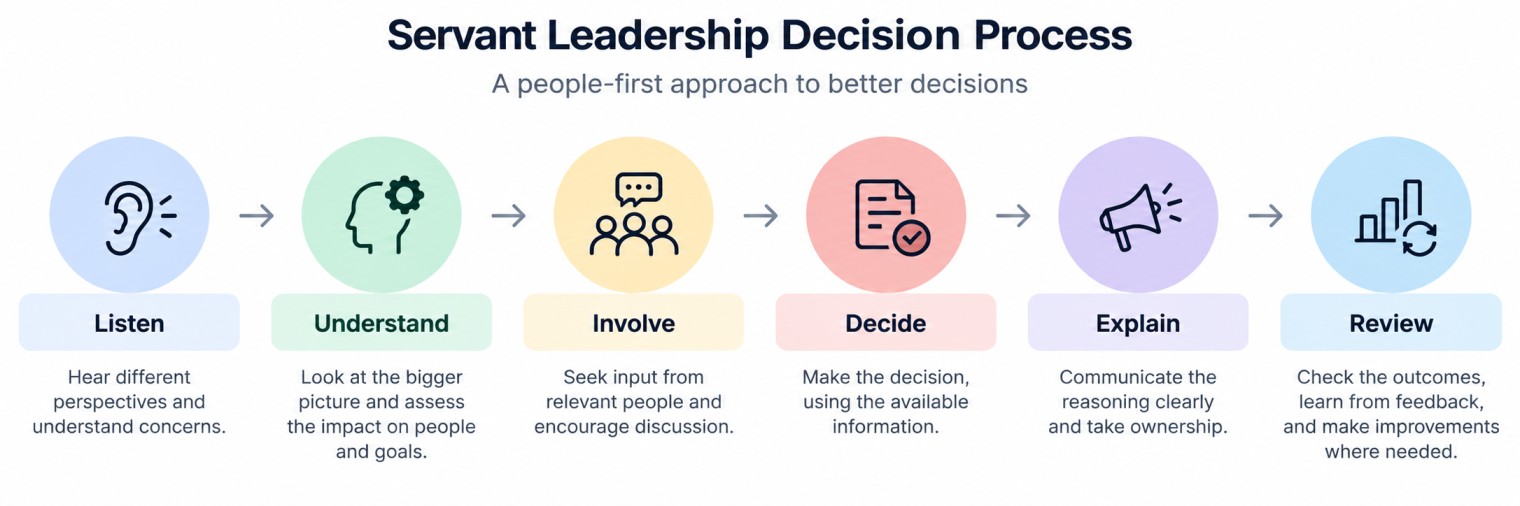


Servant leadership decision-making process showing six steps: listen, understand, involve, decide, explain, and review.Servant leadership decision-making process showing six steps: listen, understand, involve, decide, explain, and review.

First, the leader listens to the people involved. They consider how the decision could affect employees, customers, and business goals. When it makes sense, they ask employees to share their views before deciding.

The leader still makes the final call.

A senior position shouldn't mean ignoring the people closest to the work. Their experience can reveal problems or ideas that a leader might miss. Good servant leaders don't avoid responsibility. They take it.


How Servant Leaders Give Employees More Ownership

People take ownership when they have both responsibility and the freedom to act. A manager might ask an employee to improve a reporting process, set a clear outcome, provide the right resources, and let them decide how to get the work done. 

This process builds confidence and accountability. Employees need to know what success looks like and what happens when results fall short.

Servant leaders give people ownership of outcomes, not just activities. They also allow employees to make reasonable mistakes within clear limits because mistakes can become valuable learning opportunities.

Good leaders also protect their teams from unnecessary pressure. If priorities keep changing or senior management adds more complicated tasks, they help filter that issues instead of passing all of it directly to employees.

How Servant Leaders Support Employee Development

Development is a central part of this approach. A servant leader doesn't focus only on what employees can deliver today. They also consider what employees could become. Employee development isn't limited to annual reviews. Servant leaders make time for regular conversations about skills, career goals, and areas where employees want to grow.

They also give people chances to take on new challenges. A stretch assignment might slow things down in the short term, but it can help an employee build skills that benefit the team later.

That might involve coaching, mentoring, stretch assignments, feedback, training, or exposure to new responsibilities. This could include coaching, mentoring, feedback, training, or new responsibilities. The focus isn't only on what employees can do today. It's also on what they could take on next.

For example, a manager might notice that an analyst is good at solving problems but lacks presentation experience. Instead of handling every client presentation themselves, the manager could let the analyst present part of a meeting and offer feedback afterward.

The employee builds confidence and a new skill. The team gains another person who can take on greater responsibility.

Must read: Leadership Management: Meaning, Skills, Styles & Importance 

What Are the Benefits and Limitations of Servant Leadership?

Servant leadership can create strong relationships and develop capable teams, but it isn't a perfect solution for every workplace. Its effectiveness depends on the organisation, the team, the leader, and the situation. Here are the benefits and limitations of servant leadership:

Benefits

Limitations

Builds trust

Decisions can take longer

Supports employee growth

Requires a high level of leader involvement

Encourages ownership

Can be difficult in rigid hierarchies

Strengthens collaboration

Leaders may struggle to balance support with authority

Encourages open communication

Too much accommodation can weaken accountability

One of the biggest benefits is trust. Employees are more likely to speak up when they know their manager will listen instead of blaming them. It helps build stronger teams. When managers give people real responsibility, employees become more confident in making decisions and solving problems without relying on one person.

But, Servant leadership isn't about saying yes to everyone. It requires good judgment. The approach works best when support goes hand in hand with clear goals, deadlines, accountability, and business priorities.

What Are Some Real-Life Examples of Servant Leadership?

Servant leadership isn't just a management theory. Some companies have actually built people-focused practices into the way they lead and develop their employees.

TDIndustries

TDIndustries is a clear example of a servant leadership style. The construction and facilities services company openly describes its leadership approach as servant leadership. Its leaders focus on helping employees grow, take responsibility, and become more independent.

Southwest Airlines

Southwest Airlines has a strong people-first culture. The company puts employees at the centre of its workplace philosophy and uses the idea of having a “Servant's Heart” as part of its employee promise.

Leaders such as Herb Kelleher and Colleen Barrett were also known for putting employees first.

Marriott International

Marriott has long focused on taking care of its employees so they can take care of guests. Its leadership practices include listening to employees, supporting their growth, and helping them build their careers.

The Container Store

The Container Store is another example often linked to servant leadership. Former CEO Kip Tindell placed strong emphasis on employee training and development.

The company's approach shows that serving employees isn't just about listening to them. It also means giving them the skills, support, and opportunities they need to succeed.

Popeyes

Cheryl Bachelder, former CEO of Popeyes Louisiana Kitchen, used servant leadership as part of her approach to the company's turnaround. She focused on rebuilding trust with franchise owners and employees, listening to their concerns, and creating a culture based on serving others while still delivering strong business results.

These examples come from different industries, but the idea is similar. Leaders support their people, invest in their growth, and give them room to take responsibility while keeping organisational goals in view.

Also Read: Assistant General Manager Salary in India 2026: Pay Guide 

Servant Leadership vs Other Leadership Styles

Servant leadership can overlap with other leadership styles, especially when they focus on employee involvement, development, or collaboration. But the main focus isn't always the same. Let's look at how servant leadership differs from other common leadership styles. 

Leadership style

Main focus

Typical decision approach

Servant leadership

People and their development

Participation with leader accountability

Transformational leadership

Vision and organisational change

Vision-led and participative

Transactional leadership

Performance and rewards

Structured and goal-driven

Autocratic leadership

Control and speed

Centralised

Democratic leadership

Group participation

Shared decision-making

No leadership style is always right or wrong. Effective leaders adjust their approach based on the situation, the team, and the goal. A leader might use servant leadership in everyday work but take a more direct approach when a quick decision is needed. 

Ready to move beyond your current role and take on broader business responsibilities? Explore the IIM Bangalore Young Leaders Programme (YLP) to strengthen your skills in strategy, finance, operations, people management, and leadership. 

What Are Common Mistakes in Servant Leadership?

Servant leadership can go wrong when leaders misunderstand what serving people actually requires. Here are the common mistakes:

Confusing Servant Leadership With People-Pleasing

A servant leader doesn't need to agree with every employee request. Saying no can be responsible leadership when a request conflicts with business requirements or team fairness. Serving your team doesn't mean saying yes to everything. Employee needs matter, but so do team and business goals.

Avoiding Difficult Decisions and Accountability

Listening to employees doesn't mean avoiding hard conversations. Leaders still need to address poor performance, resolve conflict, and make unpopular decisions when circumstances demand them. Being a servant leader doesn't mean stepping away from responsibility.

Giving Autonomy Without Support

Giving someone responsibility without enough guidance or resources can create problems. Employees need to know what's expected and have the support to make good decisions.

Autonomy works best when people have the right tools and context.

Prioritising Individual Needs Over Organisational Goals

Servant leadership works poorly when service becomes an excuse for weak leadership. Caring about employees doesn't mean putting every personal preference ahead of business needs. Leaders need to consider deadlines, customers, budgets, team capacity, and employee well-being together.

The key is balance. Servant leadership should support people without losing sight of results.


How Can Leaders Practise Servant Leadership?

Here are some tips to practice servant leadership:

Listen and Understand

Ask questions before offering solutions. Give employees space to explain what's getting in their way instead of assuming you already know the problem.

Support and Remove Barriers

Find out what's slowing the team down and help fix it. That could mean getting the right resources, simplifying a process, or cutting unnecessary meetings.

Give Responsibility With Clear Expectations

Give employees real ownership, not just tasks. Set clear goals and boundaries, then let them make decisions within their role without micromanaging every step.

Develop People

Make growth conversations part of regular work, not just annual reviews. Give employees useful feedback, coaching, and opportunities to take on new challenges.

Maintain Accountability

Supporting employees doesn't mean lowering standards. Set clear expectations, review progress, and address problems when they come up. Hold yourself accountable too.

Just check at the end if employees are actually improving. If yes, you are moving in the correct direction.

Also Read: General Manager Salary Per Month in India 2026: ₹5 Lakh+? 


When Does Servant Leadership Work Best?

Servant leadership tends to work best in environments where long-term relationships and innovation matter more than instant execution. Servant leadership can be particularly useful in teams where collaboration, knowledge sharing, trust, and employee development matter. It can also work well when leaders want employees to take greater ownership rather than waiting for instructions.

It's a useful fit for situations such as:

  • Cross-functional teams

  • Knowledge-intensive work

  • Employee development programmes

  • Collaborative projects

  • Teams building future leadership capacity

It fits well in knowledge-based industries, healthcare teams, education, and organisations going through cultural transformation. It struggles more in high-pressure, time-critical environments like emergency response or certain manufacturing floors, where decisions need to happen instantly.

Conclusion

Servant leadership puts service at the heart of leadership. It asks leaders to listen to people, support their development, give them meaningful responsibility, and remain accountable for results.

The approach isn't about becoming passive or avoiding difficult decisions. It's about using leadership authority to help people and organisations become stronger.

If you're asking what is servant leadership in practical terms, start with one question. Are the people you lead becoming more capable because of how you lead them?


Frequently Asked Questions

General

Latest Blogs

How to Become a Project Manager: Skills and Career Path
Oct 5th, 2026

How to Become a Project Manager: Skills and Career Path

Learn how to become a project manager with the right skills, qualifications, experience, certifications, and career steps to grow in project management.

Read More
Product Strategy: Definition, Types, Process & Examples
Oct 5th, 2026

Product Strategy: Definition, Types, Process & Examples

Product strategy explained for beginners. Learn what it is, the main types, how to build one in 8 steps, real examples from Tesla and Spotify, and a template.

Read More
People Management Skills: Top 10 Skills for Leaders
Oct 1st, 2026

People Management Skills: Top 10 Skills for Leaders

Discover the top 10 essential people management skills every leader needs, why they matter, the types, the challenges, and practical steps to develop them.

Read More
Copyright 2026 of [University Name]