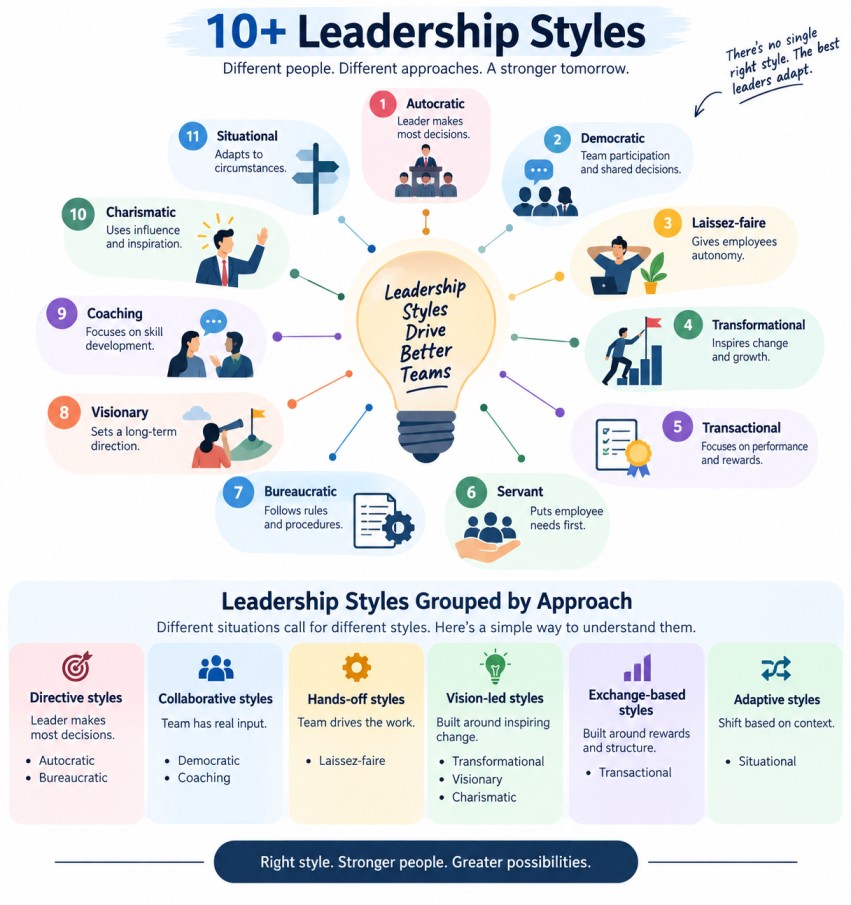
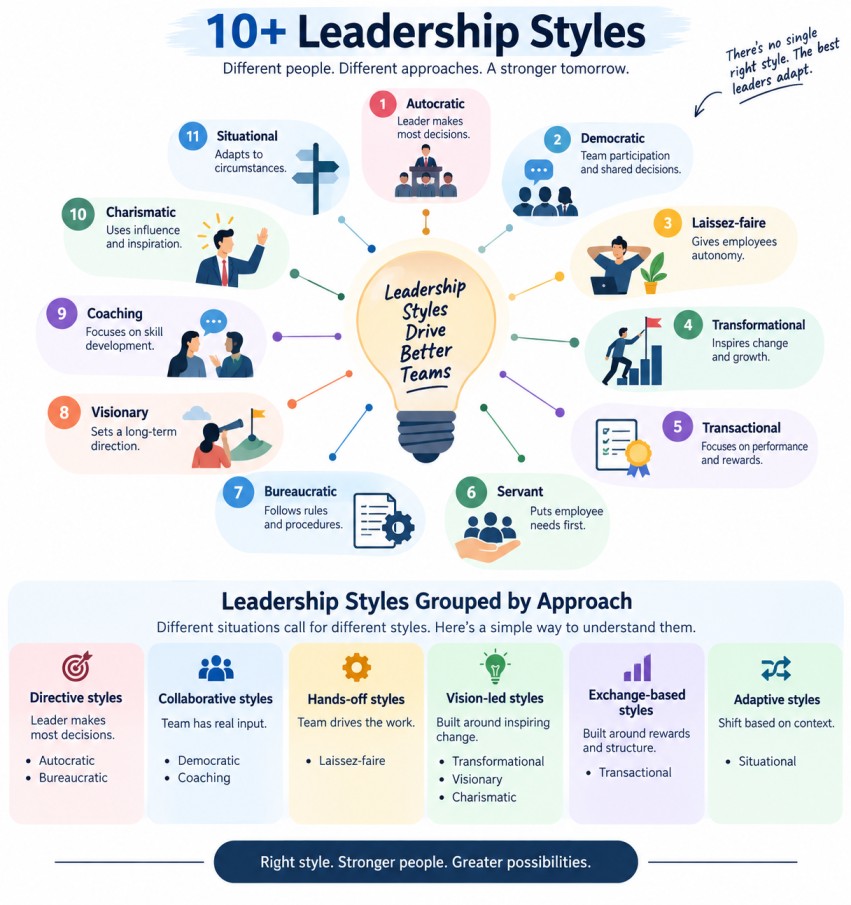
1. Autocratic Leadership
Autocratic leadership is the kind of leadership style that gives the leader major authority in decision-making. In this style, orders go in one direction, top to bottom. This kind of leadership style usually works fast in a crisis, as employees usually receive clear instructions and defined responsibilities.
But if used constantly, it kills morale and creativity. People stop offering ideas. If this approach becomes the default, it causes reduced employee participation.
Key Characteristics of Autocratic Leadership
The leader makes all the decisions
Orders flow in one direction, from top to bottom
Authority stays mainly with the leader
Team input is limited
Decisions can be made quickly
Benefits of Autocratic Leadership
It is helpful when there's a safety issue, emergency, a tight deadline, or a decision that needs one person's expertise. It can also help an inexperienced team understand exactly what needs to be done.
Limitations of Autocratic Leadership
People may become less willing to share ideas, question decisions, or take ownership of their work. When people rarely get a chance to share their ideas, they become less engaged in their work.
If the leader uses this style too often, it can also reduce creativity, create dependence on the manager, and affect team morale.
Workplace Example
A factory manager notices a serious safety issue on the production floor. Instead of calling a team meeting, they immediately stop the affected operation, assign employees specific tasks, and instruct the safety team to inspect the equipment. The decision is made quickly because waiting for group approval could put employees at risk.
2. Democratic Leadership
This type of leadership style is also called participative leadership.
Democratic leadership is the leadership style where employees are involved in decisions which affect their work. The leader still has the final authority. But team members always get a vote on final decisions. This approach works well when a problem has several possible solutions. A product manager might ask designers, developers, and sales staff for input before deciding which feature to prioritize.
Key Characteristics of Democratic Leadership
Employees have a voice in decision-making.
The leader encourages ideas and feedback.
Decisions are often made through discussion.
Communication flows in both directions.
Team members are encouraged to take responsibility.
The leader still makes the final decision when needed.
Benefits of Democratic Leadership
Democratic leadership improves employee engagement because people feel their opinions are valued. It also brings different ideas to the table, which can help teams find better solutions to complex problems. The process feels collaborative. It tends to boost buy-in and job satisfaction.
This style works well when employees have useful knowledge or experience, and there's enough time to discuss different options.
Limitations of Democratic Leadership
The decision-making process can take longer because the leader needs to hear different viewpoints. This can be a problem when a quick response is required. Too much discussion can also create confusion if roles aren't clear, or the team struggles to agree on a final decision.
Workplace Example of Democratic Leadership
A product manager is planning a new feature for a company's mobile app. Instead of deciding alone, the manager asks developers, designers, sales staff, and customer support teams for their suggestions. After discussing the ideas, the manager reviews the feedback and makes the final decision. The team gets a chance to contribute, while the manager remains accountable for the outcome.
3. Laissez-Faire Leadership
Laissez-faire is French for "let it be". Laissez-faire leadership is the style that gives the team almost total freedom. There is considerable freedom over how they complete their work. The leader sets broad expectations but doesn't closely supervise every step. This approach works in the case of capable employees who know their responsibilities and can manage their work.
Key Characteristics of Laissez-Faire Leadership
Employees have a high level of independence.
The leader provides minimal supervision.
Team members are trusted to make decisions related to their work.
Employees are responsible for managing their tasks and time.
The leader acts as a resource rather than directing daily activities.
Communication is open, but employees have significant freedom in how they work.
Benefits of Laissez-Faire Leadership
Laissez-faire leadership can increase creativity, innovation, and employee satisfaction. Team members often feel trusted and empowered because they have the freedom to make decisions and solve problems on their own. Team members learn to take ownership of their work. It creates a sense of freedom in work, which boosts morale.
This style works particularly well with experienced professionals who have the skills and confidence to work independently without constant guidance.
Limitations of Laissez-Faire Leadership
Too much freedom can lead to a lack of direction, unclear responsibilities, and inconsistent performance. Team members may become uncertain about priorities if expectations are not clearly defined. This approach may not work well for inexperienced employees who need regular guidance, feedback, and support to perform effectively.
Workplace Example of Laissez-Faire Leadership
A software development team consists of experienced engineers working on a new application. The team leader sets project goals, deadlines, and expected outcomes but allows developers to decide how they will complete the work.
Team members choose their tools, workflows, and problem-solving methods independently. The leader checks progress periodically but does not closely supervise day-to-day activities, allowing the team to use its expertise and creativity.
4. Transformational Leadership
Transformational leadership is the style of leadership where the leaders motivate people to move beyond their routine tasks and contribute to a larger goal. The leaders inspire them to achieve bigger goals, focusing on change, growth, and a compelling direction. They motivate the employees to focus on personal and professional growth to achieve something bigger and see themselves as part of a collective goal.
Key Characteristics of Transformational Leadership
The leader creates and communicates a clear vision.
Employees are encouraged to think beyond routine tasks to achieve the goal.
The leader motivates people to outdo themselves.
Innovation and new ideas are encouraged.
Employees are given opportunities to grow and develop.
The focus is on long-term improvement and shared goals.
Benefits of Transformational Leadership
Transformational leadership can build strong commitment to organizational goals. By giving employees a clear sense of direction, leaders can encourage people to take initiative and look for better ways to work.
It can also support innovation, employee development, and stronger team loyalty, especially when an organization is going through major changes.
Limitations of Transformational Leadership
Constant pressure to improve and introduce new ideas can leave employees feeling overwhelmed. If leaders focus heavily on the vision without providing practical support, teams may struggle to turn that vision into results.
The style can also become too dependent on the leader's ability to inspire and communicate effectively. It can also create fatigue if leaders constantly push for new initiatives without giving teams time to recover.
Workplace Example of Transformational Leadership
A retail company decides to shift from traditional stores to an online-first business model. The CEO explains why the change is necessary and shares a clear five-year vision with employees.
The company then trains employees in digital tools, encourages teams to suggest new ways of serving online customers, and gives them opportunities to develop new skills. The leader keeps the team focused on the larger goal while supporting them through the transition.
5. Transactional Leadership
Transactional leadership is built around very simple expectations of a give-and-take policy. It consists of very clear expectations of performance, rewards, and consequences. Employees know what they're expected to deliver and what happens if targets are not met or missed.
Key Characteristics of Transactional Leadership
The leader sets clear goals and performance standards.
Employees know what they're expected to achieve.
Rewards are linked to meeting targets or expectations.
Poor performance may lead to action.
The leader closely monitors results and progress.
Rules, structure, and accountability are important.
Benefits of Transactional Leadership
Transactional leadership brings clarity. Employees know what they need to do and how their performance will be evaluated. It works well for teams with measurable goals, such as sales, customer service, or production. Rewards also motivate employees to meet specific targets.
It's predictable and easy to measure. Employees' motivation and productivity increase. The system is easy for both leaders and team members.
Limitations of Transactional Leadership
Since this style focuses heavily on performance and rewards, it may leave less room for creativity and experimentation. Employees might focus only on meeting targets rather than finding better ways to work. It also creates followers rather than innovators.
It may also be less effective when a team needs inspiration, innovation, or major organizational change.
Workplace Example of Transactional Leadership
A sales manager sets a monthly target of 50 new customer accounts for each salesperson. Employees who meet or exceed the target receive a performance bonus. Those who miss it receive additional supervision and a performance review.
The manager tracks results throughout the month and gives employees clear feedback. The focus stays on measurable performance and targets.
6. Servant Leadership
Here, the leader's main job is to support the team's growth and well-being first. Success is measured by how well the team is performing, not by the leader's authority. Servant leadership puts strong emphasis on supporting employees and helping them succeed. The leader listens, removes obstacles, and pays attention to employee development.
Key Characteristics of Servant Leadership
The leader puts employee needs at the center of their approach.
Employees are encouraged to share ideas and concerns.
The leader listens actively and supports the team.
Employee growth and development are given importance.
The leader removes obstacles that affect the team's work.
Trust, empathy, and collaboration guide relationships.
Benefits of Servant Leadership
Servant leadership builds trust and stronger relationships within a team. Employees feel supported when their manager listens to their concerns and helps them develop their skills. It also improves collaboration, employee engagement, and team morale because people feel that their contributions and development matter.
Limitations of Servant Leadership
This approach can take more time because leaders spend considerable effort listening, supporting, and developing employees. It may not be ideal when an urgent decision requires immediate direction. If the leader focuses too heavily on employee needs, accountability can also become unclear. Support needs to be balanced with clear expectations.
Workplace Example of Servant Leadership
A team manager notices that several employees are struggling with a new software system. Instead of blaming them for slower work, the manager asks about the difficulties they’re facing and arranges practical training.
The manager also removes unnecessary obstacles, checks in with the team, and gives employees opportunities to build confidence with the new system. The focus is on helping the team succeed.
7. Bureaucratic Leadership
Bureaucratic leadership depends heavily on established rules, procedures, hierarchy, and clearly defined responsibilities. Leaders expect employees to follow the exact required process. This can be useful in environments where consistency and compliance are non-negotiable.
Healthcare, finance, and regulated operations can involve situations where procedures exist for good reasons.
Key Characteristics of Bureaucratic Leadership
Leaders follow established rules and procedures.
Employees have clearly defined roles and responsibilities.
Decisions follow formal policies and processes.
Authority is based on position and organisational hierarchy.
Consistency and compliance are given high priority.
Employees are expected to follow approved procedures.
Benefits of Bureaucratic Leadership
Bureaucratic leadership creates consistency and clear expectations. Employees know which procedures to follow and who is responsible for specific decisions. This style works well in industries where safety, accuracy, and compliance are critical. It can reduce errors and help organizations maintain consistent standards.
Limitations of Bureaucratic Leadership
The weakness is rigidity. Strict rules make decision-making slower, especially when employees need to respond to an unexpected situation. Leaders also focus too much on following procedures instead of finding a better solution.
The style limits creativity when employees have little freedom to experiment with or suggest changes.
Workplace Example of Bureaucratic Leadership
A hospital department follows strict procedures for handling patient records and medications. The department manager makes sure employees follow the approved processes, complete required documentation, and meet safety standards.
Even when an employee suggests a quicker method, the manager first checks whether it follows the organisation's policies and regulations. This keeps the process consistent and reduces the risk of errors.
8. Visionary Leadership
Visionary leadership focuses on creating and communicating a clear visionary picture of the future. This is very similar to transformational leadership but is more focused on a specific future outcome. The leader helps people understand where the team or organization is heading.
Key Characteristics of Visionary Leadership
The leader creates a clear picture of the future.
Long-term goals guide decision-making.
The leader communicates the vision clearly to the team.
Employees are encouraged to work toward a shared goal.
New ideas and opportunities are welcomed.
The leader focuses on where the organisation needs to go next.
Benefits of Visionary Leadership
Visionary leadership gives employees a clear sense of direction. When people understand the larger goal, they can better connect their daily work to what the organisation wants to achieve. It also encourages innovation and motivates teams during periods of growth or change.
Employees have a bigger purpose to work toward instead of focusing only on short-term tasks.
Limitations of Visionary Leadership
A strong vision doesn't guarantee strong execution. If leaders focus too much on future goals without explaining the practical steps, employees may struggle to turn the vision into action. The approach can also create frustration if the goals are unrealistic or keep changing without enough resources and support.
Workplace Example of Visionary Leadership
A technology company's CEO wants the organisation to become a leader in sustainable products within five years. The CEO clearly explains this goal and shows employees how their work can contribute to it. Product teams are encouraged to develop greener solutions, while operations teams look for ways to reduce waste.
The leader keeps everyone focused on the long-term goal while teams work on practical steps to achieve it.
Here the leader acts more of a coach. Coaching leadership focuses on helping employees improve their skills and judgement. Instead of solving every problem for the team, the leader asks questions, gives feedback, and creates opportunities to learn.
For example, a manager might ask an employee how they would handle a difficult client before offering their own advice.
This style takes time. It isn't always suitable when an urgent decision must be made immediately. The leader acts like a mentor, focused on developing each person's skills over time. One-on-ones, feedback loops, and growth plans define this style.
It builds strong long-term talent. It also takes real time and patience, which not every fast-moving team has.
Key Characteristics of Coaching Leadership
The leader focuses on employee learning and development.
Employees receive regular feedback and guidance.
Leaders ask questions instead of giving every answer.
Employees are encouraged to solve problems independently.
Individual strengths and improvement areas are discussed.
The leader builds skills for long-term performance.
Benefits of Coaching Leadership
Coaching leadership helps employees build confidence and improve their skills. Instead of simply telling people what to do, leaders guide them through problems and help them learn from their decisions. It can also improve employee engagement and prepare team members for greater responsibilities. Over time, employees become more comfortable making decisions without constant supervision.
Limitations of Coaching Leadership
Coaching takes time. A manager can't coach every employee through every decision, especially when the team is dealing with an urgent problem.
It may also be less effective when an employee needs clear instructions rather than questions and discussions. The leader needs to know when to coach and when to step in.
Workplace Example of Coaching Leadership
A marketing manager notices that a junior employee struggles with presenting ideas to clients. Instead of taking over the presentations, the manager reviews the employee's approach and asks questions about what could be improved.
The manager then lets the employee lead the next presentation and provides feedback afterward. With regular guidance and practice, the employee gradually becomes more confident and capable.
10. Charismatic Leadership
Charismatic leadership relies strongly on a leader's communication, confidence, personality, and ability to attract support for an idea. A charismatic leader is someone who can move people around a difficult goal, especially when morale is low, or a major change needs support.
The risk is overdependence on that individual. If the team relies too heavily on one person's influence, leadership continuity can become difficult.
Key Characteristics of Charismatic Leadership
The leader uses strong communication and personal influence.
They create enthusiasm around a shared goal.
Employees are motivated through confidence and inspiration.
Leaders connect with people on an emotional level.
They communicate a clear and compelling vision.
Employees often feel personally connected to the leader and the goal.
Benefits of Charismatic Leadership
Charismatic leadership can build enthusiasm and bring people together around a common goal. A confident and engaging leader can help employees stay motivated, especially during periods of uncertainty or major change.
Charismatic leaders lead through personal magnetism and persuasive communication. People follow because they believe in the person, not just the plan.
It can also improve team morale and make it easier to gain support for new ideas or organizational goals.
Limitations of Charismatic Leadership
A team can become too dependent on the leader's personality and influence. If the leader leaves, employees may struggle to maintain the same level of motivation.
There can also be a risk of overlooking practical details when the focus is heavily placed on the leader's vision and ability to inspire.
Workplace Example of Charismatic Leadership
A company is struggling with low employee morale after a difficult financial year. The CEO holds a team meeting and clearly explains how the company can recover, sharing a strong vision for its future.
The CEO speaks with confidence, listens to employee concerns, and encourages everyone to contribute to the turnaround. The leader's enthusiasm helps rebuild confidence and motivates employees to work toward the shared goal.
11. Situational Leadership
Developed by Hersey and Blanchard, this leadership style says that there's no single best style. Situational leadership involves adapting the leadership approach to the needs of the situation and the people involved.
A new employee may need clear direction at first. An experienced employee working on a familiar task might need much more freedom.
That's the key idea. The leader changes the way he approaches the leadership style instead of treating one style as a permanent rule.
Key Characteristics of Situational Leadership
The leader changes their approach based on the situation.
The team's skills and experience influence the leadership approach.
New employees may receive more direction and support.
Experienced employees may receive greater freedom.
The leader regularly assesses team needs.
Communication and decision-making can change as circumstances change.
Benefits of Situational Leadership
Situational leadership gives leaders the flexibility to respond to different team needs. A new employee might need clear instructions, while an experienced employee may perform better with greater independence.
It can also help leaders respond to changing deadlines, team capabilities, and business challenges without relying on one fixed leadership style.
Limitations of Situational Leadership
Changing leadership approaches requires good judgement. If a leader changes their style too frequently without explaining why, employees may become confused about expectations.
It can also be difficult to assess exactly how much direction or support each employee needs, particularly in large or diverse teams.
Workplace Example of Situational Leadership
A manager has a new employee joining a customer service team. During the first few weeks, the manager provides detailed instructions, observes their work, and gives regular feedback.
After the employee becomes confident and handles customers independently, the manager reduces supervision and gives them more freedom. When the employee faces a difficult customer issue, the manager steps in with additional guidance.
Ready to move beyond your current role and take on broader business responsibilities? Explore the IIM Bangalore Young Leaders Programme (YLP) to strengthen your skills in strategy, finance, operations, people management, and leadership.
How Do Different Leadership Styles Affect Teams?
How a leader leads their team doesn't just affect results. It shapes trust, communication, and how safe people feel raising concerns within the team. The Leadership style a leader chooses thus changes more than decision-making. It can influence how comfortable employees feel sharing ideas, taking ownership, asking for help, and challenging a decision.
An autocratic approach can create speed and clarity. A democratic approach can encourage participation. Autocratic and bureaucratic styles manage to produce fast, consistent results, but they can quietly degrade morale in people over time. People stop speaking up.
Laissez-faire leadership can give experienced employees room to work independently. It can either be a great way or a impending disaster to give that much independence to the employees. If the team is experienced and can successfully achieve the goal, then it's a success. If it's a team full of interns or less experienced people, it can easily turn into a disaster.
The effect also depends on the team.
A highly experienced team may become frustrated under constant supervision. A new team facing unfamiliar work may struggle when given complete freedom of work from day one.
No style automatically produces better performance. Context changes the result. Here's a useful way to think about the impact.
| |
| |
| |
| |
| |
Clear performance targets | |
| |
| |
| |
Which Leadership Style Is Most Effective?
There isn't one best leadership style for every team. Effectiveness depends on what the leader is trying to achieve and what the team needs at that moment.
A crisis may call for faster direction. A brainstorming session needs participation. A skilled team may perform better with autonomy, while an inexperienced employee could need more guidance.
A leadership style that works in a hospital emergency room might not work in a design studio. When every second matters, autocratic leadership can help people. But in a creative team, too much control can stop people from sharing ideas.
Research often links situational and transformational leadership with stronger long-term employee engagement. Still, there’s no single style that works for every team. The right approach always depends on the people, the goal, and the situation.
Ask three questions before choosing an approach.
What does the situation require?
How experienced is the team?
How much decision-making freedom is appropriate?
Situational leadership is particularly useful here because it treats adaptation as part of effective leadership rather than as inconsistency.
When Should You Use Different Leadership Styles?
Choosing a style becomes easier when you start with the situation rather than your personality.
Use autocratic leadership when there’s a safety issue, a tight deadline, or a decision that needs to be made quickly.
Use democratic leadership when a decision affects the whole team and getting everyone’s input matters more than speed.
Use laissez-faire leadership when you’re working with experienced professionals who can manage their work independently.
Use transformational or visionary leadership during major changes, such as a merger, business shift, or new product launch.
Use transactional leadership when work has clear and measurable targets, such as sales goals or production quotas.
Use coaching leadership when you want to help junior employees build skills and prepare for bigger responsibilities.
Use situational leadership when the needs of the team or situation keep changing. It encourages leaders to adjust their approach instead of relying on one style all the time.
The question isn't simply, "Which style am I?" It's also, "What does this situation need from me?"
The different types of leadership show that there’s no single way to lead a team. Some styles focus on quick decisions, while others give employees more freedom, encourage new ideas, or support personal growth.
The right leadership style depends on the team, the goal, and the situation. Good leaders know when to take charge, when to listen, and when to step back.