
University Logo
Admissions Open for the 2026 Cohort
Phone1800 210 2020
IIMBx - Digital Learning Foundation

Entrepreneurial Leadership: Meaning, Characteristics, Skills, & Benefits

  1. Home
  2. Entrepreneurial Leadership: Meaning, Characteristics, Skills, & Benefits

Key Highlights

  • Entrepreneurial leadership is the kind of leadership that mixes the essence of entrepreneurship with leadership. 

  • This means a leadership style that provides a mixture of opportunity-seeking, innovation, risk-taking, and people management. 

  • This leadership approach focuses on creating value, adapting to change, and turning opportunities into action.

  • Entrepreneurial leadership can be applied in startups, small businesses, established organisations, and during organisational change.

  • In this blog, you’ll explore entrepreneurial leadership meaning, principles, skills, benefits, limitations, practical applications, real-world examples, and development of entrepreneurial leadership.

Ready to move beyond your current role and take on broader business responsibilities? Explore the IIM Bangalore Young Leaders Programme (YLP) to strengthen your skills in strategy, finance, operations, people management, and leadership. 

What is Enterpreneurial Leadership and Why it is Important in 2026?

Entrepreneurial leadership is the leadership style in which the leader practices an ownership approach. This means focusing on identifying opportunities, creating value, taking calculated risks, and adapting to change. This leadership approach works by combining entrepreneurial thinking with the ability to guide people, resources, and decisions toward a defined objective.

This style is not limited to people in the business field. Any person can take the initiative to use this style of leadership and use entrepreneurial thinking when they identify an unmet customer need, test a new idea, or redesign a process through uncertainty.

The main focus of entrepreneurial leadership is taking ownership of work or any situation. They spot opportunities, don’t wait for others to help fill a gap they found, push teams toward growth and change, and are comfortable with uncertainty. It's a combination of vision, risk tolerance, and the ability to mobilise people toward something new. 

The components of entrepreneurial leadership generally include:

  • Opportunity recognition

  • Calculated risk-taking

  • Resource mobilisation

  • Adaptive decision-making

  • A bias toward action over analysis paralysis

Also read: People Management Skills: Top 10 Skills for Leaders 

Types of Entrepreneurial Leadership

Here are the types of entrepreneurial leadership

Visionary Entrepreneurial Leadership

Visionary entrepreneurial leaders focus on creating a clear picture of what the organisation could achieve in the future. They communicate that direction to their teams and use it to guide decisions, priorities, and new initiatives.

They don't focus only on immediate results. They also consider where customer needs, technology, and markets could move next. 

This approach can help teams work towards a common goal while giving them room to explore new possibilities.

Opportunity-Driven Entrepreneurial Leadership

Opportunity-driven leaders actively look for unmet customer needs, market gaps, and problems that could become new business opportunities. They pay attention to changes in customer behaviour and the competitive environment.

Once they identify an opportunity, they assess whether it is worth pursuing. They may then test the idea on a small scale before investing more resources.

Innovative Entrepreneurial Leadership

Innovative entrepreneurial leaders encourage people to question existing methods and explore new solutions. They create an environment where teams can test ideas, learn from results, and improve their approach.

Innovation doesn't always mean creating something completely new. It can also involve improving an existing product, service, process, or customer experience.

Adaptive Entrepreneurial Leadership

Adaptive entrepreneurial leaders respond quickly when circumstances change. They may adjust plans when customer expectations, technology, competition, or market conditions shift.

Rather than staying committed to an idea simply because it was the original plan, they review new information and make changes when needed.

This approach is particularly useful when the future is difficult to predict.

Risk-Taking Entrepreneurial Leadership

Risk-taking entrepreneurial leaders are willing to make decisions when the outcome isn't certain. However, effective entrepreneurial leadership isn't about taking every possible risk.

Instead, leaders assess potential rewards, costs, constraints, and possible failure points before acting. They may also start with a smaller experiment to understand the risk before committing significant resources.

Collaborative Entrepreneurial Leadership

Collaborative entrepreneurial leaders involve people in identifying opportunities, solving problems, and developing new ideas. They recognise that useful ideas can come from employees, customers, partners, and other stakeholders.

This approach gives teams a greater role in the entrepreneurial process. It can also encourage employees to take ownership of ideas and contribute more actively to organisational goals.

Why Is Entrepreneurial Leadership Important?

Entrepreneurial leadership is very important. It drives innovation, adaptability, and growth, helping organisations respond to challenges, seize opportunities, and stay competitive.

Here's why this this leadership style matters so much right now: 

  • Encourages innovation: Entrepreneurial leadership creates the scope for new ideas. They encourage people to think outside the box and create something new. 

  • Helps organisations identify new opportunities: They are constantly looking for new opportunities, and when they find one, they assess its potential, take calculated risks, and turn it into action. 

  • Supports faster decision-making: They don't wait for others to come help them. They navigate through problems to find out a solution. 

  • Improves adaptability: Change scares people. They don't open to change quite often. But entrepreneurial leaders don't fear change. They take it as a challenge and get the work done. This skill of adaptability to the situation helps organisations respond to changing market conditions and new opportunities. 

  • Encourages employee ownership: They motivate people to take ownership. That changes the team dynamics as employees become more proactive, accountable, and willing to contribute ideas. 

  • Supports business growth: Business growth often requires taking risks. Entrepreneurial leaders encourage calculated risks by assessing opportunities, weighing potential outcomes, and acting when the potential value justifies the risk. 

  • Builds an entrepreneurial culture: With time, everyone thinks as an owner and hence the whole organisation works toward a common goal. They take greater responsibility for their work, look for opportunities, and contribute more actively toward a common organisational goal. 

What Are the Principles of Entrepreneurial Leadership?

Entrepreneurial leadership is based on these principles:

Principle

Meaning

Focus on opportunities

See problems as opportunities and look for ways to act on them.

Take calculated risks

Assess the possible gains, costs, and risks before taking action.

Encourage experimentation and innovation

Give people space to test ideas and learn from results.

Make decisions with available information

Use the information at hand instead of waiting for complete certainty.

Mobilise people and resources

Bring together the people, money, knowledge, and tools needed to act.

Learn from failure

Use unsuccessful attempts to understand what needs to change.

Adapt to changing circumstances

Change plans when customer needs, technology, or market conditions shift.

Create value for customers and stakeholders

Focus on solving real problems and creating useful outcomes.


Also Read: 10 Major Leadership Theories for Workplace Success   

What Skills Entrepreneurial Leaders Need?

Entrepreneurial leaders need a mix of business mindset, people skills, and decision-making skills. The components of entrepreneurial leadership aren't limited to creativity or risk-taking. Effective leadership also requires communication, judgement, resource management, and the ability to bring people together.

Skill

Why it matters

Opportunity recognition

Helps identify unmet needs and new possibilities

Strategic thinking

Connects opportunities with long-term goals

Decision-making

Supports action when information is incomplete

Risk management

Helps evaluate uncertainty before committing resources

Communication

Turns ideas into clear direction

Problem-solving

Helps address obstacles and constraints

Creativity

Supports new approaches and solutions

Team-building

Brings complementary skills together

Delegation

Gives people ownership of important work

Adaptability

Helps leaders respond when conditions change

Networking

Opens access to knowledge, people, and resources

Must read: Business Process Management: Types, Lifecycle & Benefits    

How Does Entrepreneurial Leadership Work?

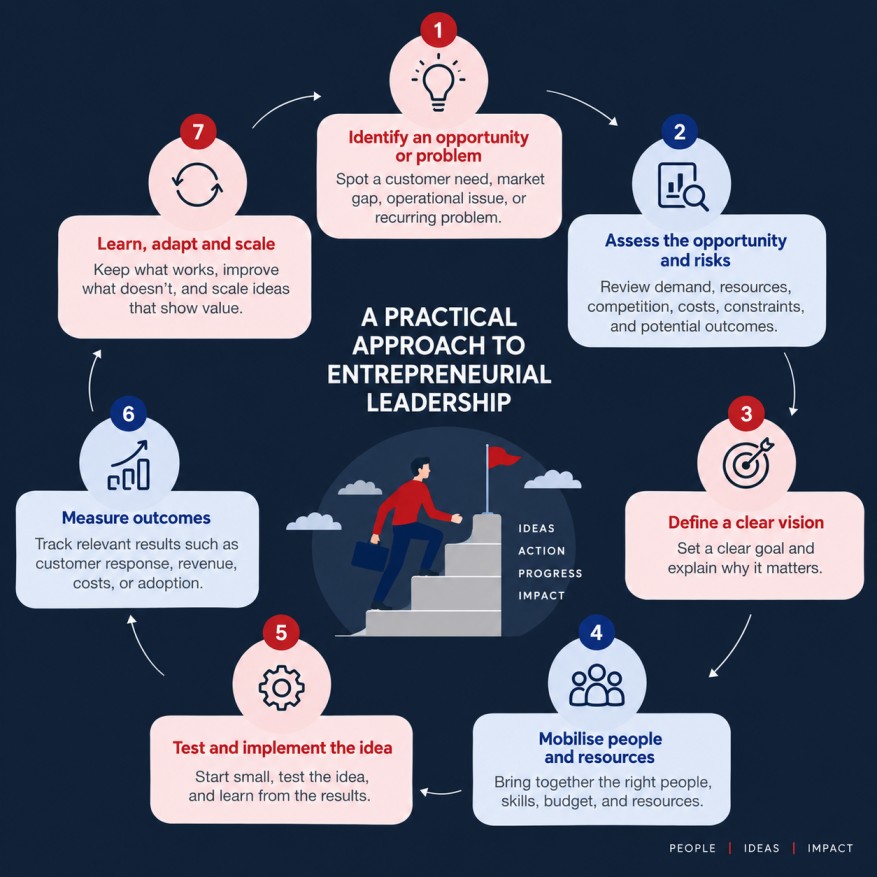
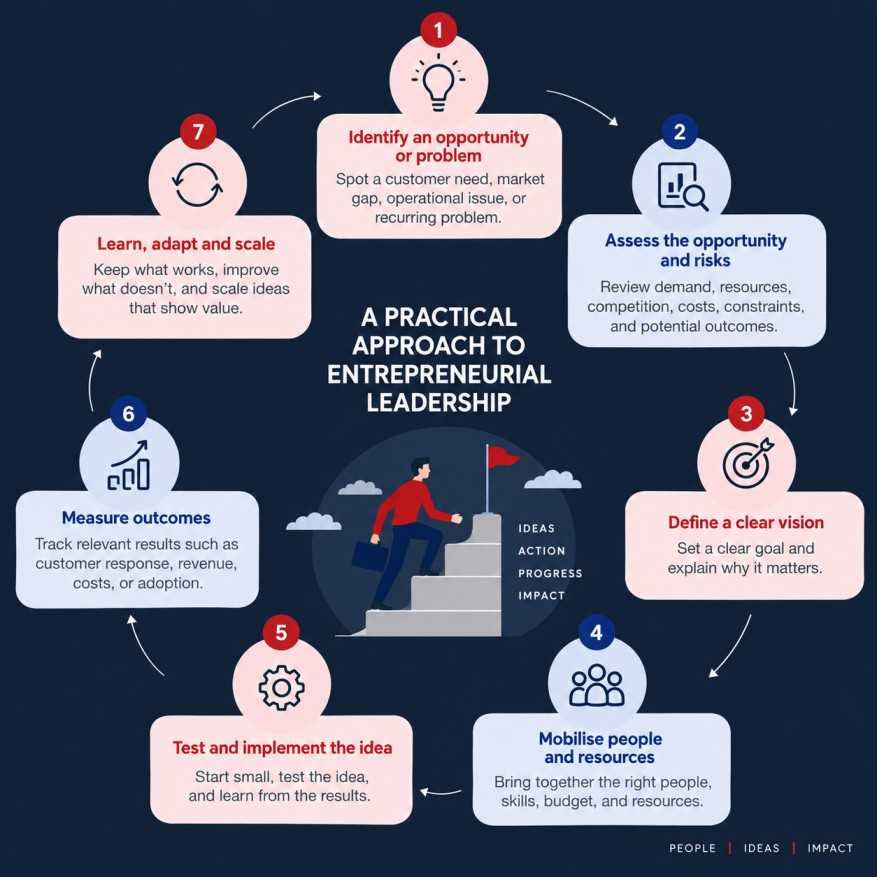
Here is a clear way to understand how this entrepreneurial leadership works:

Seven-step entrepreneurial leadership process from identifying an opportunity to learning, adapting, and scaling.Seven-step entrepreneurial leadership process from identifying an opportunity to learning, adapting, and scaling.

The cycle then repeats itself. 

Must read: Business Process Management: Types, Lifecycle & Benefits    

How Does Entrepreneurial Leadership Encourage Innovation?

Innovation does not only come from good ideas. They also need to be cultivated. People should have the freedom to explore ideas, question existing methods and norms, test alternatives, and learn from their mistakes to be able to grow and try more new ideas.

Entrepreneurial leaders support this culture in their organisation. This allows the team to challenge themselves, test even the smallest ideas, and find new ones. 


For example, A food delivery company notices that customers often cancel orders when delivery times increase. Instead of changing the entire delivery system, the team could test a new way of assigning delivery partners in one area and compare the result. 

The lesson isn't that every experiment should succeed. What matters is whether the organisation learns quickly enough to improve its next decision.

Also read: What Is Change Management? Process, Types & Models  


Entrepreneurial Leadership Examples: Real-World Leaders

Real-world leaders show how entrepreneurial leadership can work across industries and business stages. Their approaches differ, but each demonstrates behaviours such as spotting opportunities, taking calculated risks, encouraging innovation, adapting to change, and creating value.

Falguni Nayar

Falguni Nayar identified an opportunity in India’s beauty market and founded Nykaa after a career in investment banking. She built the business around changing consumer behaviour and the growing demand for online beauty shopping. Her journey shows how opportunity recognition, customer focus, and calculated risk-taking can shape entrepreneurial leadership.

Kiran Mazumdar-Shaw

Kiran Mazumdar-Shaw founded Biocon and built the company in the biotechnology sector, where scientific research and long-term investment are important. Her leadership reflects persistence, innovation, and a willingness to pursue opportunities in a complex and evolving industry.

Steve Jobs

Steve Jobs is widely associated with Apple's focus on product design, technology, and user experience. His leadership placed strong emphasis on creating products around changing consumer expectations. His example shows how vision, experimentation, and a strong focus on customer value can support entrepreneurial leadership.

Also read: Situational Leadership: Model, Styles & Examples Guide  

Reed Hastings

Reed Hastings co-founded Netflix, which changed its business model as technology and consumer habits evolved. The company moved from DVD rentals toward streaming and later expanded into original content. His example highlights adaptability, experimentation, and the willingness to rethink an existing business model.

Sara Blakely

Sara Blakely founded Spanx after identifying an unmet need in women's clothing. She started with limited resources and developed the product through experimentation and direct customer feedback. Her journey demonstrates resourcefulness, opportunity recognition, and persistence in turning an idea into a business.

Noubar Afeyan

Noubar Afeyan has built businesses around scientific innovation and founded Flagship Pioneering, the organisation behind Moderna's development. His approach focuses on exploring uncertain ideas, testing scientific possibilities, and investing in opportunities that could create significant value. His example highlights experimentation, risk-taking, and innovation under uncertainty.

Do read: Transformational Leadership Style: Meaning and Benefits  

Where Is Entrepreneurial Leadership Used?

Entrepreneurial leadership can be applied wherever leaders need to respond to opportunities, uncertainty, or change.

Entrepreneurial leadership in startups

Startup leaders frequently work with limited resources and incomplete information. They may need to test customer demand, adjust products, build teams, and decide where limited funds should go.

Entrepreneurial leadership in small businesses

Small-business owners can use this approach to identify changing customer needs, introduce new offerings, improve operations, or respond to local competition.

Also read:  What Is Business Management? Roles, Skills & Types 

Entrepreneurial leadership in established organisations

Large companies can also use entrepreneurial thinking. A product manager, department head, or innovation team might test a new service without changing the entire organisation at once.

Entrepreneurial leadership during organisational change

Change creates uncertainty. Leaders can involve employees, test new processes, collect feedback, and adjust implementation rather than assuming that one plan will work everywhere.

The setting changes, but the underlying approach remains similar. Leaders identify opportunities, assess uncertainty, mobilise people, act, and learn.

Ready to strengthen your business knowledge and leadership capabilities? Explore the IIMBx Certificate in General Management for Emerging Leaders and gain practical insights to navigate business challenges, make informed decisions, and prepare for greater leadership responsibilities. 

Conclusion

Entrepreneurial leadership is about more than starting a business. It's a way of leading that combines opportunity recognition, calculated risk-taking, innovation, adaptability, and people management to create value under uncertainty.

The strongest practitioners don't chase every opportunity. They assess what matters, involve the right people, test their assumptions, learn from results, and adjust when the evidence changes. That's what makes entrepreneurial leadership useful across startups, small businesses, and established organisations.

Frequently Asked Questions

General

Latest Blogs

How to Become a Project Manager: Skills and Career Path
Oct 5th, 2026

How to Become a Project Manager: Skills and Career Path

Learn how to become a project manager with the right skills, qualifications, experience, certifications, and career steps to grow in project management.

Read More
Product Strategy: Definition, Types, Process & Examples
Oct 5th, 2026

Product Strategy: Definition, Types, Process & Examples

Product strategy explained for beginners. Learn what it is, the main types, how to build one in 8 steps, real examples from Tesla and Spotify, and a template.

Read More
People Management Skills: Top 10 Skills for Leaders
Oct 1st, 2026

People Management Skills: Top 10 Skills for Leaders

Discover the top 10 essential people management skills every leader needs, why they matter, the types, the challenges, and practical steps to develop them.

Read More
Copyright 2026 of [University Name]