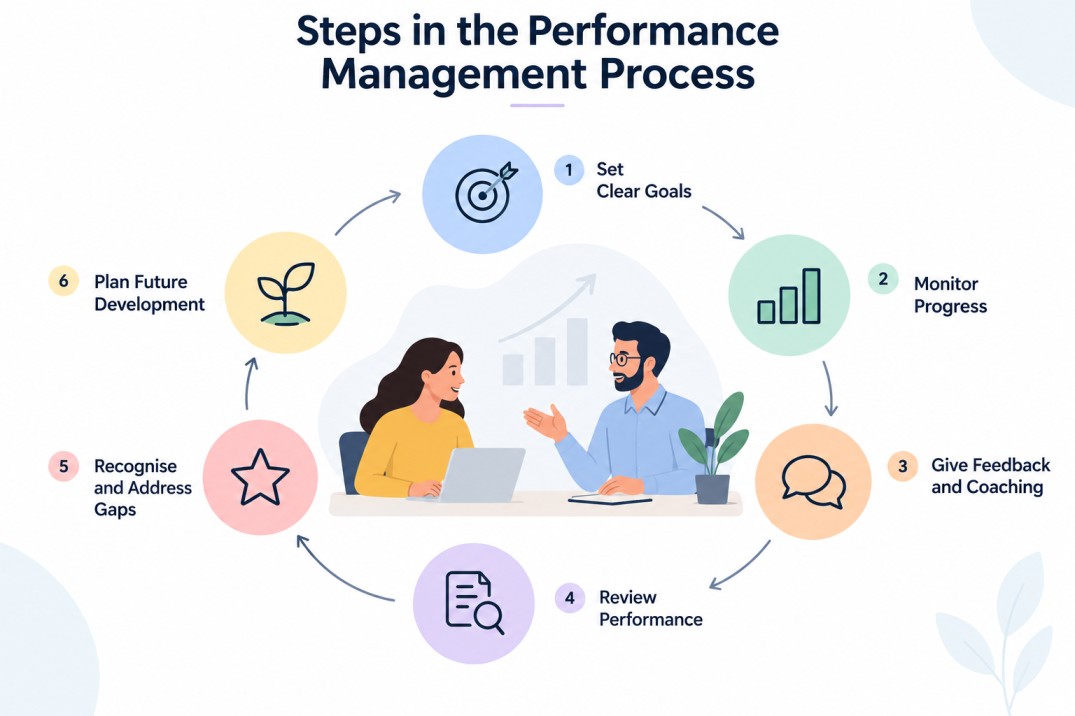
1. Plan Performance Goals and Expectations
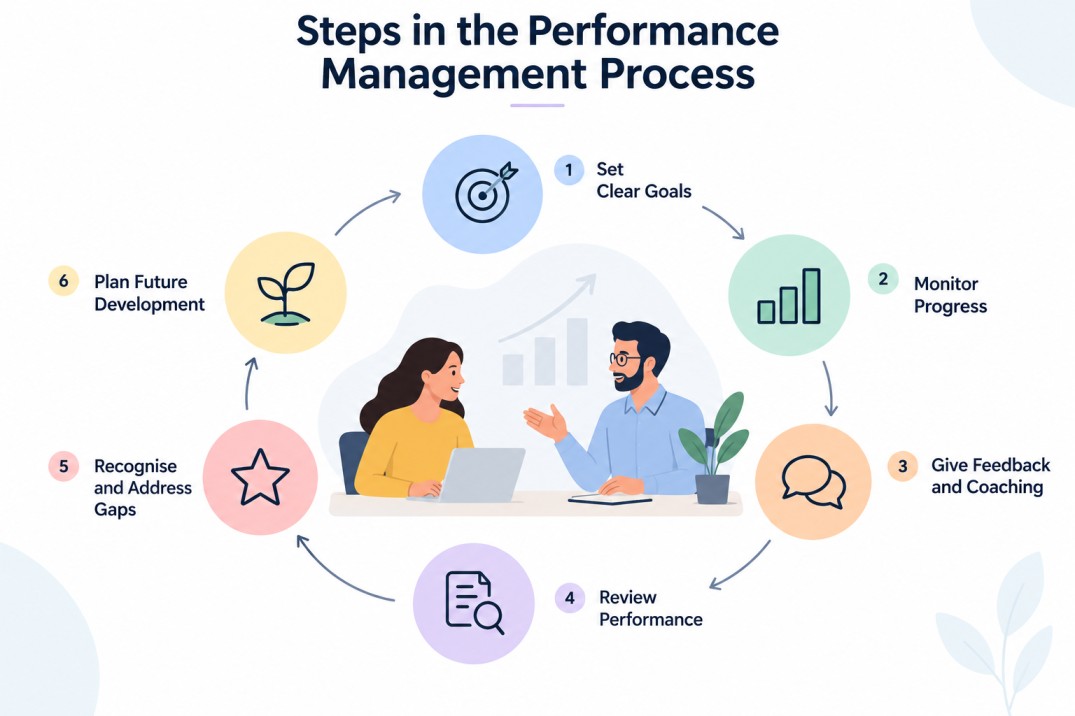
The first step of the cycle is to establish clear goals and expectations. Employees should understand what they need to achieve, what they're expected of, how success will be assessed, and how their work contributes to the organisation’s objectives.
The goals have to be specific for them to understand and implement, and at the same time flexible enough in case of changing priorities.
For example, a marketing manager asked an employee to “improve social media”, which is somewhat a vague goal. Instead, the manager can set a clear goal to increase qualified leads from social media by 15% in the next quarter, which is a much easier-to-understand goal.
Also read: Leadership and Management: Meaning, Skills & Importance
2. Monitor Performance and Progress
The second step in this cycle would be to monitor the progress of the employee because goals shouldn't only be on paper. It has to be tracked to see if it is actually happening. This should again not mean micromanaging the employee.
Managers need to do regular check-ins to review their progress, discuss what obstacles are slowing them, and identify changes that could affect the results. Monitoring can include project milestones, KPIs, quality measures, customer feedback, or progress against agreed objectives.
Frequent conversations also make it easier to spot problems early. The goal here is to keep the employee motivated and on track.
3. Provide Feedback and Coaching
The third step is to provide time to time feedback to turn performance data into useful action. Managers should explain what the employee is doing well, where improvement is needed, and what the employee can do next to do better.
Good feedback should be specific.
For example, instead of saying, "You need to work on your communication," a manager could discuss how a missed stakeholder update was something very important. And how the lack of clear communication affected this. He can then discuss a clearer communication routine.
Coaching the employee helps them build the skill rather than simply pointing out the problem.
4. Review and Assess Performance
The fourth step is to conduct a formal review and assess performance. It brings together the evidence gathered during the performance cycle, allowing managers to assess progress against the agreed goals, discuss achievements, identify gaps, and consider future development needs.
The review makes sure to avoid unpleasant surprises. This is the formal checkpoint of the overall performance review, usually quarterly or annually
Also read: Leadership and Management: Meaning, Skills & Importance
5. Recognise Performance and Address Gaps
The fifth step is to make sure that the performance gets all the recognition it deserves. And if there are performance gaps, then those have to be addressed too.
Recognition might involve formal rewards, greater responsibility, public acknowledgement, or development opportunities. Performance gaps may require additional coaching, revised expectations, training, or a documented improvement plan.
The employee’s capabilities should also be considered. Missing a target doesn’t always mean the employee lacks the skills or ability to perform. External changes, unclear expectations, limited resources, or changing priorities can also lead to poor results.
6. Plan Development and Set Future Goals
The cycle doesn’t end with the fifth step. The final step is to set future goals and create a development plan. It helps employees learn from the past and prepare for what’s next.
Managers and employees discuss skills to develop, career interests, future responsibilities, and goals for the next cycle. Development activities may include training, mentoring, new projects, job rotation, or taking on new responsibilities.
The cycle then starts again with new or revised goals.
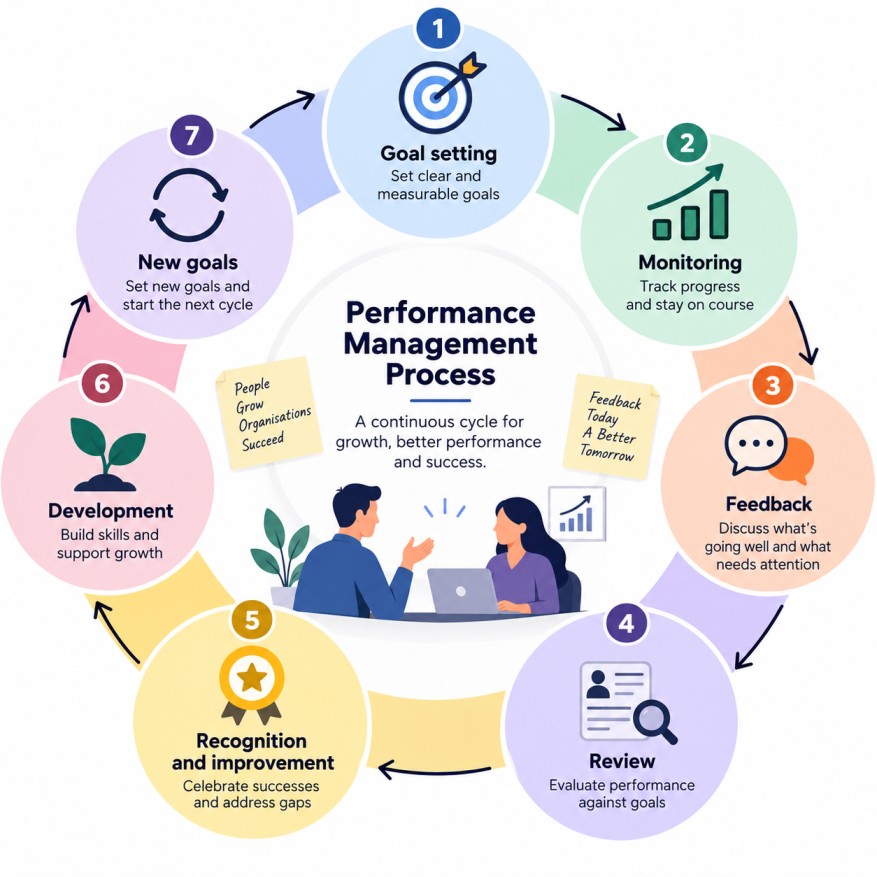
So now that we know all the steps in the performance management process, it's easier to understand how these steps provide a clear way to set expectations, track progress, give feedback, and support employee growth throughout the performance cycle. It's not only beneficial to employees, but also to the organisation as a whole.
Also Read: Assistant General Manager Salary in India 2026: Pay Guide
What Are Common Performance Management Methods?
Using the steps we discussed above, the methods may seem very similar. But each method has a different approach and purpose for managing employee performance. Organisations use different methods depending on their goals, workforce, and management style. Here are the common methods used:
Method | What It Means | Best Used When |
Goal Setting | Sets clear targets using SMART goals or OKRs. | Teams need clear goals. |
Continuous Performance Management | Uses regular check-ins and feedback. | Priorities change often. |
Management by Objectives | Links performance to agreed objectives. | Results are measurable. |
360-Degree Feedback | Collects feedback from multiple people. | Different perspectives are needed. |
Performance Appraisals | Provides a formal performance review. | Pay or promotion decisions need documentation. |
Coaching | Provides ongoing guidance and support. | Employees need skill development. |
SMART goals and OKRs are two common goal-setting frameworks used in performance management. The full form of SMART is Specific, Measurable, Achievable, Relevant, and Time-bound. The full form of OKRs is Objectives and Key Results. These frameworks help to define what an employee or team wants to achieve and how progress will be measured.
For Continuous Performance Management, the method used is regular check-ins. MBO ties performance directly to specific, previously agreed objectives set jointly by manager and employee.
360-degree feedback adds perspectives from peers, managers, direct reports, or other stakeholders. Coaching, meanwhile, focuses on helping employees understand problems and develop practical solutions.
The right combination depends on the organisation's needs. And how well the manager is able to utilise the performance management process.
Now that we understand the steps and methods used in the performance management process, the next step is to measure performance. This helps managers track improvement and document employee progress.
Also Read: General Manager Salary Per Month in India 2026: ₹5 Lakh+?
How to Measure and Improve Performance Management?
It's important to measure and track performance. But it's not as easy as it sounds, as you can't manage something you can't measure.
How Is Employee Performance Measured?
Employee performance can be measured through a mix of quantitative and qualitative indicators.
Common measures include:
Performance Measure | What It Measures |
Goal Achievement | Progress against agreed goals |
Productivity | Amount of work completed |
Work Quality | Accuracy and standard of work |
Customer Outcomes | Customer satisfaction and results |
Project Milestones | Progress against project targets and deadlines |
Role-Specific KPIs | Key results linked to the employee’s role |
Competencies and Behaviours | Skills, teamwork, communication, and work behaviour |
Managers can then use different assessment methods to evaluate these measures:
Method | What It Measures |
Rating Scales | Performance across specific skills or areas, often using a 1–5 scale |
9-Box Grid | Current performance and future potential |
BARS | Performance based on specific workplace behaviours |
Self-Assessment | Employee’s view of their achievements and improvement areas |
360-Degree Feedback | Feedback from managers, peers, direct reports, and other colleagues |
The main idea here is to use measures that match the employee’s role and agreed goals.
Must read: What Is Management? Meaning, Functions & Importance
How Can Organisations Improve the Performance Management Process?
To improve the performance management process in organisations, just start with the basics first.
Organisations can:
Set clear and measurable goals
Schedule regular performance conversations
Train managers to give useful feedback
Involve employees in goal setting
Review goals when priorities change
Use evidence when assessing performance
Connect reviews with development plans
Address performance gaps early
These basic measures make a huge difference. This process also needs consistency. If one manager holds monthly conversations while another speaks to employees only once a year, employees can have very different experiences inside the same organisation.
Now that we understand the steps, methods, and ways to measure performance, we have covered the main parts of performance management.
However, some related terms are often confused with performance management. Let’s understand how they differ.
Must read: Leadership Management: Meaning, Skills, Styles & Importance
Performance Management vs Performance Appraisal, Performance Review & Continuous Management
These are very similar terms, so it causes a fair amount of confusion.
Aspect | Performance Management | Performance Appraisal | Performance Review |
Meaning | An ongoing process of managing employee performance | A formal assessment of employee performance | A structured discussion about an employee’s performance |
Frequency | Ongoing throughout the year | Usually periodic, such as annually or twice a year | Can happen regularly or at set intervals |
Main focus | Goals, progress, feedback, development, and performance | Evaluating performance against agreed expectations | Discussing achievements, challenges, and areas for improvement |
Feedback | Regular and ongoing | Often given during the formal assessment | Usually part of the review discussion |
Development | Includes future goals and development planning | May include development recommendations | Can include development discussions |
Role in the process | The broader system and process | One formal assessment within the process | One conversation or assessment within the process |
In very simple words, performance management is the full process, whereas a performance appraisal is a formal assessment and a performance review is a discussion about an employee’s performance.
Annual Performance Reviews vs Continuous Performance Management
Annual reviews mean a formal assessment during a particular time of year. Continuous performance management means performance conversations throughout the year. The differences are:
Annual reviews | Continuous performance management |
Formal discussion at set intervals | Regular conversations |
Goals may stay unchanged for longer | Goals can be revisited |
Feedback may cluster around review time | Feedback happens throughout the cycle |
Problems can surface late | Issues can be discussed earlier |
Every good strategy has some limitations or challenges; let's know what are those challenges for performance management and how to overcome those challenges.
Also Read: What Is Leadership? Definition, Types, Skills & More
Common Performance Management Challenges and How to Overcome Them
Every strategy has some challenges. Here is how to overcome challenges in performance management:
Challenge | How to Address It |
Unclear or Unrealistic Goals | Set clear, measurable goals and check whether employees have the resources to achieve them. |
Infrequent Performance Conversations | Use regular check-ins to discuss progress, challenges, and changing priorities. |
Ineffective Feedback | Make feedback specific and two-way, giving employees space to share their views and challenges. |
Disagreement With Performance Reviews | Use agreed goals, clear criteria, specific examples, and documented evidence during review discussions. |
Rating Bias | Keep performance notes throughout the cycle and use clear criteria to assess the full review period. |
Inconsistent Standards | Use common performance criteria and manager calibration to maintain consistent ratings across teams. |
Delayed Performance Gaps | Address performance issues early through regular monitoring, feedback, and support. |
Goals Becoming Outdated | Review goals during the performance cycle and update them when priorities change. |
Process Fatigue | Keep forms, meetings, and documentation simple so managers and employees can focus on meaningful conversations. |
Feedback Avoidance | Train managers to handle difficult conversations and give clear, constructive feedback. |
Now that we understand the process, let’s look at one of the best real-world performance management process examples to see how organisations put these ideas into practice.
Build stronger management skills with the IIM Bangalore Young Leaders Programme (YLP) for Working Professionals . Learn practical business concepts and strengthen your ability to manage teams, processes, and business decisions.
Performance Management Process Case Study: Adobe
One of the best performance management process examples is of Adobe. Its change directly involved the performance management process.
In 2012, Adobe moved away from annual performance reviews and introduced ongoing Check-in conversations focused on expectations, feedback, coaching, and growth. Stanford Graduate School of Business documented the change in a dedicated case study.
The Challenge With Adobe's Traditional Performance Review System
Adobe’s old performance system was based on annual reviews, ratings, rankings, and paperwork. But as the business changed faster, this approach wasn't keeping up with how employees worked and developed.
Adobe wanted managers to have regular conversations with employees about goals, feedback, performance, and development.
How Adobe Redesigned Its Performance Management Process
Adobe introduced Check-in as an ongoing approach instead of relying on one annual review. It focused on regular conversations between managers and employees about goals, feedback, coaching, and growth.
Adobe also trained managers and provided employees with the resources and support they needed to follow the new approach. The model focused on setting clear expectations, tracking progress, giving regular feedback, and supporting employee growth.
What Changed in Adobe's Performance Management Process?
The change moved performance discussions from one formal annual review to regular conversations throughout the year. Adobe continued to develop Check-in with digital tools to help managers and employees set goals, track progress, share feedback, and discuss career growth.
By 2022, Adobe had added features such as a Check-in Dashboard, goal tracking, quarterly conversations, and real-time feedback.
Do read: Business Continuity Management: Process and Importance
What Were the Reported Outcomes?
Adobe reported saving around 80,000 manager hours through the change to its annual review process. The company also reported that voluntary employee turnover was going down after the change. These are Adobe’s own reported results and don’t mean that every organisation will see the same results.
What Can Organisations Learn From Adobe's Approach?
Adobe’s case shows that changing a performance management process involves more than removing annual reviews. Managers need proper guidance, while employees need clear goals and regular feedback. The organisation also needs simple ways to track goals, record feedback, and support employee development.
The case also shows that performance management can change over time. Adobe added more structure and digital tools after employee feedback highlighted areas that needed improvement.
Let's find out if all of this can be managed in a tool and how to do the documentation part.
Must read: What Is Servant Leadership? Meaning, Benefits & Examples
Performance Management Documentation and Tools
Documentation is very important aspect for any organisation as it gives managers and employees a shared record of goals, feedback, review outcomes, and development actions.
What Should Be Documented?
A useful record can include:
Agreed performance goals
Key expectations
Check-in discussions
Feedback and coaching points
Performance review outcomes
Development actions
Follow-up dates
Changes to goals or priorities
What Tools Can Support Performance Management?
A performance management system process may use HR platforms, goal-tracking software, feedback tools, review systems, and reporting dashboards as tools to support performance management. Many teams now use dedicated performance management system process software, such as platforms from Lattice, 15Five, or Workday, to track goals and feedback in one place instead of scattered emails and spreadsheets.
Now that we know everything about this process, let's have a look at the performance management process checklist.
Performance Management Process Checklist
Use this performance management process checklist to review whether the main elements are in place.
Performance goals are clearly defined
Expectations are documented
Goals connect with organisational priorities
Progress is reviewed regularly
Employees receive useful feedback
Managers discuss development needs
Performance assessments use clear criteria
Achievements are recognised
Performance gaps are addressed early
Important discussions are documented
Goals are reviewed when priorities change
The process itself is evaluated
A performance management process template can also help managers organise goals, check-ins, feedback, review outcomes, and development actions in one place.
Conclusion
A strong performance management process isn't just an assessment. It's a continuous cycle that connects goals, monitoring, feedback, review, recognition, and employee development. This process gives employees clear expectations while giving managers regular opportunities to discuss progress and solve problems early. The Adobe case also shows that organisations can redesign their approach when an existing system no longer fits how people work.
When the process is clear, measurable, and regularly reviewed, performance conversations become part of everyday management rather than a once-a-year administrative task.