What Is Leadership and Management?
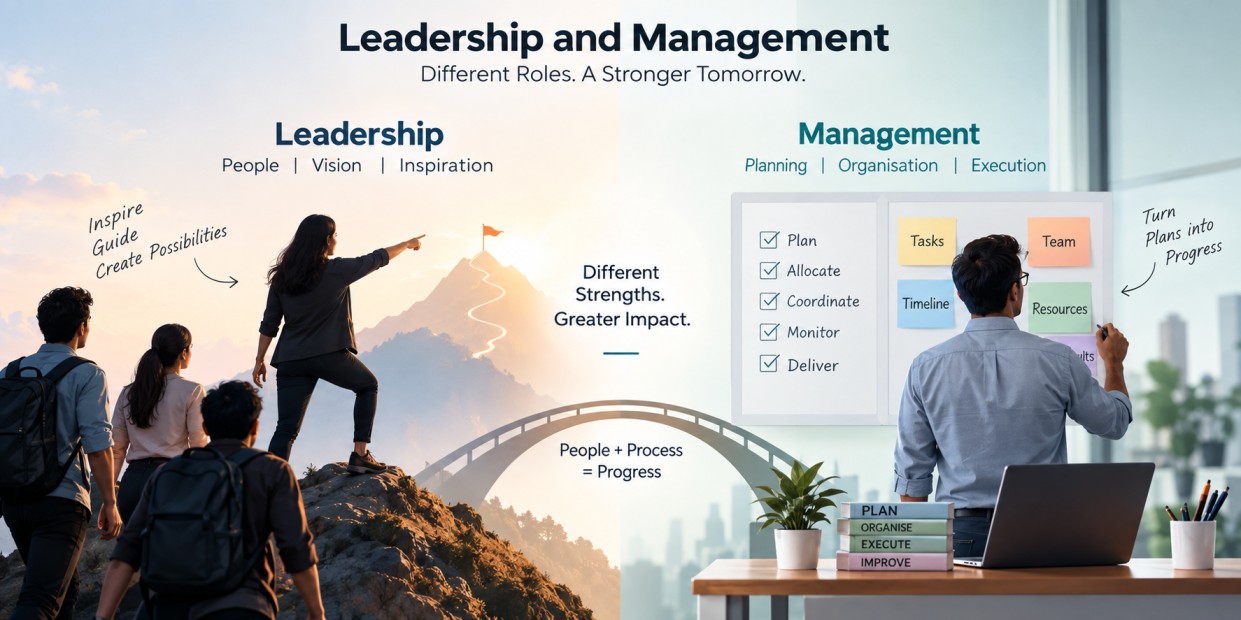
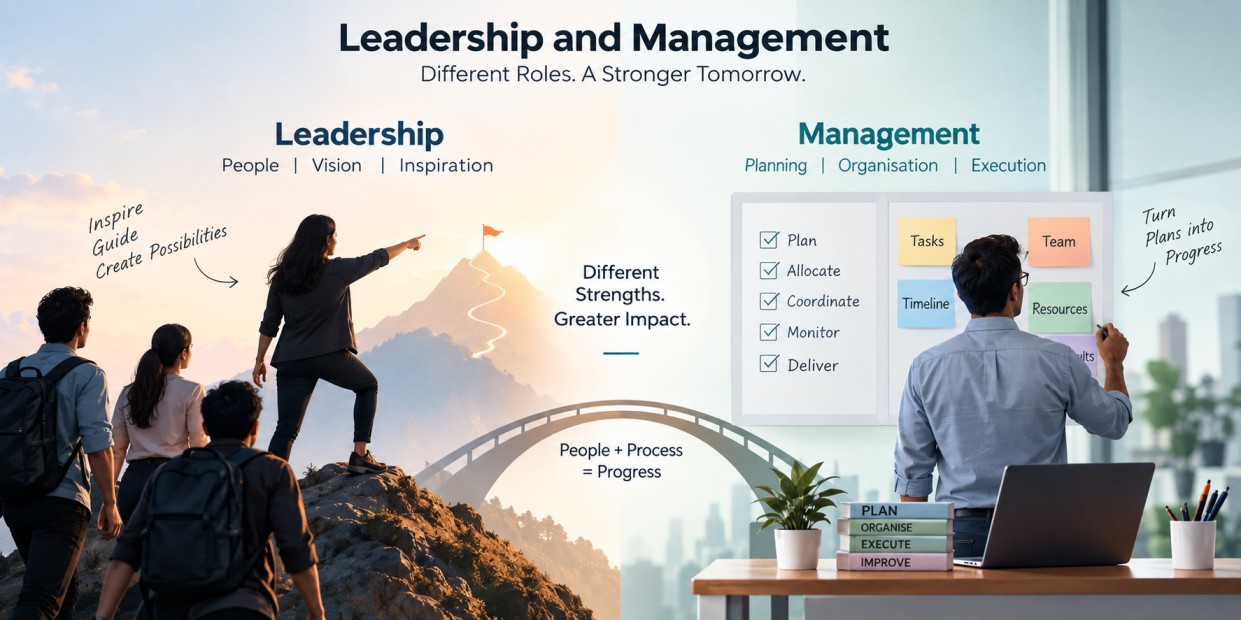
Leadership is the ability to guide, influence and motivate people towards a common goal. A leader sets direction, builds trust, and encourages people to do their best. You don't always need a formal title to be a leader.
Management is about planning and organising work to achieve specific goals. Managers assign tasks, manage resources, track progress, and solve day-to-day problems so the team stays on track.
A good leader shows the team where it's going and why the goal matters. They don't need a senior title. Even a junior employee can show leadership by sharing a good idea, gaining the team's trust, and getting people to support it. Leadership is especially useful when things are unclear. When there isn't a clear plan, a leader helps the team choose a direction and move forward with confidence.
A manager turns a goal into a clear plan. They assign tasks, check progress, manage resources, and solve problems. This keeps the work organised and helps the team stay on track.
Good management brings order to daily work. It helps teams meet deadlines, use resources properly, and focus on what needs to be done.
Must read: What Is Slack in Project Management? Types & Calculation
Why Are Leadership and Management Important?
An organisation needs both good leaders and good managers to run smoothly. Leaders guide people toward the right direction, while managers organise the work and help the team stay on track. Together, they help the organisation move toward its goals and achieve success.
Leadership and management help organisations turn goals into action while keeping people focused and work organised.
Set clear goals and priorities
Guide teams toward shared objectives
Improve employee performance
Motivate and engage employees
Coordinate people, tasks, and resources
Support better decision-making
Manage change more effectively
Maintain accountability
Solve workplace problems
Achieve organisational goals
Imagine a team launching a new service. A leader can get everyone excited about the idea, while a manager sets deadlines, assigns tasks, and checks progress. Without good coordination, even a great idea can lose momentum.
That's why organisations need both. Leadership gives the team direction, while management keeps the work organised and moving.
Also read: Leadership Management: Meaning, Skills, Styles & Importance
What Is the Difference Between Leadership and Management?
The difference between leadership and management becomes clearer when you compare their focus, responsibilities, and approach to people.
Aspect | Leadership | Management |
Main focus | Vision and direction | Planning and execution |
Primary goal | Inspire people toward a goal | Achieve defined objectives |
Approach | Influences and motivates | Organises and coordinates |
Authority | Often based on influence | Usually linked to formal responsibility |
Time focus | Future direction | Current performance and delivery |
Approach to change | Drives and champions change | Plans and implements change |
Risk | More willing to challenge existing practices | Assesses and controls risks |
People | Builds commitment | Assigns responsibilities and monitors performance |
Success | Engagement, direction, and progress | Efficiency, results, and consistency |
Leadership asks the question, "Where should we go?" Management asks, "How will we get there?"
Also Read: 10 Major Leadership Theories for Workplace Success
What Are the Similarities Between Leadership and Management?
Leadership and management share several responsibilities. Both involve people, decisions, communication, accountability, and organisational goals.
Shared Area | How It Applies to Both |
Communication | Both need to communicate goals, expectations, and feedback clearly. |
Decision-making | Both make decisions, especially when teams face challenges or pressure. |
Goal setting | Both work toward clear team and organisational goals. |
Accountability | Both take responsibility for team performance and results. |
Problem-solving | Both identify issues and find practical solutions. |
Team performance | Both play a role in keeping teams productive and focused. |
Emotional intelligence | Both need to understand employee concerns and respond appropriately. |
Relationship building | Both build trust and maintain positive working relationships. |
Also Read: Assistant General Manager Salary in India 2026: Pay Guide
What Are the Functions and Key Roles of Leadership and Management?
Leadership and management have different core responsibilities, although their work frequently overlaps.
Key Roles of Leadership
Leaders typically focus on people and direction. Their responsibilities can include:
Setting a clear vision
Building trust
Motivating employees
Encouraging new ideas
Guiding teams through change
Developing future leaders
Creating commitment around shared goals
Core Functions of Management
Managers focus more heavily on organising work and resources. Their functions include:
Planning activities and objectives
Organising people and resources
Staffing and assigning responsibilities
Directing day-to-day work
Coordinating activities
Controlling performance and resources
Also Read: General Manager Salary Per Month in India 2026: ₹5 Lakh+?
What Are the Key Skills Needed for Leadership and Management?
The skills of good leaders and good managers often overlap. But the priorities are not the same. Leaders need to understand people, build trust, and guide teams toward a goal. Being good at the technicalities of the job doesn't automatically make someone a good leader. Management needs consistency. When deadlines, roles, and expectations aren't clear, even a skilled team can lose focus and struggle to get the work done.
Leadership Skills | Management Skills |
Communication | Planning |
Strategic thinking | Delegation |
Emotional intelligence | Organisation |
Decision-making | Performance management |
Adaptability | Resource allocation |
Conflict resolution | Problem-solving |
Team building | Time management |
Vision setting | Decision-making |
Do read: Organizational Management: Meaning, Functions & Types
How Do Leadership and Management Drive Performance and Change?
Employee performance depends on the structure of the work and the motivation behind it. People need clarity, support, feedback, and a reason to care about the work.
How Do They Motivate Employees?
Leaders motivate people and find them the purpose of their work. They motivate employees by connecting their daily work to a bigger goal. Whereas managers support that motivation by setting clear expectations, giving regular feedback, recognising good work, and keeping performance standards fair. Both need good communication. Leaders give people a sense of purpose, while managers provide the structure they need to work.
How Do They Support Organisational Change?
Change is difficult for employees, especially when they don't understand why it's happening and how it's going to disrupt their way of working.
Leaders help employees understand why the change is happening and where the organisation is heading. Managers turn that direction into a practical plan. They organise training, update processes, assign responsibilities, and track progress so the change becomes part of everyday work.
Resistance is usually easier to address when employees can ask questions and understand directly.
Also read: What Makes a Good Leader? 10 Essential Qualities and Skills
What Happens When Leadership and Management Are Not Balanced?
When leadership and management do not go hand in hand, they create issues:
Situation | Likely outcome |
Strong leadership, weak management | Good vision but poor execution |
Strong management, weak leadership | Efficient work but limited direction |
Balanced approach | Clear direction with disciplined execution |
A leader who keeps changing decisions can confuse the team. A manager who focuses only on rules and procedures can limit new ideas.
Balance doesn't mean giving equal attention to both every day. A crisis may need stronger management, while a major change may need stronger leadership.
The right balance depends on the situation and what the team needs at that time.
Ready to strengthen your leadership and management skills, the IIMBx Certificate in General Management for Emerging Leaders can help you develop practical capabilities in leadership, decision-making, strategy, and business management.
Common Leadership and Management Mistakes to Avoid
Here are some avoidable mistakes that leaders and managers make
Common mistakes include:
Confusing authority with leadership
Micromanaging employees
Giving unclear expectations
Avoiding difficult conversations
Focusing only on short-term results
Failing to delegate
Ignoring employee feedback
Creating a vision without an execution plan
Managing processes while neglecting people
Good intentions aren't enough. Leaders and managers need to understand what their teams need at each stage of the work.
Must read: What Is Change Management? Process, Types & Models
Conclusion
Leadership and management have different roles, but organisations need both. Leadership gives people direction and purpose, while management turns those goals into plans, actions, and results. The key isn't choosing between the two. It's knowing when to lead, when to manage, and when you need both.
When teams have clear direction and good execution, work becomes easier to organise, and goals become easier to achieve.