

Key Highlights
Resource planning is the process of identifying what a project needs, when those resources are needed, and whether they’ll be available when the work begins.
Common project resources include people, skills, equipment, materials, technology, time, and financial resources.
A resource plan helps project managers connect resources with specific activities, schedules, capacity, and project requirements.
Effective resource planning can help teams manage shortages, avoid overallocation, resolve resource conflicts, and respond to changing project requirements.
Resource allocation, capacity planning, forecasting, scheduling, resource leveling, and resource smoothing are closely related concepts that support effective resource planning.
This blog covers what is resource planning, why is resource planning essential, the process, types, how to create a resource plan, common challenges, tools, and best practices.
Build stronger management skills with the IIM Bangalore Young Leaders Programme (YLP) for Working Professionals . Learn practical business concepts and strengthen your ability to manage teams, processes, and business decisions.
What Is Resource Planning?
Resource planning is the process by which you can identify what resources are needed to complete a project on time, within budget, and to the expected standard. It involves planning for all the resources involved, which are people, materials, equipment, technology, time, and money, based on the project’s requirements.
Let’s understand with an example.
In case of an website launch, you will need a designer, developer, a content writer, a tester, hosting, software, and a defined budget. All those resources won’t be needed at the same time or for the same duration. So you plan, look at the work, estimate the requirements, check availability, and assign resources to activities based on their required time and capacity.
This is called Resource planning.
The goal isn’t just to have enough resources. It’s to have the right resources available at the right time when needed without leaving them idle or overloading them.
Now that we understand what resource planning is, let's understand why it is important.
Why Is Resource Planning Important in Project Management?
When resources are assigned at the wrong time, unavailable when needed, or spread across too many tasks, your project will suffer. Projects don’t always fail because they lack resources. They usually fail because resources weren’t planned and managed properly.
Resource planning helps project managers see these issues before they affect delivery. It also helps teams make realistic decisions about schedules, workloads, budgets, and project priorities.
It can help teams:
Match skills with project requirements
Identify resource shortages early
Reduce workload conflicts
Improve resource utilization
Build more realistic project schedules
Control project-related costs
Anticipate future resource needs
Respond to changes in project scope
What Happens When Resources Aren't Planned Properly?
For example, when a developer is assigned to three urgent tasks all at once, a piece of equipment is booked by two teams for the same period, or a project reaches a critical stage and discovers that nobody with the required skill is available.
Take another example. A marketing team plans to launch a campaign in six weeks. No one checks if the designer is already working on other projects. The designer is handling two other projects, so the campaign gets delayed by three weeks because of the extra workload.
This kind of poor planning is why resource planning is needed.
Here is what happens if you don't plan your resources:
Missed deadlines
Budget pressure
Uneven workloads
Idle resources
Scheduling conflicts
Quality problems
Increased overtime
Delays in dependent activities
Small gaps can become very expensive when they are overlooked.
Resource Planning vs Resource Management
Resource planning and resource management are similar concepts. Resource planning is about deciding what resources a project needs and when they’ll be needed. The next step is Resource management which is assigning, tracking, and adjusting those resources as the project progresses.
The two concepts are dependent on each other. Planning requires management to fulfil the whole process.
Now that we know the importance of Resource planning, what happens without it and the difference between resource planning and resource management, let’s learn about the types of resources.
Also Read: 10 Major Leadership Theories for Workplace Success
What Are the Different Types of Project Resources?
A project can require several kinds of resources. The most common types include:
People are the most flexible resource because their skills can be used for different tasks. But they can also be harder to plan because their availability, experience, workload, leave, and other projects affects the planning. Equipment and materials are rather easier resources. As you only need to know whether they're available, how long they can be used, and whether another project needs them at the same time.
Technology as a resource can also limit a project. A team may have enough people, but they may not have access to the right software, platform, testing environment, or computing resources. A project may have enough staff, but the available budget might not cover the project work requirements. Hence, budget matters too
Time is an important resource in project planning. The total working hours available to a team aren't always the same as the hours they can spend on project tasks. Meetings, administrative work, support activities, and other responsibilities can reduce the time available for project work.
As we get to know about the types of resources, we understand resource planning a little better. Now, let's learn what a resource plan is.
Must read: Leadership Management: Meaning, Skills, Styles & Importance
What Is a Resource Plan?
The resource plan is a document, working schedule, spreadsheet, or system that records the resources. It is made for the project to show what the project requires, who will work on what, when they’ll work, and how the resources will be used.
It's more than a list of names of who is assigned.
A useful plan connects resources with activities and timelines. It also shows their availability, capacity, responsibilities, constraints, and planned utilization.
For example, for a product launch, a project manager might need a content writer during the planning stage, a designer for creating promotional materials, and a marketing specialist during the final launch phase. Each resource is assigned based on when their skills are needed.
What Should a Resource Plan Include?
A practical resource plan can include:
Now we need to understand about the process of resource planning is.
Also Read: General Manager Salary Per Month in India 2026: ₹5 Lakh+?
What Is the Resource Planning Process?
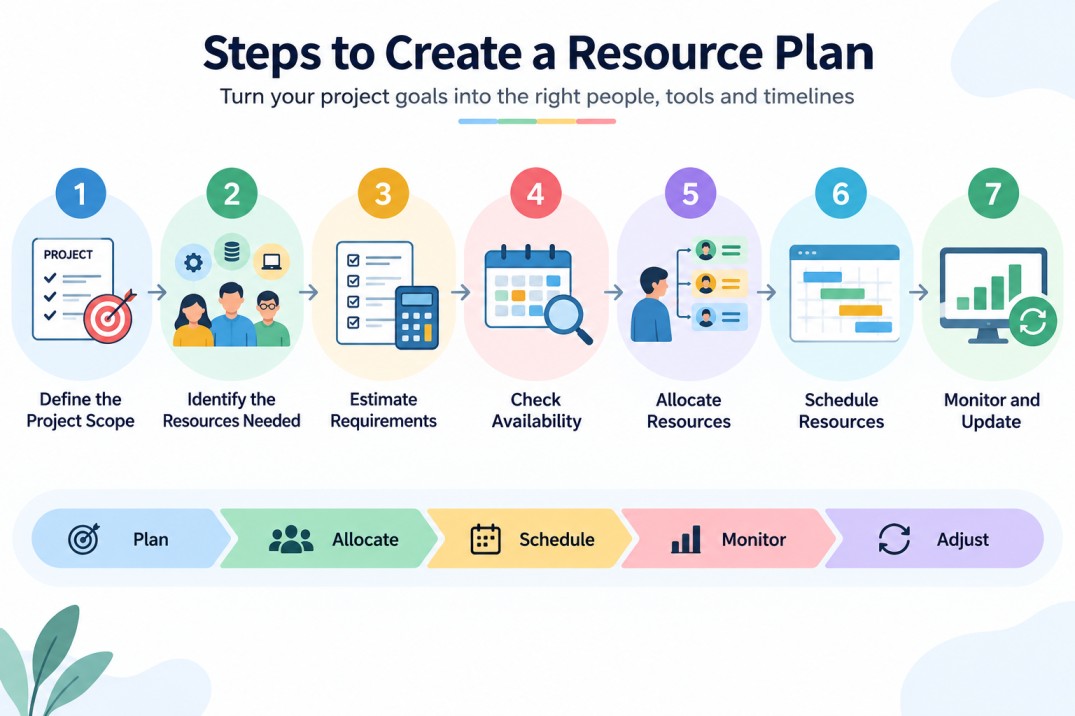
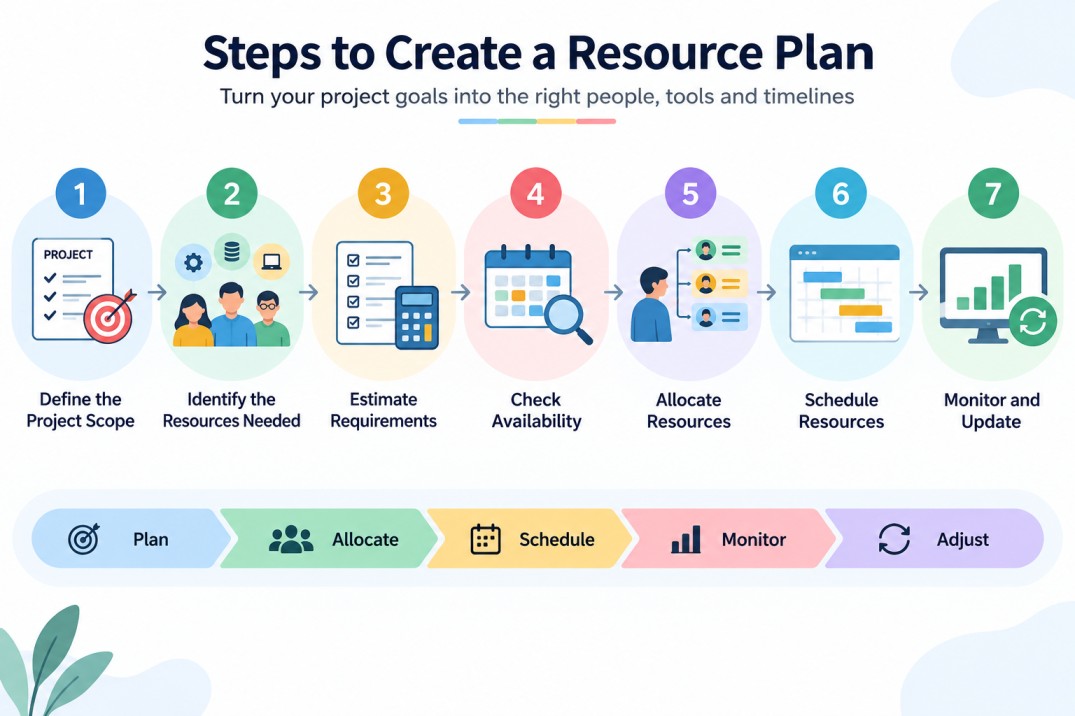
Resource planning process is a sequence of 7 steps you need to follow in order to avoid all chaos from poor planning. Here are the seven steps.