University Logo
Admissions Open for the 2026 Cohort
Phone1800 210 2020
IIMBx - Digital Learning Foundation

Business Continuity Management: Meaning, Process, and Importance

  1. Home
  2. Business Continuity Management: Meaning, Process, and Importance

Key Highlights

  • Business continuity management helps organisations prepare for disruptions such as cyberattacks, supplier failures, power outages, natural disasters, and staff shortages.

  • The main goal of business continuity management is to keep critical functions running during disruptions and support a controlled recovery when normal operations are affected.

  • Effective continuity planning involves risk assessment, business impact analysis, recovery objectives, continuity strategies, business continuity plans, testing, and continuous improvement.

  • Organisations can use practical strategies such as remote working, alternate suppliers, backup systems, cross-training, and alternate facilities to maintain essential operations.

  • In this blog, you’ll learn what do you mean by business continuity management, why it matters, how the lifecycle works, how to create a continuity plan, how testing works, and how organisations can prepare for common disruptions.

Ready to strengthen your leadership and management skills, the IIMBx Certificate in General Management for Emerging Leaders  can help you develop practical capabilities in leadership, decision-making, strategy, and business management. 

What Is Business Continuity Management? 

Business continuity management is a process that prepares an organisation for unexpected events like natural disasters, cyberattacks, or system failures. It's a process to evaluate threats and prepare for them using risk assessment, business impact analysis, recovery planning, testing, training, and continuous improvement.

You can't predict every future problem; that would be totally unrealistic. Instead, what business continuity management does is it identifies what is important, what can interrupt it, and decide how these activities will continue or recover if any such issues occur. It's not just a document saved in a shared folder. It's a system built through planning, testing, and regular updates. 

For example, imagine a fire broke out in a bank. And its main office is now inaccessible. Its continuity plan can then help employees work from another location, support customers remotely, and keep critical technology services running. 

What Are the Objectives of Business Continuity Management?

Here are the key objectives of business continuity management:

  • Protecting employees and other stakeholders

  • Maintaining critical products and services

  • Reducing operational downtime

  • Limiting financial and reputational damage

  • Establishing recovery priorities

  • Defining responsibilities during disruption

  • Supporting regulatory and contractual requirements

  • Improving organisational resilience

Also read: What Is Management? Meaning, Functions & Importance 

Why Is Business Continuity Management Important?

Businesses cannot afford to close down because of a disaster or a sudden event. It costs them money. So a disruption like a prolonged outage can affect revenue, customer relationships, suppliers, employees, compliance obligations, and an organisation's reputation at the same time.

That's why preparation matters. Business continuity management gives people the scope to be prepared by creating procedures and priorities before an incident occurs. This is so that they don't have to start or build everything out from scratch if a sudden event happens.

So now that we know what business continuity management is, why it's important, and its objectives. Let's learn about its key components in detail. 

Must read: Leadership Management: Meaning, Skills, Styles & Importance 

What Are the Key Components of Business Continuity Management?

An effective programme includes several activities. Each one has a different purpose, but together they help an organisation manage business disruptions. 

Risk Assessment

Risk assessment identifies threats that could interrupt your business. These might include cyber incidents, equipment failures, extreme weather, supplier problems, utility outages, or loss of key personnel. The assessment considers the likelihood of an event and its potential impact. Risks are then prioritised according to their significance.

Business Impact Analysis

Once you get to know the risk and threat, then you can move over to the part where you find out what it will cost your business. 

Business impact analysis, or BIA, finds out what happens when important activities are disrupted. It helps organisations identify critical functions, dependencies, resources, and recovery requirements. 

For example, a BIA might reveal that an organisation can tolerate a marketing system being unavailable for several days but needs its payment platform restored within a few hours. 

So this kind of information helps the business prioritise, in case of emergencies, what to choose first.

Do read: What Makes a Good Leader? 10 Essential Qualities and Skills 

Business Continuity Strategy

This is the part where you plan how to continue operations after the disaster. The strategy determines how critical activities will continue or recover after disruption. Options may include remote working, alternate suppliers, backup systems, manual processes, or alternate facilities.

Business Continuity Plan

This is the next step. It covers the written playbook for who will do what, how, and what will be the next course of action for the business. A business continuity plan documents what people should do during a disruption. It can define activation criteria, responsibilities, communication procedures, escalation routes, recovery actions, and important contacts.

Also read: What Is Slack in Project Management? Types & Calculation 

Training, Testing and Exercises

The next logical step would be obviously to try and test it. People need to know their roles before an incident occurs. Training introduces responsibilities, while drills allow teams to practise the procedures.

Testing also exposes weaknesses that you can't find when a plan exists only on paper.

Review and Continuous Improvement

The final step is to review and change it from time to time. Risks and business operations change. New suppliers arrive, systems are replaced, offices move, and teams change responsibilities.

Plans therefore need regular review. Lessons from exercises and actual incidents should feed back into the programme.

So now that you have a good idea of what the components of business continuity management are, let's learn about its lifecycle.

Also Read: General Manager Salary Per Month in India 2026: ₹5 Lakh+? 

How Does the Business Continuity Management Lifecycle Work?

A typical lifecycle connects the different activities of BIA into a repeating process. It looks like this:
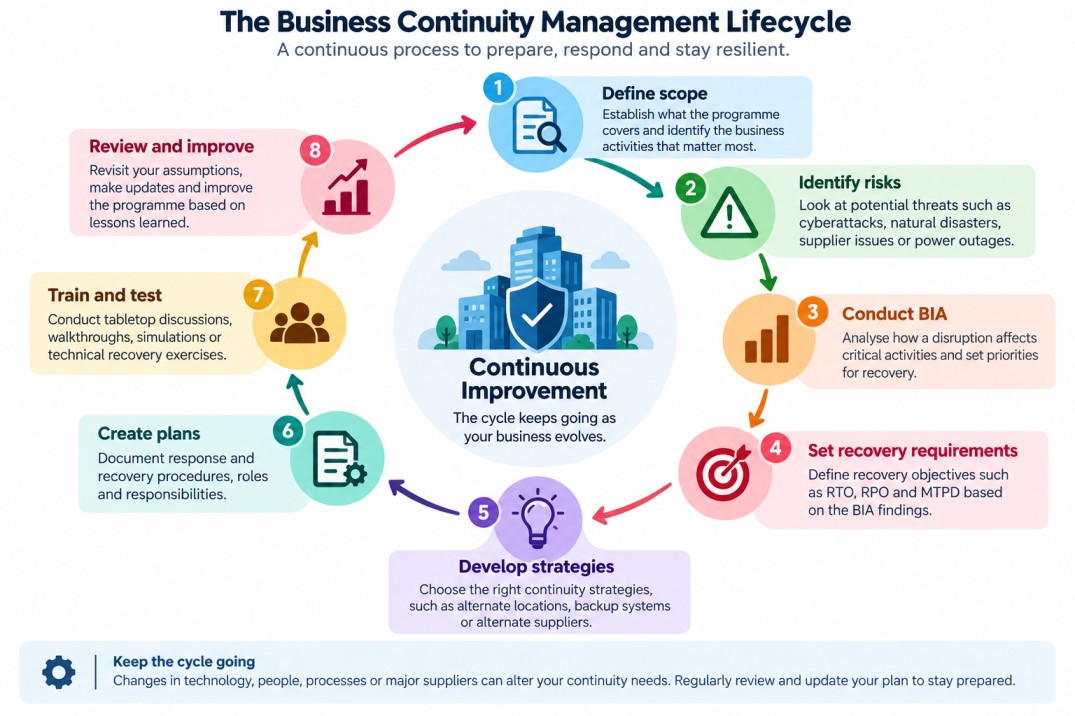
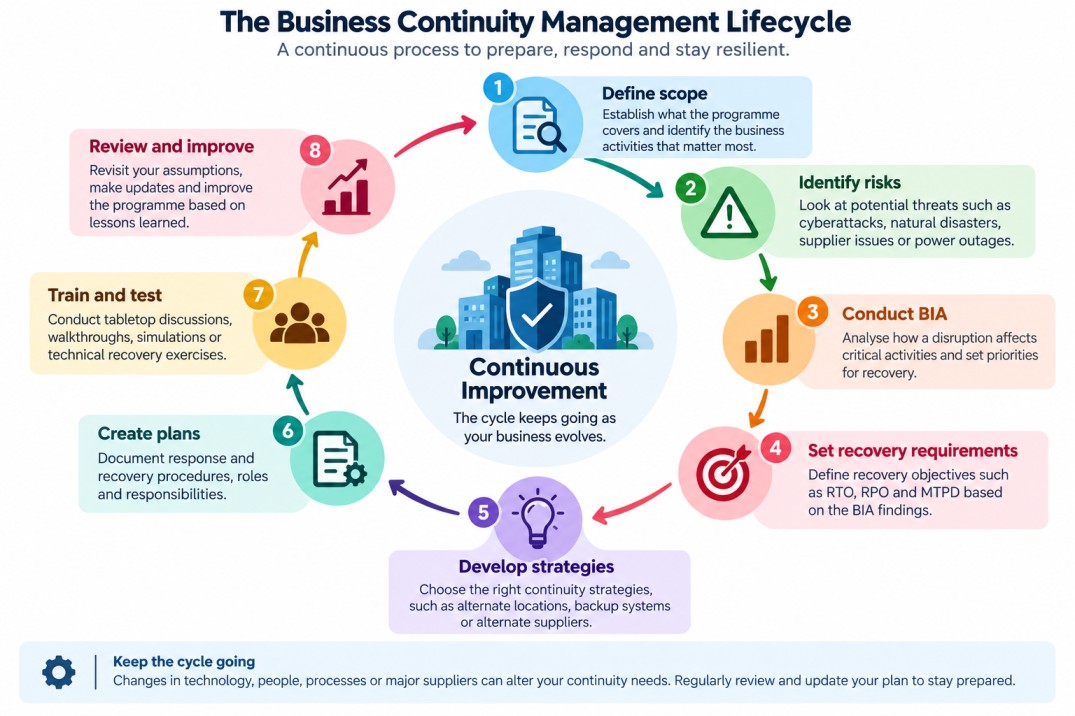
Business continuity management lifecycle infographic showing eight steps from defining scope and identifying risks to BIA, recovery requirements, strategies, planning, testing, and continuous improvement.Business continuity management lifecycle infographic showing eight steps from defining scope and identifying risks to BIA, recovery requirements, strategies, planning, testing, and continuous improvement.

Now that you know how the lifecycle of business continuity management works, let's learn about how to do a risk assessment for any organization.

Also read: What Is Management? Meaning, Functions & Importance 

How to Conduct a Risk Assessment for Business Continuity

Risk assessment means finding out what could go wrong and how it could affect your business.

Firstly, identify possible threats. For example, a technology company will look at cyberattacks or cloud outages. A manufacturing company will focus on machine failures, power cuts, transport problems, or supplier issues.

Now, check how likely each risk is and how much damage it could cause. It may look at financial loss, work delays, customer problems, safety issues, or damage to its reputation.

This whole process can be divided into four simple steps:

  • Identify possible threats

  • Check how likely they are and how much harm they could cause

  • Focus on the risks that need the most attention

  • Decide how to prevent or manage them

Risk assessment also helps with other parts of business continuity management. Its findings can be used in the business impact analysis and when choosing continuity strategies.

For example, if a key supplier has a high risk of stopping deliveries, the business could find another supplier, keep extra stock, or change its supply arrangement.

The goal is to know which risks matter most and then create a clear plan for dealing with them.

After assessing the risks, the next logical step is to analyse what it will impact; hence, let's know about Business Impact Analysis.

What Is Business Impact Analysis in Business Continuity Management?

This Business impact analysis tells us important information. It tells us how long the business will remain unaffected by the disruption. It examines the consequences of disruption to business activities. It helps organisations determine what needs to recover first, how quickly it needs to be recovered, and what resources are required to do that.

A BIA typically identifies critical products, services, processes, dependencies, people, facilities, technology, information, and suppliers.

Let's take an example of an online retailer. Its website, payment system, order processing, warehouse, and customer support all need to work together. If the payment system stops working, customers can't complete their orders even if the website is still running. 

That's what dependency analysis gives us.

What Are RTO, RPO and MTPD?

Here are the terms explained:

Term

Meaning

Simple example

RTO

Recovery Time Objective. The target time for restoring an activity or service

Restore an application within four hours

RPO

Recovery Point Objective. The acceptable amount of data loss measured in time

Recover data to within one hour of the incident

MTPD

Maximum Tolerable Period of Disruption. The longest period a disruption can continue before its impact becomes unacceptable

A critical service cannot remain unavailable beyond 24 hours

Now that we know about Business impact analysis, RTO, RPO and MTPD, the next step comes to create a business continuity plan.

Do read: Business Process Management: Types, Lifecycle & Benefits 

How to Create a Business Continuity Plan

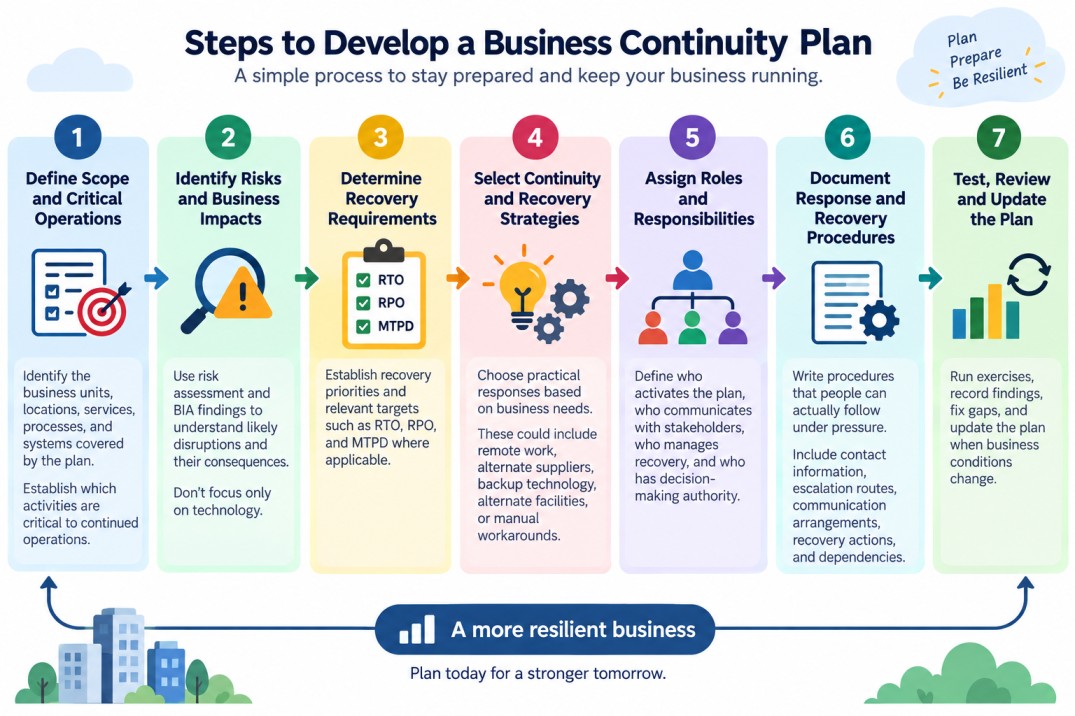
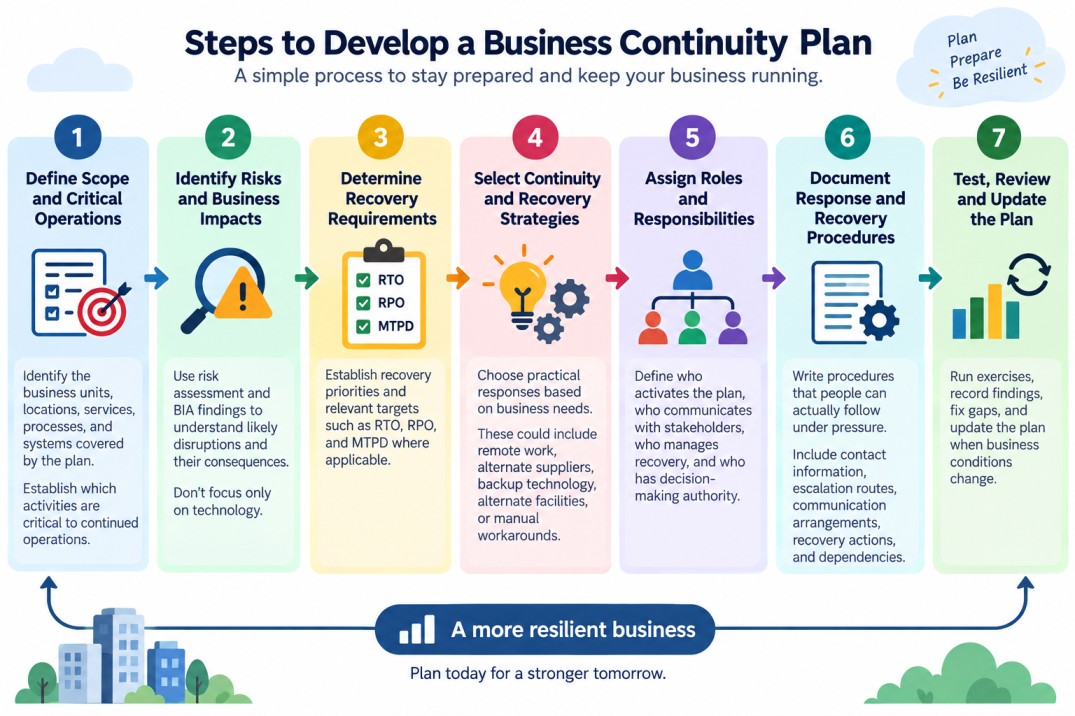
A business continuity plan turns analysis and strategy into practical instructions to be followed. It tells people what happens if a disaster occurs, who acts, and what resources are needed when normal operations are disrupted.


Steps to create a business continuity plan, covering scope, risk assessment, recovery requirements, continuity strategies, roles, procedures, testing, review, and updates.Steps to create a business continuity plan, covering scope, risk assessment, recovery requirements, continuity strategies, roles, procedures, testing, review, and updates.

A document is not everything here. It's more like a written, fixed plan or a handbook to tell the business what will happen. 

The business continuity plan is only useful when it turns into strategies. Once a disaster occurs, it gives direction to the organisation.

Do read: Transformational Leadership Style: Meaning and Benefits 

What Are Business Continuity Strategies?

Continuity strategies are practical steps a business takes to keep critical activities running or recover them quickly during a disruption. 

Common approaches include:

  • Remote or alternate working arrangements

  • Backup and recovery systems

  • Alternate facilities

  • Secondary suppliers

  • Cross-training employees

  • Manual workarounds

  • Data backup arrangements

  • Emergency communication procedures

The appropriate choice depends on the activity.

For example, a customer support team can work from home if its office becomes unavailable. A manufacturer can use another supplier if an important part isn't available.

Also Read: Assistant General Manager Salary in India 2026: Pay Guide 


What Is Business Continuity Testing?

Testing helps you to understand whether the theory on paper is actually good or not in real situations. It checks whether the arrangements work as expected. 

Testing can reveal missing information, unclear responsibilities, unrealistic recovery targets, technology limitations, and communication gaps.

Organisations can use several approaches:

Testing method

What it involves

Tabletop exercise

Teams discuss how they'd respond to a scenario

Walkthrough

Participants review procedures step by step

Simulation

Teams respond to a realistic disruption scenario

Technical recovery test

Specific systems or recovery capabilities are tested

Full-scale exercise

Multiple teams practise a larger coordinated response

What Should Organisations Do After a Business Continuity Test?

After a successful test, teams should document what happened and compare the results with the expected response.

They should then:

  • Record identified gaps

  • Assign corrective actions

  • Update procedures

  • Review recovery targets

  • Clarify unclear responsibilities

  • Retest important weaknesses

Also Read: 10 Major Leadership Theories for Workplace Success 

Business Continuity Management, Disaster Recovery, and Crisis Management: Key Differences

These terms work very similarly but have totally separate definitions

Area

Business Continuity Management

Disaster Recovery

Crisis Management

Main focus

Maintaining critical business activities

Restoring technology, systems and data

Managing the immediate crisis

Scope

Organisation-wide

Often technology-focused

Organisation-wide response

Key question

How will essential operations continue?

How will affected systems recover?

How will the organisation coordinate its response?

Typical activities

BIA, continuity planning, testing

Backup, system recovery, restoration

Communication, escalation, decision-making

Disaster recovery can form part of a wider continuity programme. Crisis management can also operate alongside it.

Risk management has a different focus. It deals with identifying and managing uncertainty and threats, while continuity planning focuses on maintaining or recovering important activities when disruption occurs.

Business resilience is broader still. It describes an organisation's capacity to absorb disruption, adapt, recover, and continue operating.

Must read: Organizational Management: Meaning, Functions & Types 

What Is ISO 22301 in Business Continuity Management?

ISO 22301 is an international standard for business continuity management systems. It provides requirements for establishing, implementing, maintaining, and improving a BCMS.

The standard helps organisations approach continuity through a structured management system rather than treating the business continuity plan as an isolated document.

ISO 22301:2019 is the published edition, with an amendment issued in 2024. A newer edition is under development, so organisations should check the current ISO position when working with certification or compliance requirements.

For a reader learning the subject, the key point is simple. ISO 22301 provides a recognised framework for managing business continuity systematically.

Build stronger management skills with the IIM Bangalore Young Leaders Programme (YLP) for Working Professionals . Learn practical business concepts and strengthen your ability to manage teams, processes, and business decisions. 

Common Business Continuity Management Challenges and Mistakes

Every process has some challenges or mistakes that are avoidable. 

Common mistakes of business continuity management include:

Challenge

Practical response

Focusing only on IT

Include people, processes, facilities and suppliers

Not identifying critical functions

Use BIA to establish priorities

Setting unrealistic recovery targets

Base targets on business requirements

Ignoring third-party dependencies

Assess critical suppliers and service providers

Assigning unclear responsibilities

Define ownership and escalation paths

Never testing the plan

Use exercises suited to relevant risks

Keeping outdated contact details

Review plans and contacts regularly

Writing overly complicated procedures

Keep instructions clear and usable

One particularly common problem is treating the plan as a finished product. Business conditions change, so continuity arrangements need attention after major organisational, technological, operational, or supplier changes.

Do read: Leadership and Management: Meaning, Skills & Importance 

Business Continuity Management Best Practices

Good practices make continuity arrangements easier to operate when pressure is high.

  • Base priorities on business impact analysis

  • Involve business, technology, operations, and leadership teams

  • Identify important internal and external dependencies

  • Set recovery targets based on actual requirements

  • Keep roles and escalation paths clear

  • Train people who have continuity responsibilities

  • Test plans using realistic scenarios

  • Record lessons from exercises and incidents

  • Update plans after significant changes

  • Keep critical information accessible during an outage

Conclusion

Business continuity management helps organisations prepare for problems, protect important work, and recover quickly. It includes risk assessment, business impact analysis, planning, recovery strategies, testing, and regular updates.

It shouldn't be treated as a one-time task. Risks, systems, suppliers, and employees can change, so plans need regular updates too.

When a problem happens, a clear plan helps everyone know what to do, who is responsible, and how important business activities can continue.


Frequently Asked Questions

General

Latest Blogs

How to Become a Project Manager: Skills and Career Path
Oct 5th, 2026

How to Become a Project Manager: Skills and Career Path

Learn how to become a project manager with the right skills, qualifications, experience, certifications, and career steps to grow in project management.

Read More
Product Strategy: Definition, Types, Process & Examples
Oct 5th, 2026

Product Strategy: Definition, Types, Process & Examples

Product strategy explained for beginners. Learn what it is, the main types, how to build one in 8 steps, real examples from Tesla and Spotify, and a template.

Read More
People Management Skills: Top 10 Skills for Leaders
Oct 1st, 2026

People Management Skills: Top 10 Skills for Leaders

Discover the top 10 essential people management skills every leader needs, why they matter, the types, the challenges, and practical steps to develop them.

Read More
Copyright 2026 of [University Name]