
University Logo
Admissions Open for the 2026 Cohort
Phone1800 210 2020
IIMBx - Digital Learning Foundation

Strategic Management: Meaning, Process, Importance, & Objectives

  1. Home
  2. Strategic Management: Meaning, Process, Importance, & Objectives

Key Highlights

  • Strategic management helps organisations set direction, make strategic choices, allocate resources, and evaluate performance against long-term goals.

  • It involves strategic analysis, strategy formulation, implementation, evaluation, and adjustments based on business conditions and results.

  • A strategic management approach helps organisations align their goals, resources, teams, and actions towards a defined strategic direction.

  • Effective strategic management can help organisations respond to market changes, make informed decisions, improve performance, and build competitive advantage.

  • In this blog, you’ll explore the strategic management definition, objectives, characteristics, levels, process, advantages, limitations, and practical applications through a real-world case study.

Ready to strengthen your leadership and management skills, the IIMBx Certificate in General Management for Emerging Leaders  can help you develop practical capabilities in leadership, decision-making, strategy, and business management. 

What Is Strategic Management?

Strategic management is the continuous process of setting organisational goals, analysing the business environment, developing and implementing strategies, and evaluating results to achieve those goals. It doesn’t always mean addressing only the long-term plan. 

In very simple terms, it is the process of evaluating where the organisation is now, what its future plans are, and what should be done to achieve those goals. It's used across businesses of different sizes and industries. A company might use it to enter a new market, respond to competitors, improve profitability, develop new products, or change its business model.

Strategic management also requires making choices. Organisations don't have unlimited money, people, time, or capabilities, so leaders must decide which opportunities deserve attention and which don't.

Now that we know strategic management meaning, let’s understand why it is important.

Why Is Strategic Management Important?

Good strategy gives an organisation direction. Without it, departments can work hard while moving away from its main priorities. That's when it becomes a costly problem.

Strategic management connects organisational goals with decisions about people, money, technology, products, customers, and operations. It also helps leaders respond when assumptions change.

It matters because it can help organisations:

  • Set a clear long-term direction

  • Align teams around common goals

  • Allocate resources to strategic priorities

  • Identify opportunities and threats

  • Improve strategic decision-making

  • Respond to competitive pressure

  • Track progress against objectives

The process isn't a guarantee of success. A well-designed strategy can still fail if the assumptions are wrong or implementation is weak.

Now let’s understand the objectives and characteristics of strategic management. 

Do read: Performance Management Process: Steps & Best Practices 

What Are the Objectives of Strategic Management?

The main objective is to help an organisation make purposeful decisions that support its long-term goals. Those decisions should connect ambition with available resources and actual market conditions.

Key objectives include:

  • Achieving organisational goals

  • Creating competitive advantage

  • Improving resource allocation

  • Strengthening organisational performance

  • Responding to changes in the business environment

  • Identifying growth opportunities

  • Aligning different business functions

For example, consider a company that is planning expansion. It can't simply decide to enter a new market because the market looks attractive. It needs to assess customers’ demand, competitors, costs, capabilities, and risks before committing resources.

That's where strategic management becomes useful. It turns broad ambitions into decisions that can be evaluated.

Must read: Leadership and Management: Meaning, Skills & Importance 

What Are the Characteristics of Strategic Management?

Strategic management has several features that distinguish it from routine operational decision-making.

  • Long-term orientation

  • Organisation-wide focus

  • Goal-driven decision-making

  • Continuous evaluation

  • Internal and external analysis

  • Resource allocation

  • Adaptability

  • Focus on performance

It's also dynamic. A strategy created under one set of market conditions might need to change when customer behaviour, regulations, technology, or competitors shift.

A rigid strategy isn't necessarily a strong strategy. Organisations need enough discipline to stay focused while retaining the ability to respond to meaningful changes.

Now that we know the characteristics and objectives of strategic management. Let’s learn the three stages of strategic management.

Also read: What Is Management? Meaning, Functions & Importance 

What Are the Levels of Strategic Management?

Strategic decisions operate at different levels. Each level has a different scope, although they need to work together.

Corporate-Level Strategy

Corporate-level strategy concerns the overall direction of a diversified organisation. For example, entering new industries, expanding into new markets, acquisitions, or deciding which businesses deserve investment.

Must read: Business Continuity Management: Process and Importance 

Business-Level Strategy

Business-level strategy focuses on how a particular business competes in its market. For example, decisions about pricing, differentiation, customer segments, products, or market positioning.

Functional-Level Strategy

Functional-level strategy translates broader business priorities into actions for functions such as marketing, finance, operations, human resources, and technology.

For example, if a business chooses product differentiation, its marketing, product development, and operations teams must make decisions that support that direction.

Now that we know the levels, let's understand the 5-step process of strategic management. 

Also read: What Is Slack in Project Management? Types & Calculation 

What Is the Strategic Management Process?

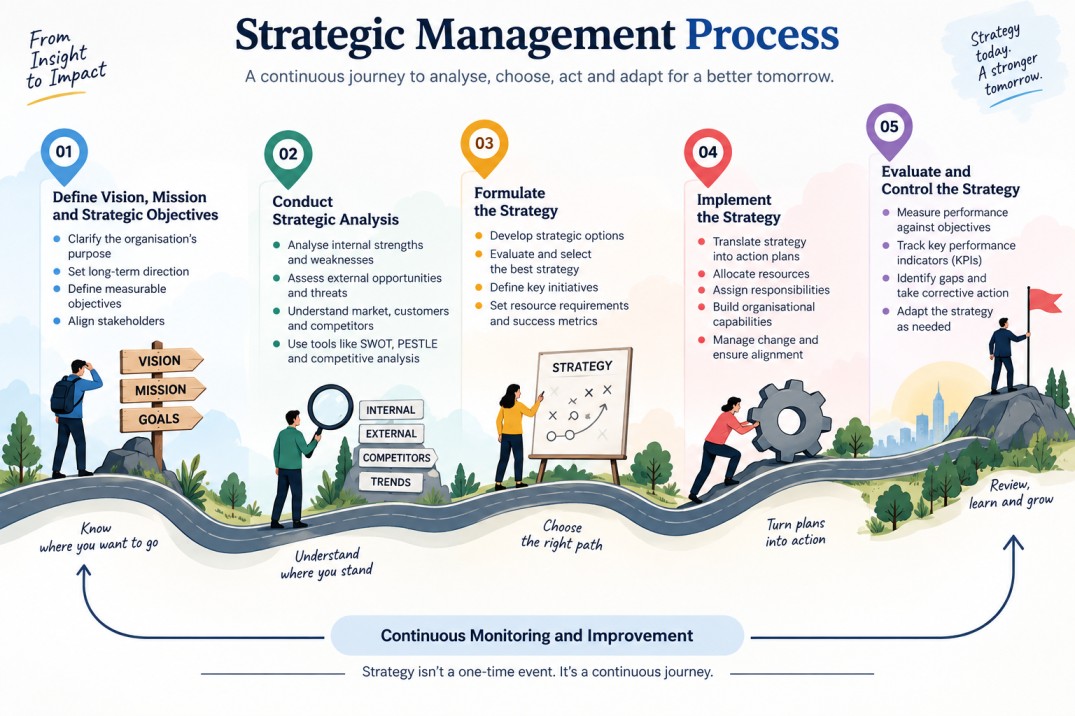
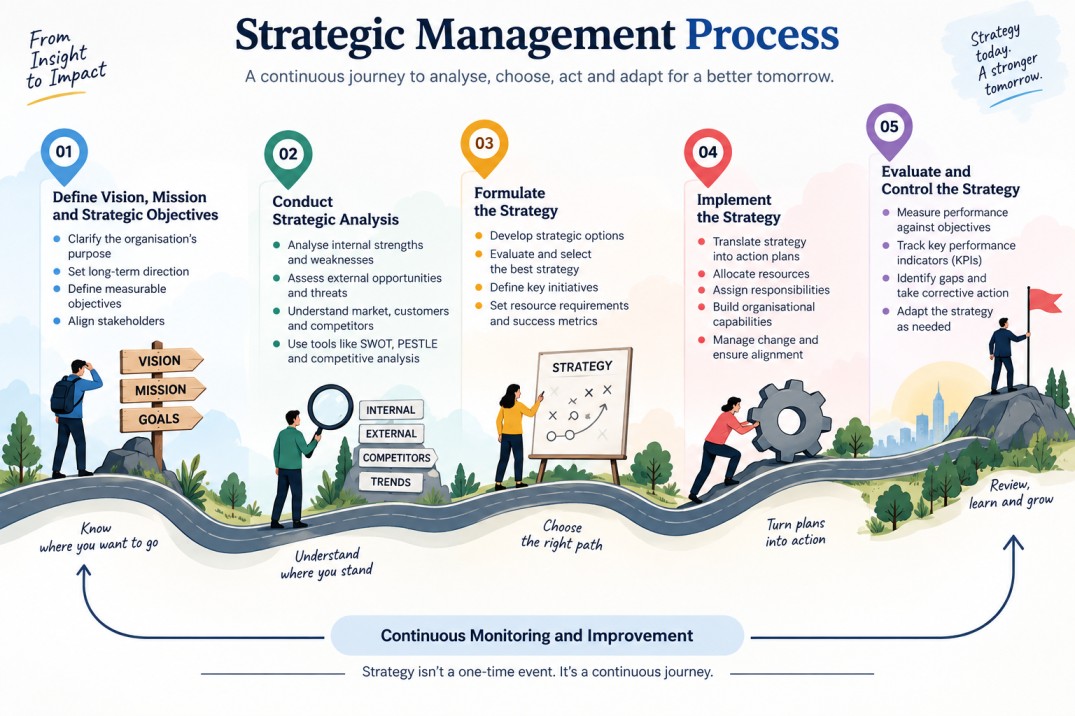
The strategic management process is a continuous cycle of strategic thinking. Here is the 5-step process:

Business continuity management lifecycle infographic showing eight steps from defining scope and identifying risks to BIA, recovery requirements, strategies, planning, testing, and continuous improvement.Business continuity management lifecycle infographic showing eight steps from defining scope and identifying risks to BIA, recovery requirements, strategies, planning, testing, and continuous improvement.

Step 1: Define Vision, Mission and Strategic Objectives

The organisation first establishes which direction it wants to go and what it aims to achieve. Objectives should be clear enough to guide decisions and measure progress.

Step 2: Conduct Strategic Analysis

The organisation examines its current position before choosing a strategy.

Internal analysis looks at resources, capabilities, performance, strengths, and weaknesses. External analysis considers customers, competitors, markets, economic conditions, regulations, and other environmental factors.

Tools such as SWOT analysis, PESTLE analysis, and competitive analysis are used to support this stage.

Step 3: Formulate the Strategy

The organisation identifies possible strategic choices and evaluates them against its objectives, resources, capabilities, and external conditions.

Not every attractive-looking opportunity should be pursued. The selected strategy needs to fit what the organisation can realistically execute.

Step 4: Implement the Strategy

This is where plans turn into actions. Implementation can involve allocating budgets, assigning responsibilities, changing processes, developing products, training employees, or modifying organisational structures.

A strategy that stays in a presentation isn't a strategy in action. You can only tell if the strategy is good or bad when it comes into action.

Step 5: Evaluate and Control the Strategy

The organisation tracks results against its objectives. If performance falls short, leaders need to understand why.

The strategy might need adjustment. Sometimes the problem lies in execution rather than the strategic choice itself.

Since we have now learnt about strategic management, let's understand it better with a real case study of Tata Motors. 

Also read: What Makes a Good Leader? 10 Essential Qualities and Skills 

Strategic Management Case Study: Tata Motors' Turnaround Strategy

One of the best examples of strategic management is Tata Motors because the company publicly documented its Turnaround strategy and the actions behind it.

The Strategic Challenge

Tata Motors' domestic businesses faced challenging market conditions, pressure on profitability, and the need to improve competitiveness. Its FY2019 reporting described a strategy focused on competitive, consistent, and cash-accretive growth.

The company didn't rely on one action. Its strategy addressed products, costs, cash flow, market share, customer experience, and operational efficiency.

Strategic Analysis and Priorities

Tata Motors identified distinct priorities across its businesses. Its Turnaround framework included winning decisively in commercial vehicles, winning sustainably in passenger vehicles, winning proactively in electric vehicles, and embedding turnaround thinking into the organisation.

That's a useful strategic management lesson. Different business situations can require different strategic priorities within the same organisation.

Also read: Business Process Management: Types, Lifecycle & Benefits 

Strategy Formulation

The strategy included product development, cost reduction, stronger retail focus, operational improvements, and investment in electric mobility.

In passenger vehicles, Tata Motors also focused on refreshing its portfolio, improving customer experience, strengthening its dealer network, and increasing the use of digital channels.

Strategy Implementation

Implementation involved tangible changes. Tata Motors reported actions around product launches, cost reduction, supply-chain efficiency, retail sales, dealer performance, and working capital.

The company also introduced products such as the Altroz and Nexon EV as part of its product strategy.

Do read: 11 Types of Leadership Styles and Their Key Features 

Measuring the Outcomes

Tata Motors reported several measurable outcomes during the turnaround period. In FY2019, the company reported gains in domestic market share in several commercial vehicle segments and a 60-basis-point increase in passenger vehicle market share, while its passenger vehicle business reached EBITDA break-even for the full year.

The case also shows why strategic evaluation isn't a one-time exercise. Tata Motors continued refining its priorities as market conditions changed.

Key Strategic Management Lessons

The case highlights five practical lessons.

  • Strategy needs clear priorities.

  • Analysis should inform strategic choices.

  • Implementation requires resource allocation.

  • Different business units may need different strategic responses.

  • Performance needs to be measured and reviewed.

So now you can get a good idea of why strategic management is essential for any organisation. Let's now understand how to measure strategic performance.

Also read: Situational Leadership: Model, Styles & Examples Guide 

How Do Organisations Measure Strategic Performance?

A strategy needs outcomes that can be measured. Otherwise, leaders won't know whether the chosen direction is producing the expected results.

Organisations can track:

Measure

What it can indicate

Revenue growth

Financial progress

Profit margins

Business efficiency

Market share

Competitive position

Customer metrics

Customer response

Operational KPIs

Execution quality

Strategic milestones

Progress against major initiatives

The right measures depend on the strategy. A market-expansion strategy might focus heavily on customer acquisition and market share, while a cost-reduction strategy could place greater weight on margins and operating efficiency.

Every process has some advantages and limitations. Let's learn those in the next section.

Also read: What Is Business Management? Roles, Skills & Types 

What Are the Advantages and Limitations of Strategic Management?

Every strategy has some advantages and limitations. Here they are:

Advantages of Strategic Management

Limitations of Strategic Management

Creates clearer organisational direction

Strategic analysis takes time and resources

Improves resource allocation

Poor assumptions can produce weak strategies

Supports better decision-making

Implementation can face internal resistance

Helps identify opportunities and threats

External conditions can change unexpectedly

Aligns different organisational functions

Excessive planning can delay action

Provides a basis for measuring progress

Results can be difficult to attribute to one strategic decision

A strategy should therefore be reviewed against evidence rather than simply using it because significant effort went into creating it.

There are many similar terms which can create confusion. Let's distinguish between them.

Do read: Organizational Management: Meaning, Functions & Types 

Strategic Management vs Strategic Planning vs Operational Management

These terms all look related, but they aren't the same. Here are the differences:

Aspect

Strategic Management

Strategic Planning

Operational Management

Main focus

Direction, choices, execution, and evaluation

Strategic priorities and plans

Day-to-day activities

Time horizon

Long-term and ongoing

Medium to long term

Short to medium term

Scope

Organisation-wide

Usually organisation-wide

Functional or operational

Key question

What direction should we take and how will we execute it?

What should we aim to achieve?

How should today's work be carried out?

Strategic planning is therefore one part of a broader strategic management approach. Operational management focuses much more closely on execution of ongoing activities.

Once we get to know the benefits and disadvantages, the next logical step is to learn the common mistakes. 

Build stronger management skills with the IIM Bangalore Young Leaders Programme (YLP) for Working Professionals . Learn practical business concepts and strengthen your ability to manage teams, processes, and business decisions. 

How Does Strategic Management Create Competitive Advantage?

Competitive advantage comes from making choices that help an organisation create and deliver value better than relevant alternatives.

Strategic management supports this by helping organisations understand their capabilities, customers, competitors, and market conditions.

For example, a company might identify a gap in customer service, develop a differentiated service model, allocate resources to support it, and measure whether customers respond positively.

The advantage isn't created by writing the strategy. It comes when these choices are understood, and the capabilities the organisation builds are effectively executed. 

What Are the Common Challenges in Strategic Management?

Strategies can fail if they are planned poorly and not executed well.

Common challenges include:

  • Unclear objectives

  • Poor alignment between strategy and execution

  • Limited resources

  • Weak communication

  • Resistance to organisational change

  • Inaccurate market assumptions

  • Failure to monitor performance

  • Delayed strategic adjustments

Conclusion

Strategic management connects organisational direction with analysis, strategic choices, implementation, and evaluation. Its value lies in helping organisations make deliberate choices while staying responsive to changing conditions.

A strong approach isn't just about having a strategy document. It's about knowing what the organisation wants to achieve, understanding its current position, making clear choices, executing those choices, and measuring what happens next.


Frequently Asked Questions

General

Latest Blogs

How to Become a Project Manager: Skills and Career Path
Oct 5th, 2026

How to Become a Project Manager: Skills and Career Path

Learn how to become a project manager with the right skills, qualifications, experience, certifications, and career steps to grow in project management.

Read More
Product Strategy: Definition, Types, Process & Examples
Oct 5th, 2026

Product Strategy: Definition, Types, Process & Examples

Product strategy explained for beginners. Learn what it is, the main types, how to build one in 8 steps, real examples from Tesla and Spotify, and a template.

Read More
People Management Skills: Top 10 Skills for Leaders
Oct 1st, 2026

People Management Skills: Top 10 Skills for Leaders

Discover the top 10 essential people management skills every leader needs, why they matter, the types, the challenges, and practical steps to develop them.

Read More
Copyright 2026 of [University Name]