Also read: 10 Major Leadership Theories for Workplace Success
How Do You Turn Data Into Actionable Insights?
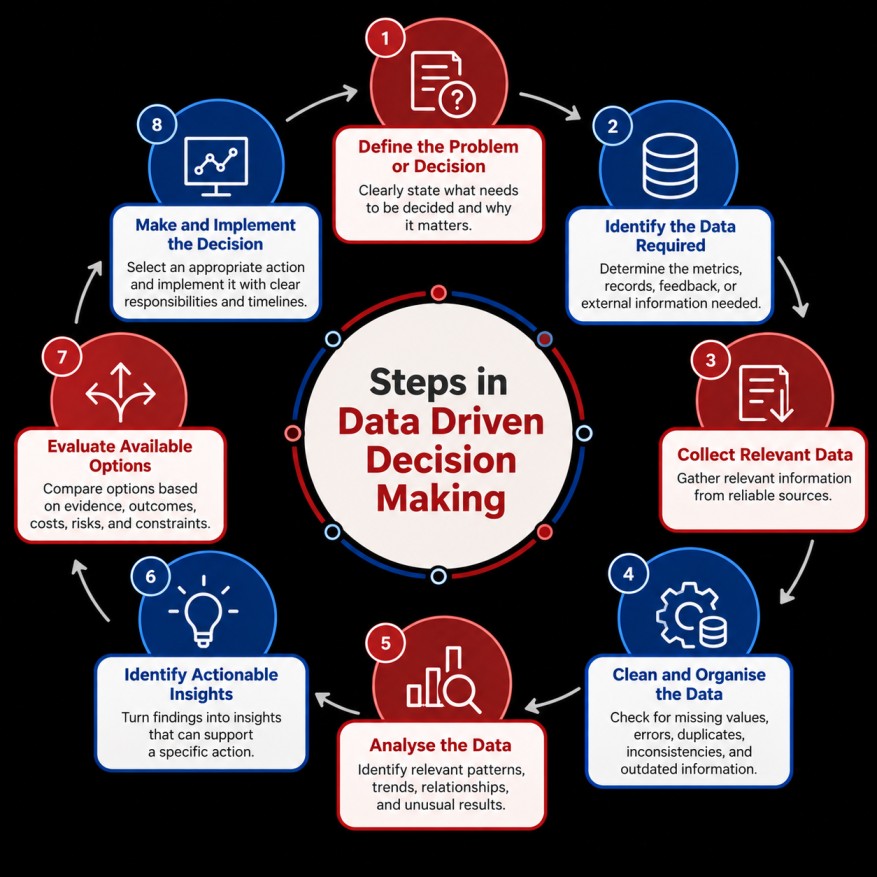
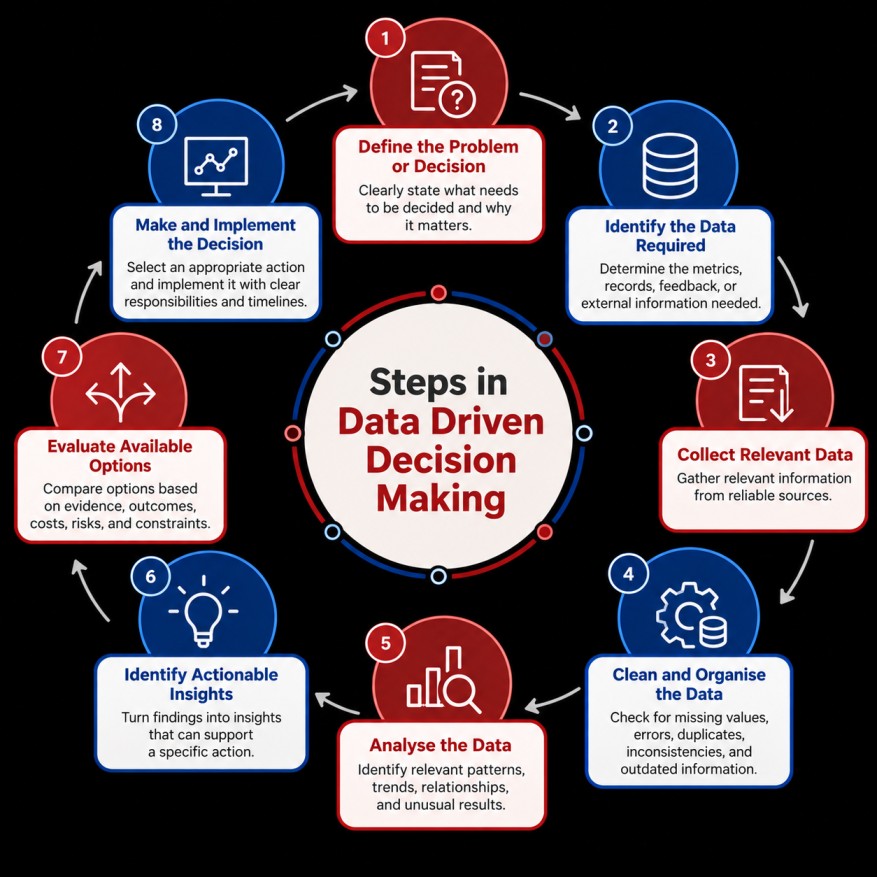
Raw data isn't useful. It becomes valuable when analysis reveals something meaningful that can influence a decision.
Identify Patterns and Trends
Look for meaningful changes, movement over time, recurring behaviour, differences between groups, and unusual results.
A sudden fall in repeat purchases, for example, could signal a customer experience problem.
Interpret the Findings in Context
Numbers need business context. A fall in sales might reflect seasonality, pricing changes, supply problems, or a shift in customer demand.
Evaluate Possible Decisions
Match each insight to options. Don't jump from one finding to one action. Compare possible responses and consider what each option could mean for customers, costs, resources, and future performance.
Turn Insights Into Action
Write the action as a task with an owner and a date. A useful insight should lead to a clear next step.
The team might change a campaign, revise inventory levels, adjust pricing, or investigate a customer segment.
Measure the Outcome
Track the result against a defined KPI. If the expected improvement doesn't happen, the new evidence becomes part of the next decision.
Must read: What Is Slack in Project Management? Types & Calculation
Benefits, Limitations and Challenges of Data Driven Decision Making
Data can make business decisions more measurable, but it doesn't make them automatically correct. All approaches have some benefits, limitations, and challenges.
Benefits and Limitations of Data Driven Decision Making
Here are the benefits and some limitations:
Aspect | Benefits | Limitations |
Decision quality | Supports decisions with relevant evidence and measurable information | Poor-quality or biased data can lead to misleading conclusions |
Opportunity identification | Helps businesses identify opportunities and monitor performance | Historical patterns don’t guarantee future outcomes |
Resource allocation | Supports better allocation of time, money, and other resources | Data may not capture every factor affecting resource decisions |
Customer understanding | Helps businesses understand customer behaviour, preferences, and needs | Some customer motivations and emotions are difficult to quantify |
Goal setting | Supports measurable goals and performance tracking | Metrics may not capture qualitative aspects of performance |
Accountability | Makes it easier to explain decisions using relevant evidence | Correlation doesn’t necessarily prove causation |
Decision context | Provides evidence for evaluating options | Values, relationships, uncertainty, and other contextual factors may require human judgement |
Do read: What Is Business Process Management? Types, Lifecycle, & Benefits
Challenges of Data Driven Decision Making
Poor data quality: Incomplete, inaccurate, duplicated, or outdated data can affect analysis and decisions.
Data silos: Information stored across disconnected systems can make it difficult to access and combine relevant data.
Data bias: Biased datasets can produce findings that don’t accurately represent customers, employees, or markets.
Limited data skills: Teams may struggle to analyse data or interpret results correctly without the required skills.
Too much data: Large volumes of information can make it difficult to identify the metrics that actually matter.
Privacy and security concerns: Collecting and using data requires appropriate controls to protect sensitive information.
Resistance to change: Teams may hesitate to adopt data-driven approaches when they’re accustomed to relying on experience or intuition.
Overreliance on data: Focusing only on numerical evidence can overlook context, experience, values, and factors that are difficult to measure.
Also read: What Makes a Good Leader? 10 Essential Qualities and Skills
Real-World Examples of Data-Driven Decision Making
Data driven decision making appears across many businesses. Here are some real-life examples:
Walmart: AI and Customer Data for Product Substitutions
The challenge: An online grocery order may face a simple problem wherein the selected item is out of stock during the preparation process, and thus, a shopper has to look for a substitute.
The method: Walmart created an AI system which suggests the alternative rather than leaving the decision to the client. Various aspects are considered, such as the type of product, size, brand, price, inventory, customer preferences, and shopping behavior.
Feedback mechanism: Customers either accept or decline the offered suggestion, and these responses add more useful information for further improvement.
Outcome: According to Walmart, the rate of acceptance of substitution suggestions increased above 95% with the use of the technology.
Data-driven decision: What available item is the most appropriate one when the customer's desired item is unavailable?
Usefulness of data: With the collection of information regarding inventory, products, customer preferences, and shopping behavior, substitution decisions were made according to factors other than shoppers' personal judgement.
Business application: This example illustrates how data can assist in making customer-related decisions amid variable inventory.
Do read: What Is Servant Leadership? Meaning, Benefits & Examples
Amazon: Using Customer Behaviour in Recommending Products
The challenge: Given a wide selection of products, the customer cannot look through all of them. Amazon takes into account customer behaviour when recommending products.
Approach: Amazon considers signals such as products the customer has searched for, looked through, purchased, or placed in their cart. Such signals assist recommendation algorithms in identifying the relevant products for that particular customer.
Working mechanism: Customer purchases and recent views may affect the recommended products that the customer sees on Amazon.
Data-driven decision: What are the relevant products to recommend to a specific customer based on their shopping patterns?
How data was used: By considering unique signals about customer's shopping patterns, Amazon has been able to make a decision on what products should be recommended to the customer.
Business application: This is an example of how a business can use data-driven decision making in order to personalise product discovery for customers.
UPS: Using Data to Optimise Delivery Routes
The problem: UPS drivers make multiple deliveries each day, and even minor modifications in route planning may lead to a significant increase in driving time and fuel usage.
The solution: UPS developed the ORION system (On-Road Integrated Optimization and Navigation). The purpose of ORION was to assist drivers to find more effective delivery routes. The system used route data, delivery points, mapping data and algorithms to find the appropriate routes considering delivery needs.
Next step: Later, UPS introduced Dynamic ORION – a system capable of updating route depending on changing circumstances during the course of the day. Therefore, routes were not fixed when new information appeared.
The result: According to UPS reports, the implementation of ORION allowed to decrease the average daily driving distance by 8 miles per driver. The introduction of Dynamic ORION allowed to further reduce driving distance by 2–4 miles per driver per day. According to UPS, annual savings amount to 130+ million miles of driving and 10 million gallons of fuel.
Data-based decision: Which delivery sequence and route should the driver choose?
How data helped: UPS used delivery location information, route information and changing circumstances to make routing decisions.
Business application: The case illustrates how analysis of operational data can be used by a firm to make decisions effectively while decreasing unnecessary driving and fuel use.
Must read: Leadership Management: Meaning, Skills, Styles & Importance
What Are the Best Practices for Data Driven Decision Making?
A good piece of data does not necessarily imply that a good decision will be made.
Organizations require a process that involves selecting appropriate data, ensuring data quality, analyzing results, and linking the insights gained from analysis to organizational objectives. The best practices outlined below should aid in doing this.
Useful practices include:
Define the decision clearly.
Use relevant and reliable data.
Focus on meaningful metrics.
Check data quality before analysis.
Combine quantitative evidence with qualitative context.
Look for possible bias in the data.
Communicate findings in simple language.
Measure outcomes after implementation.
Review decisions when new evidence appears.
Also read: What Makes a Good Leader? 10 Essential Qualities and Skills
Tools and Technologies Used for Data Driven Decision Making
Organizations can use different techniques at different stages of data-based decision making. There are some that help in the collection and organization of data, while there are those that help in analyzing, visualizing, predicting, and governance of data.
Here are the tools and technologies that are used:
Tool category | What it does | Examples of tools |
Business Intelligence and Reporting | Helps teams create dashboards, reports, and performance views to track KPIs and support business decisions. | Microsoft Power BI, Tableau, Looker, Qlik Sense |
Data Analytics and Visualisation | Helps users analyse datasets, identify trends and relationships, and present findings through charts and visualisations. | Microsoft Excel, Python, R, SAS |
Data Integration and Warehousing | Brings data from different sources together, cleans and organises it, and stores it in a form that can be analysed. | Snowflake, Google BigQuery, Amazon Redshift, Databricks, Apache Airflow |
AI and Machine Learning | Helps identify patterns, make predictions, classify information, automate analysis, and generate recommendations from large datasets. | TensorFlow, PyTorch, scikit-learn, Google Vertex AI, Amazon SageMaker |
Data Governance | Supports data quality, access control, privacy, security, compliance, and responsible management of organisational data. | Collibra, Alation, Informatica, Microsoft Purview |
Ready to move beyond your current role and take on broader business responsibilities? Explore the IIM Bangalore Young Leaders Programme (YLP) to strengthen your skills in strategy, finance, operations, people management, and leadership.
Future Trends in Data Driven Decision Making
The way organisations use data is changing as analytics and AI become more accessible. Here are the trends that are gaining popularity:
AI assisted analysis: People will ask questions in plain language and get charts back. That's useful, but it makes checking the source data more important, not less.
Real time decisions: Streaming data lets retailers adjust prices or stock within hours instead of weeks. Speed helps only if the data is accurate.
Predictive and prescriptive analytics going mainstream: These methods once belonged to large firms with data science teams. Cheaper tools are putting them within reach of smaller businesses.
Tighter privacy and governance: Rules on consent and data use keep getting stricter, so teams need clear records of what they collect and why.
Data literacy as a basic skill: Managers who can't read a chart will struggle, and hiring managers already notice.
Also Read: 10 Major Leadership Theories for Workplace Success
Conclusion
Data driven decision making isn't simply about collecting more information. It's about asking the right question, using relevant evidence, interpreting it carefully, and turning the findings into a decision that can be measured.
When businesses connect reliable data with analytics, context, human judgement, and continuous feedback, they can make decisions that are easier to evaluate and improve. The real value comes when data moves beyond a report and shapes what the business does next.