

Key Highlights
The top leadership skills include communication, emotional intelligence, decision-making, problem-solving, critical thinking, adaptability, delegation, conflict resolution, motivation, creativity, and strategic thinking.
Leadership skills shape how professionals communicate, make decisions, solve problems, build relationships, and work with others toward shared goals.
Leadership skills aren't limited to managers or senior executives. Professionals at different career stages can demonstrate leadership by taking ownership, guiding others, and handling challenges effectively.
Developing leadership skills requires practical experience, feedback, self-reflection, and increasing responsibility rather than relying only on courses or theoretical knowledge.
In this blog, you’ll explore leadership skills, their types, few real-life examples, its difference from management skills, how to develop leadership skills, how to improve leadership skills, common mistakes, and ways to assess your progress.
Ready to strengthen your business knowledge and leadership capabilities? Explore the IIMBx Certificate in General Management for Emerging Leaders and gain practical insights to navigate business challenges, make informed decisions, and prepare for greater leadership responsibilities.
What Are Leadership Skills?
Good leaders aren't always born with leadership skills. These skills are the abilities that make leaders who they are. These are the skills that enable the leader to lead a team. It's the same skills that enable leaders to guide people, make sound decisions, solve problems of others, build trust, and motivate people to work toward shared goals.
These skills include interpersonal abilities such as communication and empathy, and thinking and execution skills such as decision-making, delegation, and strategic planning.
You don't need a formal title to demonstrate leadership. A team member who spots a problem, finds a solution, and fixes it is a practical example of leadership.
Leadership also involves judgement. Knowing what to say is important, but knowing when to listen is a great virtue of a leader. A leader always reads the room before he reacts. Leadership doesn't mean giving orders. It means being involved with people, guiding them, and motivating them to do their personal best. They're about making decisions under pressure, communicating clearly, and earning trust over time.
Why Are Leadership Skills Important?
A good leader can bring positive change in any organisation. Leadership affects the whole culture of a company. It shapes how people communicate, respond to challenges, make decisions, and work together.
Effective leadership skills can help professionals:
For example, let's take an example of a case where the project is already reaching its deadline, but it's not finished yet. A manager who simply tells people to work faster won't help the team or the project in this situation at all. Because all the manager is doing is creating chaos and confusion. A good manager with leadership skills will do things differently.
He will first assess everyone’s strengths and put the best person on the particular tasks according to the team member’s abilities. He will then remove any obstacles that may hamper their speed or quality of work. He will then motivate the team to work at their best. He will listen to his team members and make decisions accordingly at this crucial time. He will not blame others. He will be along with his team, trying their best to finish the project within the deadline.
This scenario is exactly why leadership skills matter across different roles. They're useful when you're managing people, leading a project, working with clients, or taking responsibility for a difficult problem.
Now that we know what are leadership skills and why are leadership skills important. Let's learn about the 12 most important leadership skills
Must read: Transformational Leadership Style: Meaning and Benefits
Top 12 Leadership Skills
Strong leadership usually comes from a combination of several abilities and knowing which situation demands which leadership skill.
Communication
Good leaders always speak clearly about what they expect from the people. They make the goals easier to understand, explain why the goals are so important, and how the team member’s contribution affects the end goal of the organisation. They will give regular feedback and ask questions, and adjust their way of communicating with the people involved.
Communication isn't a one way road. It is not only about speaking. Listening is also a part of communication. If you keep on giving vague orders and not listen to people’s concerns, your team will be confused and less willing to share the difficulties they might face . This, in turn, will affect your team's productivity, trust, and overall performance.
For example, if a team member keeps missing deadlines, a good leader won't immediately blame them. Instead, they'll ask why the work is getting delayed, understand the problem, and work with the person to find a solution.
Emotional Intelligence and Empathy
Emotional intelligence is a quality that helps leaders understand people's emotions and how they may respond to a situation. It also helps them recognise their own reactions, understand what others may be experiencing, and respond to people with greater awareness.
Empathy is a valuable quality anyone can develop. Understanding that people aren't machines and will have different emotions, challenges, and personal circumstances helps leaders respond with patience and understanding. This can also help build trust and create a more supportive work environment.
For example, if an employee makes a mistake that delays a project, a leader shouldn't shame or blame them in front of others. Instead, they should discuss the mistake privately, understand what went wrong, find a solution, and help the employee avoid making the same mistake again. This approach builds trust and encourages the employee to take ownership of the mistake. It also helps them learn from the experience and perform better in the future.
Decision-Making
Leaders have to make many decisions every day, from small choices to decisions that can affect an entire project. A leader may not always have complete information, but they still need to choose a direction and take responsibility for the outcome.
Good decision-making involves understanding the problem, looking at the available information, considering the risks, and choosing a practical option. Waiting for complete certainty isn't always possible, especially when a delayed decision can create bigger problems.
For example, if a project is running behind schedule, a leader may need to decide whether to adjust the deadline, redistribute the workload, or bring in additional support. They can consider the available information and choose the option that best supports the project and the team.
Problem-Solving
Problems are a normal part and parcel of any workplace. A project may face budget limits, changing deadlines, limited resources, or communication issues. Leaders have to stay focused on finding a workable solution instead of becoming overwhelmed by the size of the problem.
To be successful in problem-solving, you have to separate the chaos from the solution. This means understanding the actual cause of the problem, breaking it into smaller parts, and focusing on what can be fixed first.
For example, if a team keeps missing project deadlines, the leader shouldn't simply ask everyone to work faster. They can look at the workflow, identify where delays are happening, and make changes to responsibilities or priorities to keep the project moving.
Critical Thinking
Critical thinking helps leaders question the usual way of doing things instead of accepting the first easy answer they hear. It allows them to examine information, consider different viewpoints, and make decisions based on facts rather than quick conclusions. A critical thinker also asks questions, challenges assumptions, and looks for information that others might overlook.
This skill becomes especially useful when a situation looks simple but has hidden risks. Leaders need to ask whether they're missing something, whether the available evidence is reliable, and what could happen if they choose a particular course of action. This helps them look beyond the obvious answer and make more informed decisions.
For example, if a team suggests changing a process because it seems faster, a leader shouldn't approve it immediately. They can first ask how the change will affect quality, costs, customers, and the workload of the team.
Adaptability
Plans change. Priorities shift. Teams face unexpected challenges.
Adaptability is the skill that helps leaders respond to these changes without losing sight of the main goal. An adaptable leader doesn't hold on to an old plan simply because it was decided earlier. They assess the new situation, make the necessary changes, and explain those changes clearly to the team.
For example, if a client suddenly changes the requirements of a project, an adaptable leader will review the new expectations, identify what needs to change, and communicate the revised plan. This helps the team adjust without losing focus.
Relationship Building and Trust
People are more likely to share ideas, raise concerns, and ask for help when they trust their leader. Trust doesn't develop overnight through a single conversation or in one day. It comes from consistent behaviour and honesty over time. Leaders can build trust by keeping their promises, treating people fairly, and accepting responsibility for their own mistakes. They also need to show that they value their team members' contributions.
For example, if a leader promises to discuss an employee's concern with senior management, they should follow through. Keeping such commitments shows employees that their concerns are being taken seriously.
Delegation
Delegation isn't simply about giving tasks to other people. It means understanding what needs to be done, choosing the right person for the task, explaining the expected outcome, and giving them enough freedom to complete the work. It's not a way to just dump work on others.
Many new managers struggle with delegation because they feel they can complete the work faster themselves. But trying to handle everything can leave the leader overloaded and give team members fewer opportunities to learn.
For example, if a manager is preparing a presentation, they could delegate the research and data collection to team members with relevant skills. The manager can then review the final work without controlling every small step. This also gives the work another set of eyes, which can help identify errors, improve the quality, and bring in a different perspective.
Conflict Resolution and Negotiation
Disagreements are a normal part of working with different people. A leader knows how to handle those disagreements before they affect relationships or the work itself.
Good leaders listen to different viewpoints, identify the actual source of the conflict, and help people find a workable solution. Negotiation is also useful when teams have competing priorities, limited resources, or different expectations.
For example, if two departments need the same resources for separate projects, a leader can bring both teams together, understand their priorities, and negotiate an arrangement that supports the organisation's larger goals.
Motivation and Empowerment
Not everyone is motivated by the same things. One employee might value recognition, while another might care more about learning, career growth, autonomy, or meaningful work. Another employee may simply value the financial rewards that come with the job. A good leader understands these differences and knows that the same approach won't work for everyone.
Good leaders take these differences into account. They give people clear responsibilities, recognise good work, and create opportunities for team members to contribute their ideas.
For example, instead of telling an experienced employee exactly how to complete a task, a leader can explain the expected outcome and give them room to decide how to approach it. This builds ownership and helps the employee develop confidence.
Creativity and Innovation
Leaders need to question existing ways of working when those methods no longer solve the problem. Creativity helps teams think of different approaches, while innovation involves turning useful ideas into practical changes.
This doesn't mean every process needs to be completely redesigned. Sometimes a small change can make a meaningful difference.
For example, if a team spends several hours each week preparing a manual report, a leader could ask the team to find a simpler way to collect and present the information. A small process change might save time without disrupting the entire workflow.
Strategic Thinking and Prioritisation
Strategic thinking helps leaders look beyond immediate tasks and think about where their team or organisation needs to be in the future. It involves understanding broader goals and considering how current decisions may affect them in the long run. A strategic leader doesn't just ask, "What needs to be done today?" They also ask, "Will this decision help us achieve our larger goals?"
Prioritisation turns that thinking into action. Leaders can't treat every task as equally urgent, so they need to decide what deserves attention first based on its impact, deadlines, available resources, and organisational goals.
For example, if a team has five tasks due at the same time, a leader can identify which task has the greatest effect on customers or business objectives and allocate resources accordingly. This helps the team focus its effort where it matters most.
Do read: Situational Leadership: Model, Styles & Examples Guide
Types of Leadership Skills
Leadership skills can be grouped according to the kind of work they support. Here are the 4 types of leadership skills that every leader must know:
Must read: 11 Types of Leadership Styles and Their Key Features
Leadership Skills vs Management Skills: What's the Difference?
Leadership and management may seem like similar concepts because both involve working with people and achieving organisational goals.
However, their main focus is different. Leadership is more about setting direction, influencing people, and creating a shared vision, while management focuses on planning, organising, and getting work done. There are similarities too, and effective managers often need strong leadership skills.
Here are the differences between the two overlapping concepts:
A manager is responsible for allocating resources and tracking deadlines. A leader needs to explain why the work matters, build commitment, and help people respond when circumstances change.
Good managers are also people who have leadership skills. Likewise, leadership skills are also needed outside formal management roles.
Also read: What Is Servant Leadership? Meaning, Benefits & Examples
How to Develop Leadership Skills
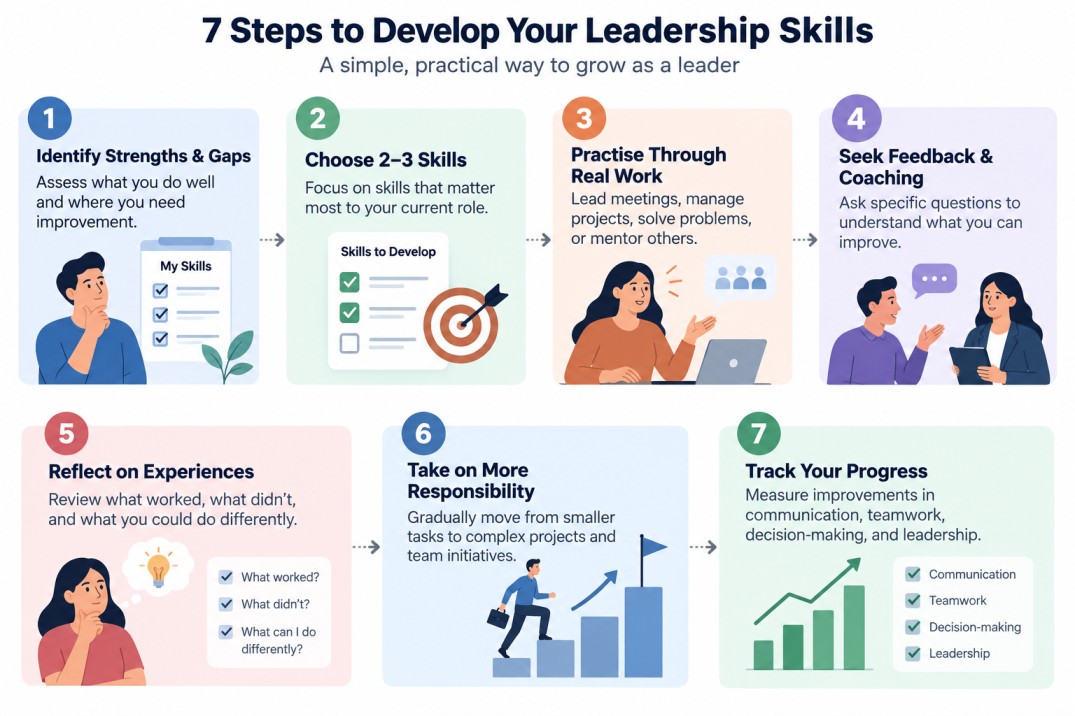
Some people are born with leadership skills. Some people may need to develop them. These are skills that, with practice and experience, can be acquired.